Sentence mining: the complete guide, from i+1 to Anki card
Sentence mining means saving real lines from shows and videos that contain one new word, then reviewing them as flashcards. What i+1 really means, which tools work, and how many cards a day.
You are three episodes into a Spanish series, you have looked up the same word four times, and it is gone again by the next episode. On r/languagelearning, people recommend sentence mining for this, but every guide assumes you learn Japanese and know what i+1 means.
Sentence mining is saving real sentences from what you watch or read, usually ones with just one new word, and reviewing them later as flashcards with spaced repetition. That is close to Refold's definition. The sentence keeps the word attached to a scene you remember, a voice, and the grammar around it.
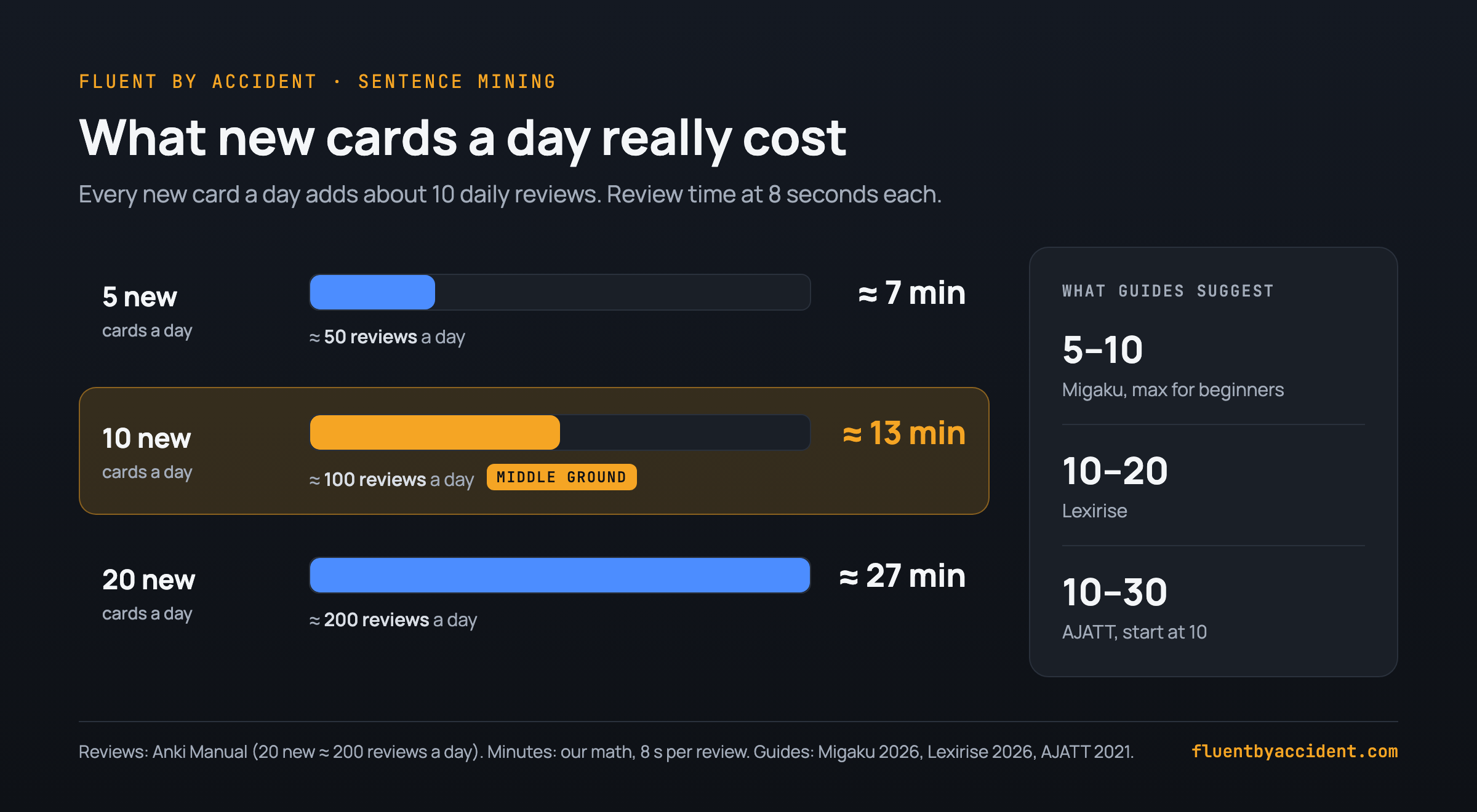
The short version: watch something you mostly understand, pause on a line with one unknown word, look it up, save the line with its meaning (and audio if your tool records it), and review a few minutes a day. Guides suggest roughly 5 to 20 new cards a day (Migaku, Lexirise); the Anki manual notes that 20 new a day grows into about 200 reviews a day.
Last checked: October 2026 (tool prices and versions verified on October 9, 2026).
What is sentence mining?
Sentence mining means finding a sentence with an unknown word in your own content, looking the word up, saving the sentence as a flashcard and reviewing it on a spaced schedule (Refold). Names you will see for it:
- 1T sentence ("one target"): only one thing in it is new. Refold and AJATT both use the term.
- Targeted sentence card (TSC): AJATT's name for the card made from it.
- N+1 or i+1: what AI summaries call the same thing (i+1 originally meant something else, see below).
Unlike a pre-made deck, every card has a scene behind it, because you only add what you met. Frequency decks still help early on. The loop: watch, spot, look up, save, review.
The sentence mining loop in five steps: watch something you mostly understand, spot a line with one new word, look it up, save the line as a card, review a few minutes a day 1 Watch Something you mostly understand 2 Spot A line with one new word 3 Look it up The word or chunk, in context 4 Save The whole line as a flashcard 5 Review A few minutes a day, spaced Then back to step 1 with the next episodeWhat does i+1 mean in sentence mining?
The label comes from Stephen Krashen's input hypothesis. In his 1982 book, i is your current stage and i+1 the next stage of grammar structure, acquired by understanding messages with help from context. Given enough understood input, he argued, i+1 arrives on its own, and "the best input should not even attempt to deliberately aim at i + 1".
Sentence miners use the label for something else: a sentence where only one word or grammar point is new. Refold's rule is one unknown, maybe two, never three. That is a practical filter for choosing cards, not Krashen's theory, and the theory itself is debated. Lichtman and VanPatten (2021) argue that its core idea, a central role for meaningful input, survives in modern research. For the background, see why watching TV shows teaches you a language.
With one word missing, the line and the scene tell you what it means. With three missing, you are guessing.
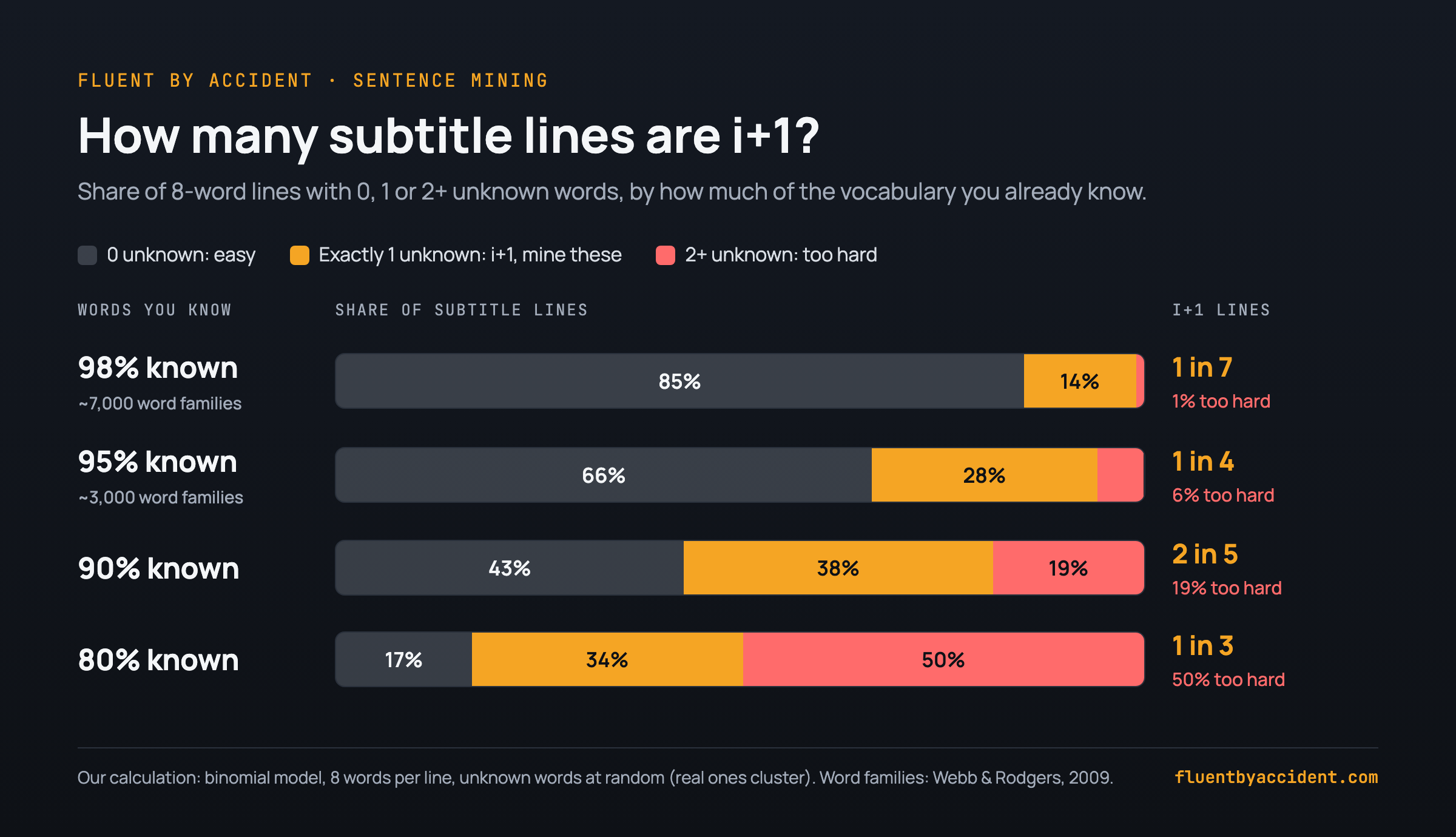
How often does a line qualify? Our simplified calculation assumes an 8-word subtitle line (Netflix allows two lines of 42 characters) and unknown words spread at random (real ones cluster). At 95% coverage, about 3,000 word families for TV (Webb and Rodgers, 2009), exactly one unknown has a chance of 8 × 0.05 × 0.95^7 ≈ 28%, about 1 line in 4. At 98% it is 1 in 7. At 80%, a third of lines still qualify, but half have two or more unknowns, so you lose the scene.
So the bottleneck is understanding the context, not finding 1T lines. Pick content where you follow most lines, and i+1 lines appear on their own.
Does sentence mining work? What the research says
No study tests "sentence mining" by name, but the mechanisms it relies on are well supported.
- Retrieval: in Karpicke and Roediger (2008), repeated studying of vocabulary pairs did nothing for delayed recall, while repeated testing had a large positive effect.
- Spacing: a meta-analysis of 48 experiments (Kim and Webb, 2022) found a medium-to-large effect, with longer gaps winning on delayed tests.
- Repetition: Uchihara, Webb and Yanagisawa (2019) found a medium link (r = .34) between meeting a word often and learning it.
- Context plus translation: Prince (1996) found translations gave more words, but weaker learners struggled to use them in context; he suggested combining both, which is what a mined card does.
The honest caveat: Webb (2007) found no significant advantage for one glossed sentence over plain word pairs. The sentence alone is not magic; its value is the remembered scene, the audio and meeting the word again.
| Claim you will hear | What studies show | What it means for your cards |
|---|---|---|
| "Testing beats rereading" | Large effect of repeated retrieval (Karpicke and Roediger, 2008) | Hide something on every card |
| "Spaced reviews work" | Medium-to-large effect, 48 experiments (Kim and Webb, 2022) | Review a little daily, let the app schedule |
| "Words you meet often stick" | r = .34 across 26 studies (Uchihara et al., 2019) | Mine recurring words first |
| "Context beats word lists" | Mixed: translations give more words, context helps use them (Prince, 1996); one sentence alone gave no edge (Webb, 2007) | Real line on the front, meaning on the back |
| "i+1 is proven" | A debated hypothesis about grammar, not word counts (Krashen, 1982; Lichtman and VanPatten, 2021) | Use 1T as a filter, not a law |
When should you start sentence mining?
No study sets a start date, and guides disagree (table below). Coverage research adds a benchmark: the 3,000 most common word families cover about 95% of the words in TV programs (Webb and Rodgers, 2009) and movies (Webb and Rodgers, 2009). Below that, 1T lines in native shows are slow to find, so start with learner shows, kids' shows or a frequency deck.
One r/LearnJapanese commenter learns words first, then turns them into sentence cards to see them in context.
Our rule of thumb (advice, not a study finding): start when you can follow a slow show with target-language subtitles and pause on single words, not whole lines. For Spanish, our Netflix shows to learn Spanish, by level helps you pick one.
| Source | Suggested starting point | Notes |
|---|---|---|
| Migaku | 300 to 500 most common words | Vendor guide, 2026 |
| Lexirise | About 500 words | Vendor guide, 2026 |
| AJATT | About 1,000 words | Japanese-focused, 2021 |
| Refold | After the foundation phase | No word count |
| Webb and Rodgers, 2009 | 3,000 word families = about 95% of TV words | A comprehension benchmark, not a start rule |
Sentence mining tools: asbplayer, Yomitan, Migaku and the rest
Prices and versions checked October 9, 2026.
- Anki + AnkiConnect: desktop and Android are free, AnkiMobile is $24.99; the AnkiConnect add-on (code 2055492159) lets browser tools create cards while Anki is open. Latest desktop: 26.09.3, September 2026.
- asbplayer: makes Netflix and YouTube subtitles selectable, detects them on most other streaming sites, and mines a line with Ctrl + Shift + X, sending the sentence, an audio clip from the stream and a screenshot to Anki. No built-in dictionary, so it pairs with Yomitan. Latest: v1.21.2, September 28, 2026.
- Yomitan: hover a word, see the definition, send a card to Anki with one key. The wiki lists 34 languages; you import dictionaries yourself. Latest: 26.9.8.0, September 8, 2026. Combined flow: make the card in Yomitan, then press Ctrl + Shift + U in asbplayer to add audio and a screenshot.
- Migaku: paid all-in-one with its own flashcard app; Standard is $10 a month (yearly saves 20%), 11 languages.
- Language Reactor: exports saved words as an Anki deck (.apkg) where the line appears with the word removed, a ready-made cloze.
Other options (Lexirise, VidToAnki, Vocabsieve, subs2srs, mpvacious) exist; we did not test them here.
| Tool | Price | Works with | What lands on the card | Setup effort | Best for |
|---|---|---|---|---|---|
| Anki + AnkiConnect | Free (AnkiMobile on iOS $24.99) | Desktop, Android, iOS, web | Whatever your tools send | Medium (note type, add-on) | Anyone who wants full control |
| asbplayer | Free, open source | Chrome (Firefox builds); Netflix, YouTube, most streaming sites | Sentence, audio clip, screenshot, source, URL | High (Anki, AnkiConnect, a dictionary) | Mining from video with audio |
| Yomitan | Free, open source | Chrome, Firefox, Edge; any web text | Word, definition, sentence, optional audio | Medium (import dictionaries) | Fast lookups in 34 languages |
| Migaku | From $10/month, $499 lifetime, 10-day trial | Browser extension, iOS, Android | Sentence, meaning, audio, image | Low | An all-in-one setup |
| Language Reactor | Check current plans | Netflix, YouTube and more | Line, word, translation, audio, images (export) | Low to medium | Dual subtitles, occasional export |
"Setup effort" and "Best for" are our judgement; the rest comes from each tool's own pages.
How to sentence mine from Netflix: from subtitle line to flashcard
The method on one example line, tool-neutral: a Spanish learner watching a Netflix series hears "No me da la gana ir a la fiesta." They know every word except the idiom "me da la gana", so it is a 1T line.
- Pause and check that you follow the rest of the line and the scene.
- Look up the chunk, not single words. "Dar la gana" means "to feel like (doing something)", informal; "gana" alone would mislead you.
- Save the whole package: the line, the target chunk, its meaning here, the translated line ("I don't feel like going to the party."), audio if your tool records it, a screenshot, and episode plus timestamp.
- Choose a card layout (table below).
- Keep watching. Do not stop every 30 seconds.
The note template, in order: Sentence, Target, Meaning in context, Sentence translation, Audio, Image, Source and timestamp. AJATT adds a rule worth copying: keep the front minimal and put extras on the back.
Anatomy of a mined sentence card: the sentence with the target chunk highlighted, the target, its meaning in context, the sentence translation, an audio clip, a screenshot and the source with timestamp SENTENCE No me da la gana ir a la fiesta. TARGET dar la gana MEANING IN CONTEXT to feel like (informal) SENTENCE TRANSLATION I don't feel like going to the party. AUDIO clip of the line SCREENSHOT scene still SOURCE + TIMESTAMP Episode 3, 12:41One note can produce three layouts. Webb (2009) found receptive learning gave larger gains in recognizing meaning, productive learning in form, grammar and production.
| Layout | Front | Back | Trains |
|---|---|---|---|
| Recognition | The line, target in bold | Meaning + translated line | Reading, recognizing meaning (receptive) |
| Listening | Audio only | The line + meaning | Your ear |
| Cloze | "No me ___ ir a la fiesta." + translation | da la gana | Recall and production (productive) |
In Anki, a cloze is written as No me {{c1::da la gana}} ir a la fiesta. (Anki manual).
If you start remembering the sentence instead of the word, mine the word again in a new line or swap the old one out; one r/LearnJapanese tip recommends short, memorable lines. For the viewing routine this plugs into, see the dual subtitle method, step by step.
Mine it or skip it: 1) Do I understand the rest of the line? 2) Is only one word or chunk new? 3) Will I hear this word again in this show? 4) Could I imagine saying it? 5) Can I read the line in a few seconds? 6) Is it more than a name, a rare term or a one-off joke? Mostly yes: mine it. Two or more no: skip it and keep watching.
How many sentences should you mine per day?
The Anki manual gives the key ratio: a steady 20 new cards a day means roughly 200 reviews a day, about 10 reviews per new card.
Our arithmetic, assuming 8 seconds per sentence review (Migaku estimates 5 to 10 seconds, Migaku guide):
- 5 new a day ≈ 50 reviews × 8 s = 400 s ≈ 7 minutes
- 10 new a day ≈ 100 reviews ≈ 13 minutes
- 20 new a day ≈ 200 reviews ≈ 27 minutes
Making 10 cards adds 3 to 5 minutes at Migaku's 20 to 30 seconds per card.
What the guides recommend: Migaku says 5 to 10 a day at most for beginners; Lexirise suggests 10 to 20; AJATT 10 to 30, starting at 10. A reply in the Migaku subreddit says most people cap at 10 to 20 new cards a day, and Refold warns against mining 30 or more in one session.
In practice: cap new cards in your app, bank extra mined lines for later, and do reviews before new cards, an order one long-time learner suggests.
Sentence mining mistakes that make people quit
People rarely quit because the method fails. They quit because the habit gets heavy:
| Mistake | Why it hurts | Fix |
|---|---|---|
| Mining lines with 2 or 3 unknowns | Context cannot explain the word. One r/Spanish learner had about 600 such cards and asked whether to continue | Use the 1T filter |
| Too many new cards | 20 new a day means about 200 reviews a day (Anki manual) | Cap new cards at 5 to 20 |
| Making every card pretty | A Bunpro forum user called it "a huge time sink" | A fixed template, no manual formatting |
| Watching to mine | One learner found it hard to enjoy shows while hunting for sentences | Mine on rewatches or after the episode, or cap at 5 per episode |
| Memorizing the sentence, not the word | A common complaint on r/Anki | Short lines, cloze cards, replace lines when the word reappears |
| Never meeting the word again | Repetition drives learning (Uchihara et al., 2019); coverage varies between episodes (Webb and Rodgers, 2009) | Mine from one show or genre at a time |
Keep mining light enough that you still want to press play tomorrow. If you watch with two subtitle lines in Chrome, Fluent by Accident saves each word you click together with the subtitle line it came from, and its "Export for Anki" button turns them into cards with that line in italics on the front.
FAQ
What is sentence mining in language learning?
Sentence mining builds vocabulary from content you already watch or read. You find a sentence where only one word or chunk is new (a "1T" sentence), look that part up, and save the whole sentence as a flashcard with its meaning. You then review it with spaced repetition, usually in Anki (Refold). The sentence keeps the word tied to a scene, a voice and real grammar, which helps you remember how it is used.
When should you start sentence mining?
No study sets a start point, and guides disagree. Suggestions range from the 300 to 500 most common words (Migaku) to about 500 (Lexirise) and about 1,000 (AJATT). For native TV, research shows that the 3,000 most common word families cover about 95% of the words (Webb and Rodgers, 2009). Below that level, start with easier material such as learner shows, kids' shows or a frequency deck, and mine from those.
How many sentences should I mine a day?
Most guides land between 5 and 20 new cards a day. The budget that matters is reviews: the Anki manual says a steady 20 new a day leads to roughly 200 reviews a day. At 8 seconds per review (our assumption), that is about 27 minutes, versus 13 minutes for 10 new cards and 7 for 5. Start at 5 to 10 and raise the cap only if you still finish reviews comfortably.
Is sentence mining better than learning word lists?
The research is mixed. Prince (1996) found translation learning produced more words, while context helped learners use them. Webb (2007) found one glossed sentence gave no significant edge over word pairs. What clearly drives results is retrieval (Karpicke and Roediger, 2008) and spacing (Kim and Webb, 2022), and both apply to either format. Many learners combine them: a frequency deck early on, then mining once they can follow real content.
Can you sentence mine without Anki?
Yes. Any app with spaced repetition works, and spacing is the part with the strongest evidence behind it (Kim and Webb, 2022). Migaku has its own flashcard app (Migaku). Language Reactor exports .apkg decks and CSV files you can import elsewhere (Language Reactor). A notes file or spreadsheet also works for collecting lines, but without a scheduler you have to decide yourself when to review each one, which is where most people slip.
Sources
Checked October 9, 2026.
- Research: Krashen, 1982; Lichtman and VanPatten, 2021; Webb and Rodgers, 2009, TV and movies; Webb, 2007; Prince, 1996; Webb, 2009; Karpicke and Roediger, 2008; Kim and Webb, 2022; Uchihara, Webb and Yanagisawa, 2019
- Anki: deck options, cloze, releases, AnkiConnect, AnkiMobile
- Tools: asbplayer and docs; Yomitan and languages; Migaku pricing; Language Reactor export
- Netflix Timed Text Style Guide; guides by Refold, AJATT, Migaku and Lexirise; learner threads linked in the text