Spaced Repetition for Language Learning, Explained
Spaced repetition schedules each review just before you would forget a word. Here is the forgetting curve research, the interval math behind your daily review pile, and the mistakes that make decks collapse.
Spaced repetition for language learning means reviewing a word at growing gaps (one day, then a few days, then weeks, then months), each review timed for just before you would forget it. It beats cramming for long-term memory because every successful recall makes the next round of forgetting slower, so the gaps can keep stretching.
You know the pattern: you look up a word during an episode on Tuesday, it feels obvious, and by Friday it is gone. This guide covers what the research actually found (Ebbinghaus, his modern replication, and the large Cepeda spacing study), how apps turn that into intervals, the review-load math behind your daily pile, and the mistakes that make decks collapse.
What is spaced repetition for language learning?
Spaced repetition combines two ideas. The first is active recall: you look at the prompt (a word, a sentence, a subtitle line) and try to produce the meaning before you see it. Rereading a word list feels productive, but it only tests recognition, and recognition is the weaker, more flattering signal.
The second idea is expanding gaps. After a word comes back correctly, the next review is scheduled further out. Babbel's guide puts the principle in one line: "the time between the first and second repetition should be shorter than the time between the fourth and fifth" (Babbel Magazine).
The target is the moment just before forgetting. Review too early and the recall is effortless, so it does little. Review too late and the word is gone, so you are relearning it from scratch. Vendors pick different targets; Lingvist, for example, says its team schedules a repetition "when the learner remembers a word at the 80% level" (Lingvist), which is their claim about their own system.
You do not have to track any of this by hand. The flashcard apps that schedule this for you do the calendar work; your job is to answer honestly.
Spaced repetition for language learning: one card's review days One card, every answer "Good": review days after first study Day 1 Day 4 Day 12 Day 32 Day 82 Day 207 +3 d +8 d +20 d +50 d +125 d Log time scale. Our calculation: SM-2 style defaults, ease 2.5, no forgotten cards.What is the forgetting curve (and what Ebbinghaus actually tested)?
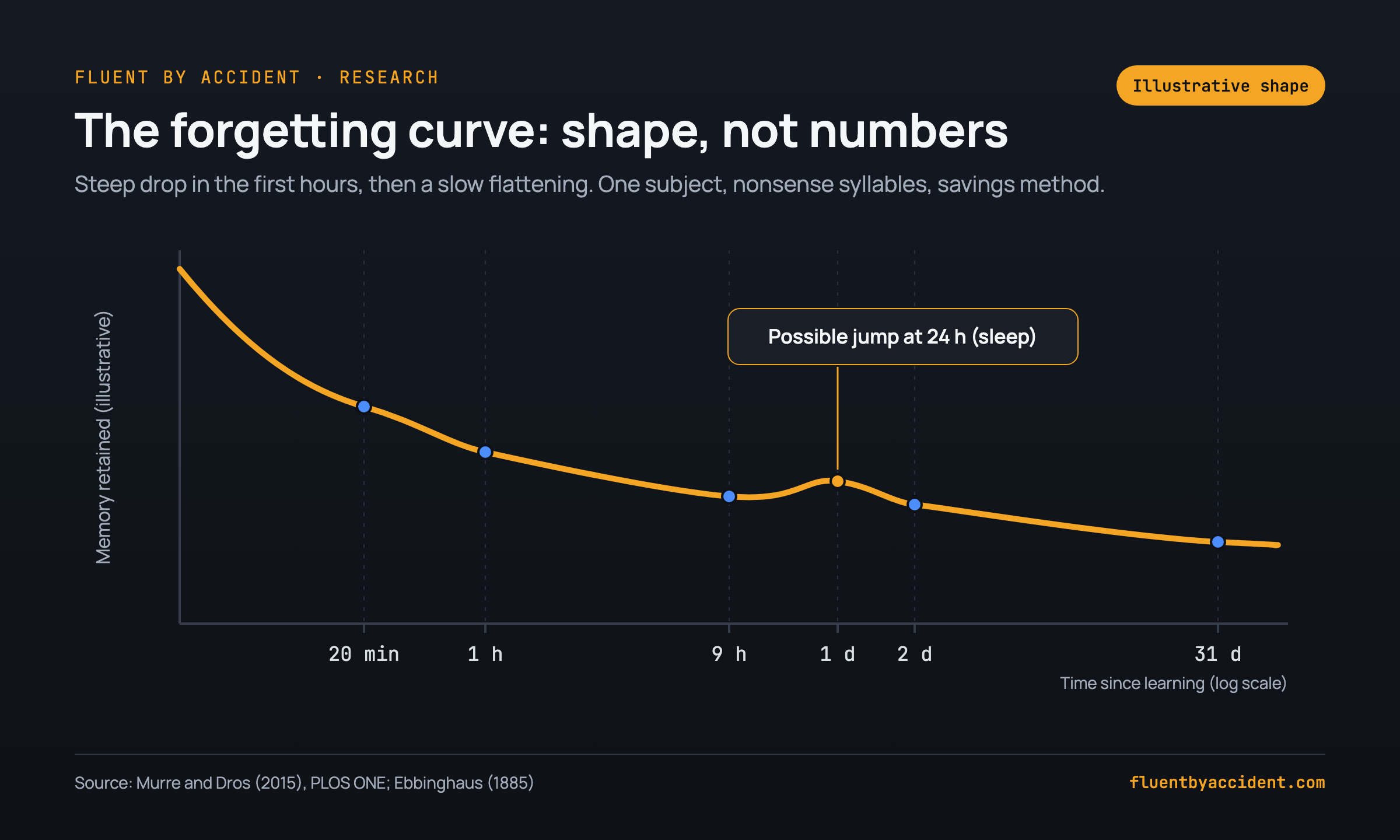
The forgetting curve is the observation that memory for new material drops fastest in the first hours and the first day, then flattens out. It comes from Hermann Ebbinghaus, who published Über das Gedächtnis in 1885. Most vendor pages stop at his name, so here is what he actually did.
Ebbinghaus was his own and only subject. He memorized lists of nonsense syllables, so that meaning and prior knowledge could not help, and he measured memory with the savings method: how much less effort it took to relearn a list than to learn it the first time. Murre and Dros give a clear example: if a list takes 25 repetitions to learn and 20 to relearn a day later, you saved 5 of 25, or 20% (Murre and Dros, 2015).
In 2015, Jaap Murre and Joeri Dros replicated the experiment. One subject spent 70 hours learning lists of nonsense syllables and relearning them after 20 minutes, 1 hour, 9 hours, 1 day, 2 days or 31 days, and "the results are similar to Ebbinghaus' original data" (PLOS ONE). They also found the curve is "not completely smooth" and most probably shows a jump upwards starting at the 24-hour point, which the authors discuss in connection with sleep.
Three caveats matter for language learners:
- One person each time. Both the original and the replication rest on a single subject.
- Nonsense, not vocabulary. Real words attach to sounds, scenes and meanings you already have, which changes how fast they fade.
- Savings is not flashcard recall. The replication itself notes that savings experiments "are very different from normal memory retention experiments" (Murre and Dros, 2015). A word can be "partly saved" and still blank on your review screen.
Takeaway: trust the shape, not a precise percentage: forgetting is steep early and slow later. That shape is why the first reviews come quickly and later ones can wait for months.
How long should the gap between reviews be? (Cepeda's spacing study)
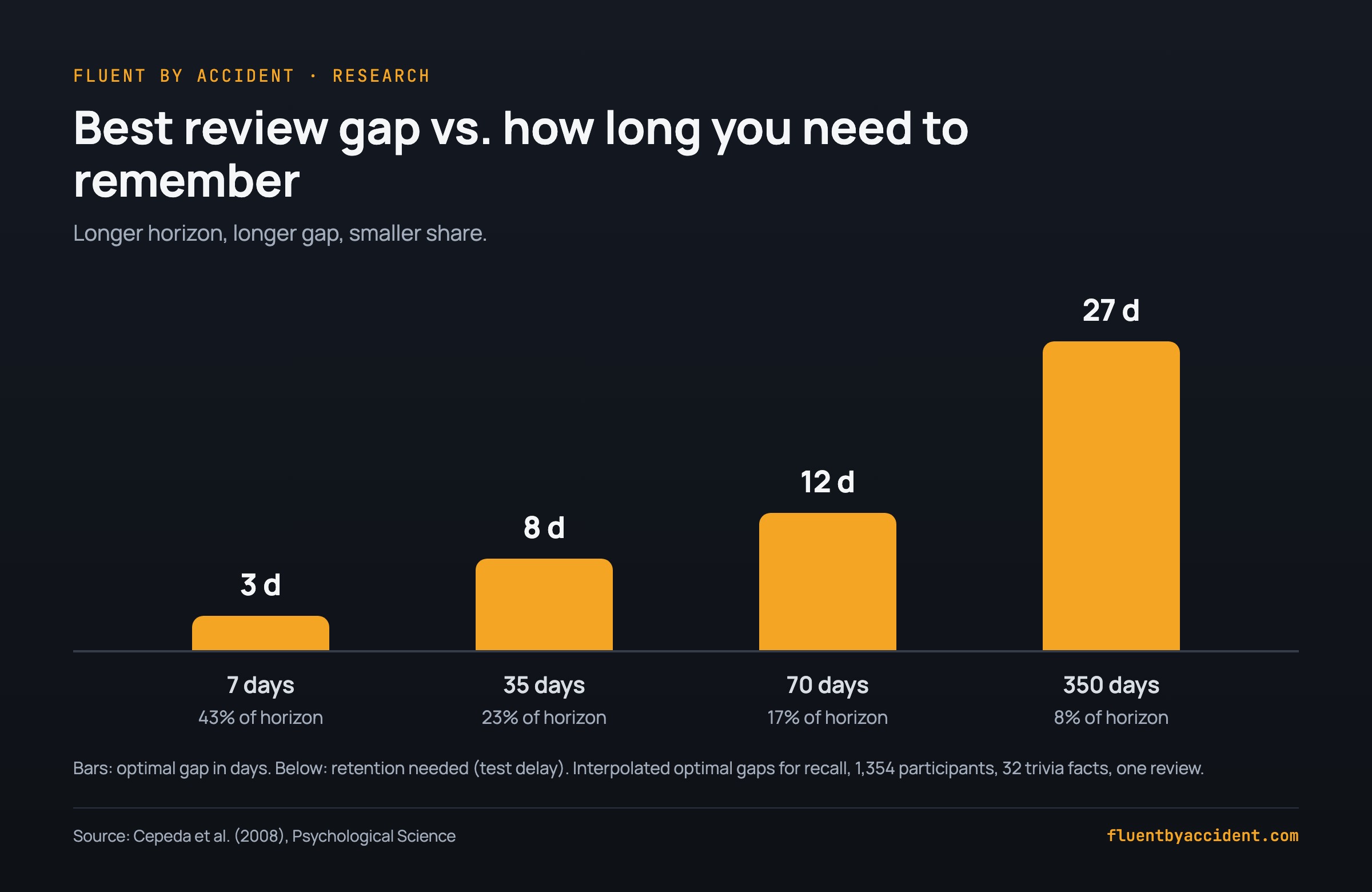
The best gap depends on how long you need to remember: the longer the horizon, the longer the gap, but as a shrinking share of that horizon. That is the core finding of Cepeda, Vul, Rohrer, Wixted and Pashler (2008), the largest study on this question.
They taught 1,354 people a set of 32 obscure but true facts, gave one review after a gap of up to 3.5 months, then ran a final test up to a year later, across 26 conditions (Cepeda et al., 2008). The pattern was the same at every test delay: lengthening the gap first improved final scores, then slowly hurt them.
The numbers, for recall:
| You need to remember for | Best tested gap | Interpolated best gap | Gap as share of that time |
|---|---|---|---|
| 7 days | 1 day | about 3 days | 43% |
| 35 days | 11 days | about 8 days | 23% |
| 70 days | 21 days | about 12 days | 17% |
| 350 days | 21 days | about 27 days | 8% |
Source: Cepeda et al. (2008), Psychological Science 19(11).
How much does the gap matter? For a fixed amount of study time, the optimal gap gave a 64% increase in final recall compared with reviewing right away (a zero-day gap). Broken down by test delay, the improvement was 10%, 59%, 111% and 77% for the 7, 35, 70 and 350-day tests (Cepeda et al., 2008). The authors conclude that the interaction of gap and test delay "implies that many educational practices are highly inefficient."
Worked example (our calculation from the table above). Say you want a set of travel phrases to hold for a trip in 35 days. Cepeda's best tested gap for that horizon was 11 days, interpolated at about 8 days. If you want the same words for a year, the best gap is closer to 27 days, only 8% of the horizon. A fixed "review every Sunday" plan is too slow for the trip and too frequent for the year.
Keep the limits in view. The material was trivia facts, not foreign words, and the study tested a single review, not the chain of expanding reviews that apps use. Spaced repetition software extrapolates from findings like these; it is a sensible extrapolation, not something this study measured directly.
How spaced repetition apps turn this into intervals
Most apps use a version of the SM-2 idea. Each card has an ease multiplier, commonly starting at 2.5. When you answer "Good", the next interval is roughly the last one times the ease. "Hard" lowers the ease and grows the interval less. "Again" (you forgot) counts as a lapse: the card goes back into short relearning steps and returns with a much shorter interval.
The result is an interval ladder that climbs fast. Here is one card, answered "Good" every time, using SM-2 style defaults (graduating interval 1 day, ease 2.5, rounded):
| Review | Interval before the next review | Day this review falls on |
|---|---|---|
| 1 | 1 day | Day 1 |
| 2 | 3 days | Day 4 |
| 3 | 8 days | Day 12 |
| 4 | 20 days | Day 32 |
| 5 | 50 days | Day 82 |
| 6 | 125 days | Day 207 |
| 7 | 312 days | Day 519 |
| 8 | 780 days | Day 1299 |
Our calculation, assumptions as stated, no lapses. A card you never forget needs six reviews in its first year and only two more in the following three years.
Notice how this lines up with Cepeda's pattern: early gaps are a large share of the time since you learned the word, later gaps are long in days but each review protects an ever longer stretch. Newer schedulers go further and model the probability that you will forget each card; if you use Anki, read how FSRS predicts forgetting instead rather than tuning ease by hand.
How many new cards per day can you handle? (the review-load math)
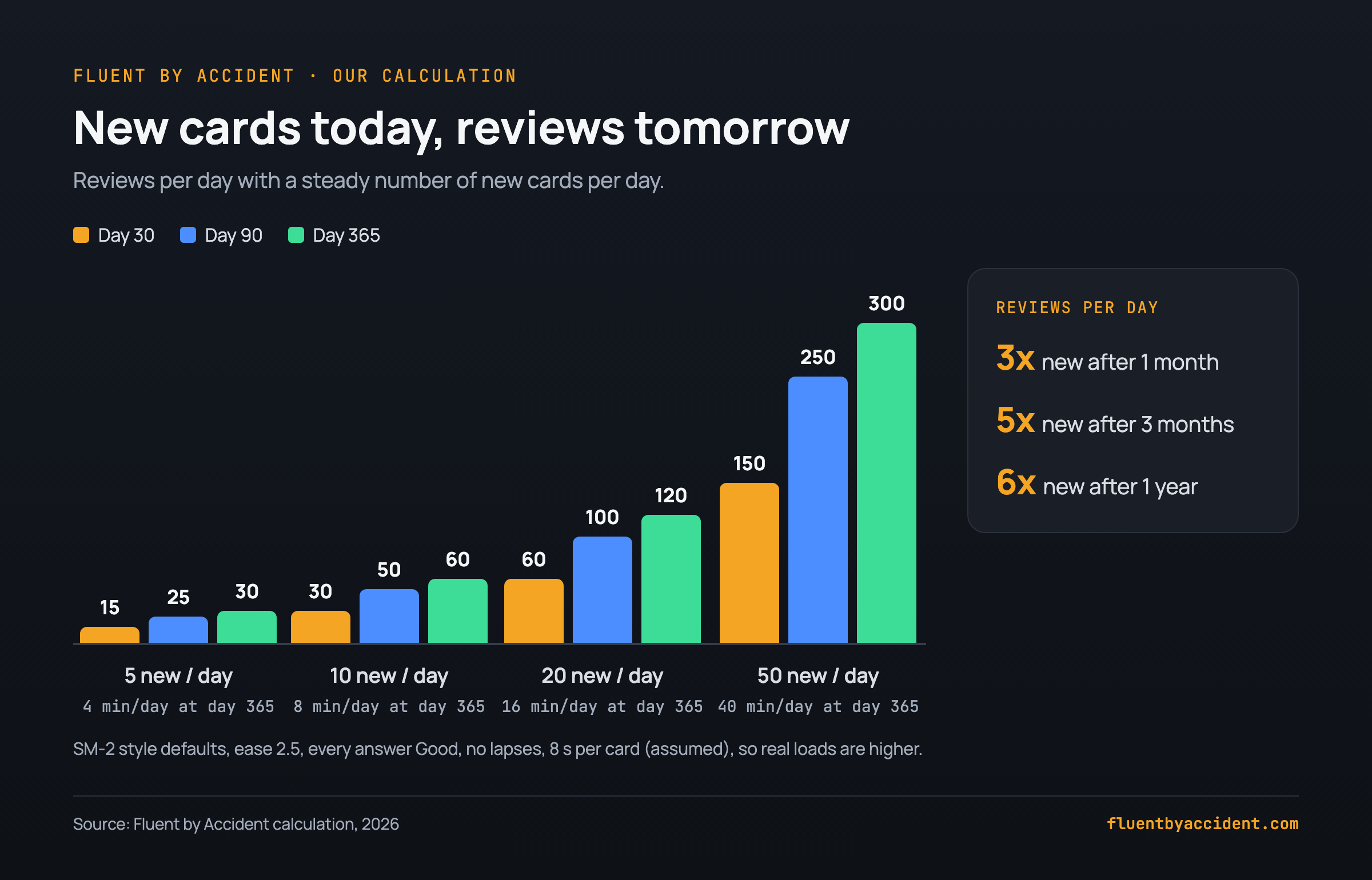
Your daily review pile is set by how many new cards you add, not by how many reviews you "feel like" doing. With a steady number of new cards each day, reviews settle at about 3 times your new cards per day after a month, 5 times after three months and 6 times after a year, before counting any forgotten cards.
This is our own calculation, not a study result. Assumptions: SM-2 style defaults (graduating interval 1 day, ease 2.5, intervals multiplied by 2.5 and rounded), every answer "Good", no lapses, learning-step reviews not counted, the same number of new cards every day, and an assumed 8 seconds per review. On any given day, you review one batch for every rung of the ladder above that has already been reached (days 1, 4, 12 by day 30; add 32 and 82 by day 90; add 207 by day 365).
| New cards per day | Reviews per day at day 30 | At day 90 | At day 365 | Minutes per day at day 365 (8 s per card) |
|---|---|---|---|---|
| 5 | 15 | 25 | 30 | 4 |
| 10 | 30 | 50 | 60 | 8 |
| 20 | 60 | 100 | 120 | 16 |
| 50 | 150 | 250 | 300 | 40 |
Treat these as a floor. Every forgotten card adds relearning steps and drops back to a short interval, so real piles run higher, and new cards take longer than 8 seconds while you are still learning them. Still, the shape of the math is what matters: 50 new words a day looks fine in week one and turns into hundreds of reviews by month three.
A practical rule from the table: pick the review time you can protect every single day, then work backwards. If you can give 10 minutes, 10 new cards per day is roughly the ceiling under ideal conditions, so starting lower leaves room for lapses. For specific numbers to enter, see the new-card and review limits we recommend in Anki.
Common spaced repetition mistakes language learners make
Most decks fail for mechanical reasons, and each one traces back to the math or the research above. Use this table as a checklist when your reviews start to feel like a chore.
| Mistake | Why it fails | Fix |
|---|---|---|
| Adding too many new cards | Reviews grow to about 5x your daily new cards within three months (our calculation above), plus lapses. | Set new cards from the minutes you can protect daily, not from enthusiasm. |
| Skipping days | Due cards do not wait; they stack, and overdue cards are more likely to be forgotten, which adds relearning. | Do at least the due reviews daily, even with zero new cards. |
| Cramming or reviewing ahead | In Cepeda's study the zero-day gap was the weakest option for long-term recall. | Let the schedule make you wait. Effortless reviews do little. |
| Rereading instead of recalling | Seeing the answer first tests recognition, which feels like knowing. | Say or type the meaning before you flip the card, then grade honestly. |
| Bare words with no context | Isolated words blur together and are hard to use. | Try mining whole sentences instead of bare words. |
| Random word lists | Rare words cost the same reviews as common ones and pay back less. | Start from frequency, e.g. a list of the most common Spanish words. |
| Treating flashcards as the whole method | Spaced repetition keeps words you have met; it does not supply new ones or train listening. | Pair reviews with input, such as comprehensible input from TV shows. |
The last row deserves a second sentence. Babbel's own guide reports a 2019 flashcard study in which "students really didn't like the spaced repetition flashcard technique" (Babbel Magazine), which is a fair warning: a deck that is all grind and no meaning gets abandoned. Reviews work best as the maintenance layer for a language you are also hearing and reading, and the method for learning a language with Netflix is one way to build that input habit.
Where your cards should come from
Words you met in something you watched come with a scene, a voice and a sentence attached. That context gives each review more to hook onto than a word copied from a list, and it means every card is a word you have already seen used. The guide to making flashcards from Netflix and YouTube walks through the workflow, and the free subtitle vocabulary tool helps you pick out the words in an episode worth learning.
Tip: Add only words from the last thing you watched, and cap new cards at what your daily review time allows (see the table above). A small deck of words you have heard in context beats a large deck of strangers.
If you want this in one place, Fluent by Accident lets you save words from Netflix and YouTube subtitles into decks that you review with spaced repetition in its web app.
FAQ
Does spaced repetition work for language learning?
Yes, for retaining vocabulary you have already met. The spacing effect is one of the most robust findings in memory research: in Cepeda et al. (2008), with 1,354 participants, the best review gap gave 64% more final recall than reviewing immediately, for the same study time. That study used trivia facts rather than foreign words, so it shows the mechanism, not a language-specific result. Spaced repetition does not teach grammar, listening or speaking on its own; it keeps the words you collect from reading and watching from slipping away, which is exactly the part of language learning that leaks most.
Is spaced repetition better than cramming?
For anything you need to remember beyond the next few days, yes. Cramming packs reviews close together, which feels effective because recall is easy in the moment. In Cepeda et al. (2008), a zero-day gap (reviewing right away) produced the weakest long-term recall, and spacing the review improved final scores by 10% to 111% depending on how long people had to remember. Cramming can get you through tomorrow's quiz. For vocabulary you want to understand in a show next year, spread the reviews out and let the gaps grow as the word gets stronger.
What are the best spaced repetition intervals?
There is no single best set, because the ideal gap depends on how long you need to remember. Cepeda et al. (2008) found optimal gaps of about 3, 8, 12 and 27 days for test delays of 7, 35, 70 and 350 days, which is a shrinking share of the delay (43% down to 8%). Apps handle this by growing intervals with each correct answer. With SM-2 style defaults and every answer "Good", one card comes back on days 1, 4, 12, 32, 82 and 207 (our calculation). Forgotten cards restart with short intervals.
How many new flashcards should I learn per day?
Work backwards from the time you can review every day. In our calculation with SM-2 style defaults and no forgotten cards, daily reviews reach about 3 times your new cards per day after one month, 5 times after three months and 6 times after a year. That means 10 new cards a day settles around 60 reviews, roughly 8 minutes at an assumed 8 seconds per card, and 50 new cards a day reaches about 300 reviews. Real loads are higher because some cards are forgotten. Many learners do better starting lower and raising it once reviews feel steady.
What happens if I miss a day of reviews?
The cards that were due stay due, and tomorrow's cards join them, so the pile for the next session is roughly double. Overdue cards are also more likely to have slipped, and each forgotten card goes back to short relearning intervals, which adds more work later. One missed day is easy to recover from: do the due reviews first and pause new cards until the backlog is gone. Missing several days in a row while still adding new cards is what turns a manageable deck into one that people abandon.
Can you learn a language with spaced repetition alone?
No. Spaced repetition is a memory tool: it protects words and phrases you have already encountered. It does not give you listening practice, natural sentence patterns or the thousands of hours of input that understanding real speech takes. Use it as the maintenance layer. Watch, read and listen to collect words in context, put the useful ones on cards, and let the scheduler keep them alive. That pairing gives each card meaning and gives your input time a way to stick instead of fading by the end of the week.
Sources
- Cepeda, N. J., Vul, E., Rohrer, D., Wixted, J. T., and Pashler, H. (2008). Spacing Effects in Learning: A Temporal Ridgeline of Optimal Retention. Psychological Science, 19(11). Author PDF, abstract page.
- Murre, J. M. J., and Dros, J. (2015). Replication and Analysis of Ebbinghaus' Forgetting Curve. PLOS ONE, 10(7): e0120644. PLOS ONE.
- Ebbinghaus, H. (1885). Über das Gedächtnis. Historical source, described via Murre and Dros (2015); no figures quoted.
- Babbel Magazine. How To Use Spaced Repetition In Your Language Learning. babbel.com, checked November 2026.
- Lingvist blog. Repetition Works! How To Learn a New Language with Spaced Repetition. lingvist.com, checked November 2026.
- Fluent by Accident team calculation (2026): interval ladder and review-load table from SM-2 style defaults (graduating interval 1 day, ease 2.5, intervals multiplied by 2.5 and rounded, every answer "Good", no lapses, constant new cards per day, 8 seconds per review assumed). Daily load on day D = new cards per day times the number of ladder review days on or before D.