Sentence cards vs word cards: which work better?
Word cards are fast, sentence cards teach how a word is used, cloze tests production. We built all four formats for the same 3 words and counted what each one costs to make.
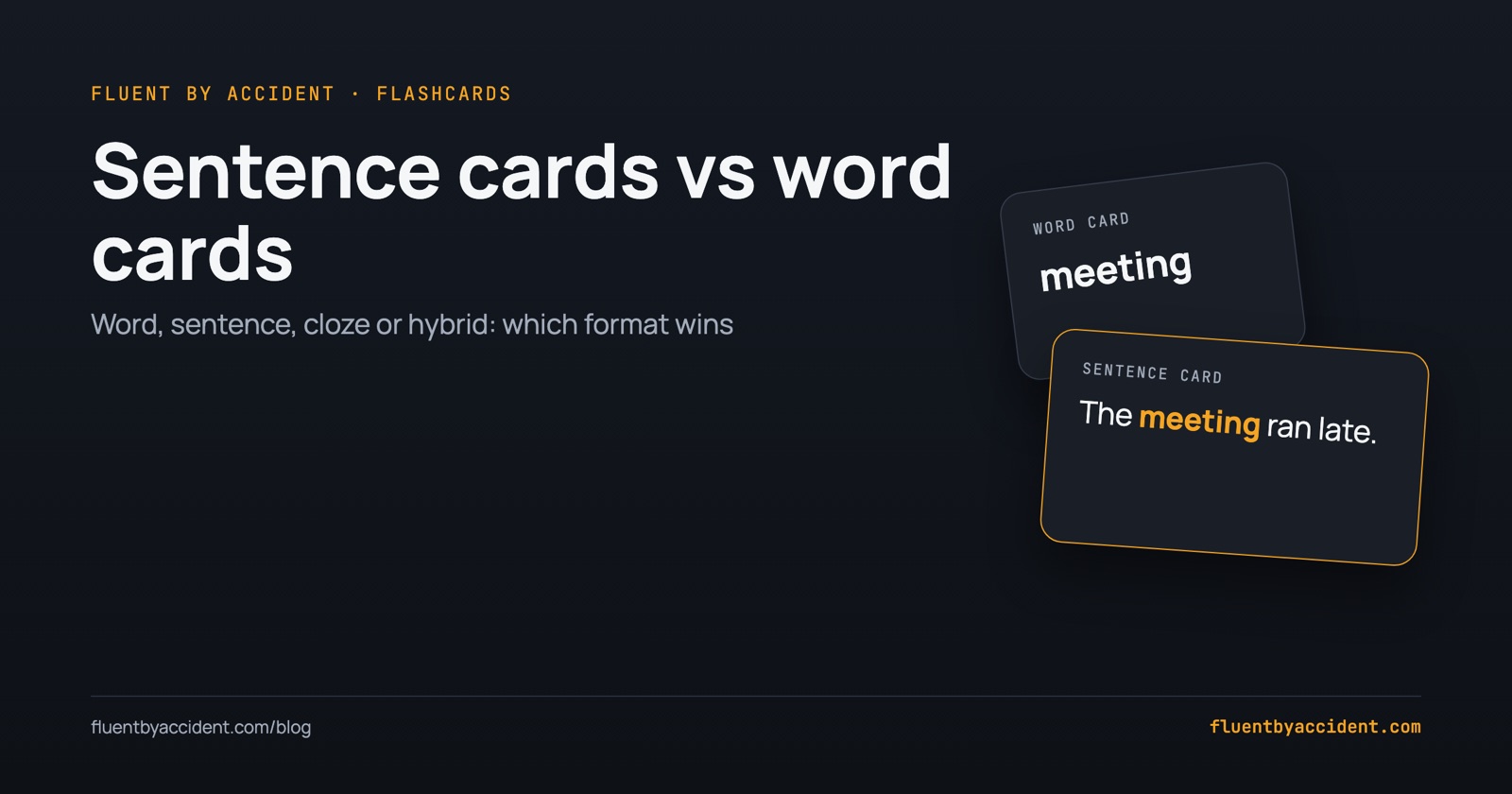
In the sentence cards vs word cards debate, neither format wins outright: word cards are the fastest to make and review and work well for concrete nouns, while sentence cards teach meaning, grammar and usage for abstract or multi-meaning words but take longer to review. For most learners the best card is a hybrid: the word on the front, the real sentence it came from as a fallback, the meaning on the back.
Sentence cards vs word cards: the short answer
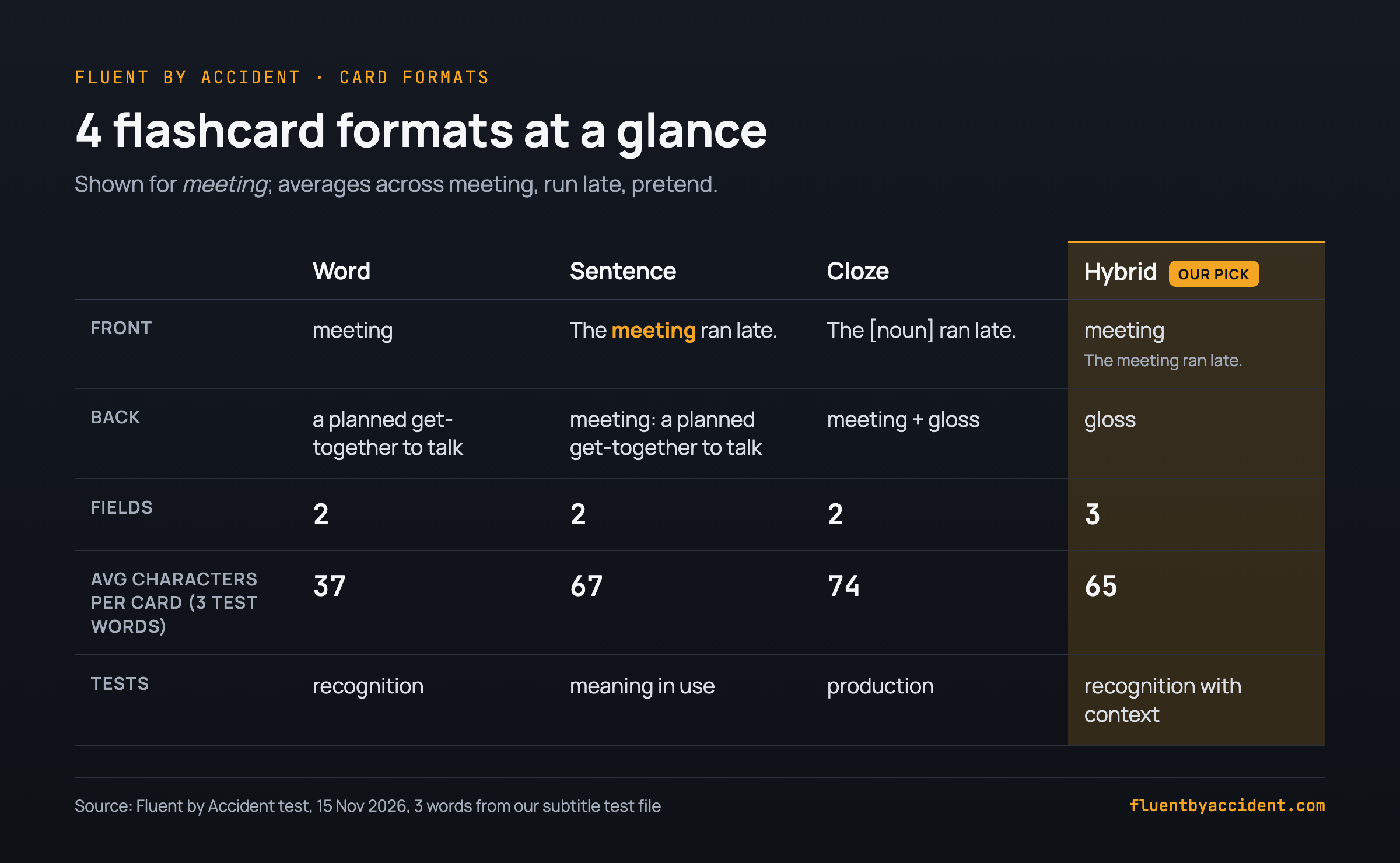
A word card shows the bare word, a sentence card a full sentence, a cloze card blanks the word out of the sentence, and a hybrid card shows the word with the sentence as a hint.
How we tested: On 15 November 2026 we took three real lines from the English subtitle file of our fake Netflix test page (the test clip in our repo): a concrete noun (meeting, from "The meeting ran late."), a phrasal expression (run late, same line) and an abstract verb (pretend, from "We can't keep pretending everything is fine."). We wrote each word as all four Anki formats using the standard Basic and Cloze note types, with a short English gloss on the back, then counted fields and characters with a script. Anki was not installed on the test machine, so the Anki numbers are typing cost, not seconds. We did time the capture step in Fluent by Accident on the same test page, in Chrome 157.0.8103.52 (headless, scripted Playwright clicks, Polish as the native language).
| Format | Fields | Characters per card (meeting / run late / pretend) | Average | What you read on the front | What it tests |
|---|---|---|---|---|---|
| Word | 2 | 37 / 36 / 37 | 37 | 7-8 characters | Recognizing the bare word |
| Sentence | 2 | 60 / 59 / 83 | 67 | 4-7 words | Understanding the word in use |
| Cloze | 2 | 65 / 69 / 88 | 74 | 4-7 words with a gap | Producing the word |
| Hybrid | 3 | 58 / 57 / 81 | 65 | 7-8 characters, sentence as fallback | Recognition, with context on demand |
Our arithmetic: the three word cards came to 110 characters in total, the hybrids to 196 (78% more), sentence cards to 202 (84% more) and cloze to 222 (about twice as much). Most of the extra is the sentence itself. If you paste the line instead of typing it, a hybrid costs you the same typing as a word card plus one paste.
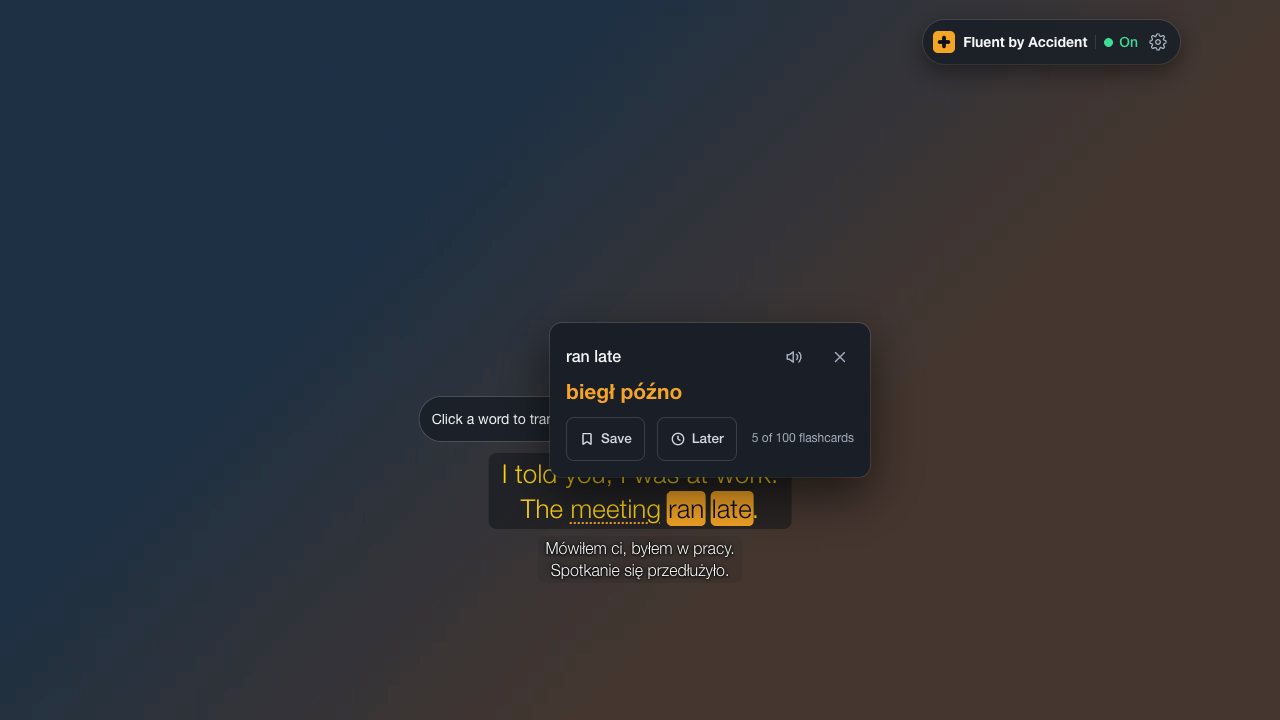
Capturing a word and its line in the extension took about a second: in our second timed run the popup was ready 0.83 to 0.91 seconds after the click (first run: 0.83 to 1.37), and Save took 0.03 to 0.04 seconds. Each saved word kept its full subtitle line. The test also showed why context matters: the phrase ran late came back word by word as "biegł późno" (Polish "ran" in the running sense, plus "late"), while the full-line translation underneath, "Spotkanie się przedłużyło" ("the meeting went on too long"), got it right. A bare word card would have taught the wrong meaning.
What is a word card, and when does it win?
A word card is one word on the front, its meaning on the back. It tests one fact, so it is the cheapest format to build and review (37 characters on average in our test).
Speed matters most where the word has one clear meaning. Concrete nouns like table, key or meeting rarely need a sentence to make sense. Tatsumoto, an AJATT-style Japanese guide, argues that "the time saved by using SWCs for nouns outweighs the benefits of using sentence cards" (SWC = simple word card) and suggests they make up roughly 15% of a deck. That is one author's rule of thumb, not a measurement, but it matches the logic: when context adds nothing, skip it.
The weak spots are just as clear:
- Multi-meaning words. Run in "The meeting ran late" means "went on too long", which a bare run card never teaches.
- Grammar that lives around the word. Gender, articles and prepositions vanish. A German card that says Tisch instead of der Tisch drops the gender you need to use it.
- Collocations. You learn decision but not that English speakers make one.
Retrieval of isolated words does work. A 2022 study in Cognitive Science states plainly that "retrieval practice of isolated words (e.g., with flashcards) enhances foreign vocabulary learning" (van den Broek et al., 2022). The question is what you lose by stripping context, not whether word cards work at all.
| Example word card | Front | Back | Good fit? |
|---|---|---|---|
| Concrete noun | meeting | a planned get-together to talk | Yes: one clear meaning |
| Phrasal expression | run late | to go on longer than planned | Weak: the phrase only makes sense in a sentence |
| Abstract verb | pretend | to act as if something is true | Weak: no hint of how it is used ("keep pretending") |
| Gendered noun (German) | der Tisch | table | Yes, if the article is on the front |
What is a sentence card, and why do learners swear by it?
A sentence card puts a sentence you met in a show, book or article on the front. The back gives the meaning of the target word, often with audio or a translation.
The case for it is that words live in context. The same van den Broek et al. paper notes that "vocabulary is often encountered in context", and in its first experiment "retention was significantly higher in the inference than in the retrieval condition". In the second experiment, once feedback was added, "retrieval opportunities were only as beneficial as exposure to rich contextual information." Read that carefully: the study looked at word learning while reading stories, not at Anki templates. It supports "context helps, and so does retrieval", not "sentence cards beat word cards by X%".
Sentence cards shine for:
- Multi-meaning words, where the sentence picks the meaning (ran in "the meeting ran late").
- Grammar and collocations, which come for free with the sentence.
- Intermediate learners who can already read most of a subtitle line.
The costs are real too:
- Slower reviews. Our sentence fronts were 4-7 words against 1-2 for word cards. Tatsumoto estimates "on average, it takes 20 seconds to answer a sentence card"; that is his estimate, not a timed study. Slow reviews add up fast, which is one route to needing to clear an Anki backlog.
- Remembering the sentence, not the word. Tatsumoto warns about "context-dependent memories": you know the word only when you see that exact line.
- Too hard for beginners. If you cannot read four of the six words, the card tests everything except your target.
In a 2017 Chinese-forums thread arguing the "drill sentences" advice is wrong, the original poster agreed that reading and "drilling simple 2-3 word collocations is useful, but substituting memorising long sentences for memorising words is not." In reply, imron wrote: "The problem is not so much wordlists, it's wordlists that contain words without context."
If you want sentences from what you already watch, our guide on how to mine sentences from shows covers the picking and cutting.
Example sentence card built from a subtitle line: front shows The meeting ran late, back shows the meaning of ran late FRONT The meeting ran late. What does "ran late" mean here? BACK run late = go on longer than planned source: subtitle line Example card, built from our test subtitle fileAre cloze deletion cards good for vocabulary?
A cloze card hides part of a sentence and asks you to fill the gap. In Anki you mark the hidden part with double curly braces, as in the manual's example "Canberra was founded in {{c1::1913}}." You can add a hint after two colons, {{c1::Canberra::city}}, and Anki "will treat the text after the two colons as a hint". Each numbered deletion becomes its own card, so a note with c1 and c2 gives you two cards.
| What you type in the Text field | What the review shows | Answer |
|---|---|---|
The {{c1::meeting::noun}} ran late. | The [noun] ran late. | meeting |
The meeting {{c1::ran::run, past}} late. | The meeting [run, past] late. | ran |
We can't keep {{c1::pretending::verb}} everything is fine. | We can't keep [verb] everything is fine. | pretending |
The strength of cloze is production. You have to come up with the word and its form (ran, not run; pretending, not pretend), which is closer to speaking and writing than recognizing a word on a card.
The drawbacks:
- Several right answers. "The meeting [verb] late" could be ran, went or started. A hint that names the base form, such as "run, past", rules out started; a hint like "verb, past" would not. Every hint is one more thing to write.
- Most typing. Cloze was our most expensive format at 74 characters per card on average, because the sentence and the markup both go in.
- Critics. Tatsumoto writes that "cloze cards are rarely used in language learning, and for good reason"; cloze app vendors claim the opposite. Neither shows controlled data.
Our take: use cloze for words you already recognize and now want to produce, and for grammar patterns (verb endings, particles, prepositions). Avoid it for brand-new words, where you would just be guessing.
The hybrid card: word front, sentence as fallback
The hybrid keeps the speed of a word card and the safety net of a sentence card. You see the word, try to recall it, and only read the sentence if you are stuck. The learner behind mikumino's blog describes the same idea: "The sentence is merely a fallback for if I can't get it from just the word in isolation", adding that "I don't form context-based memories because I don't always look at the sentence before flipping the card." The same post describes "click and hover" cards that hide the sentence until you click, a stricter version of this setup.
In our test the hybrid cost 65 characters per card, less than a sentence card, because the back only needs the gloss.
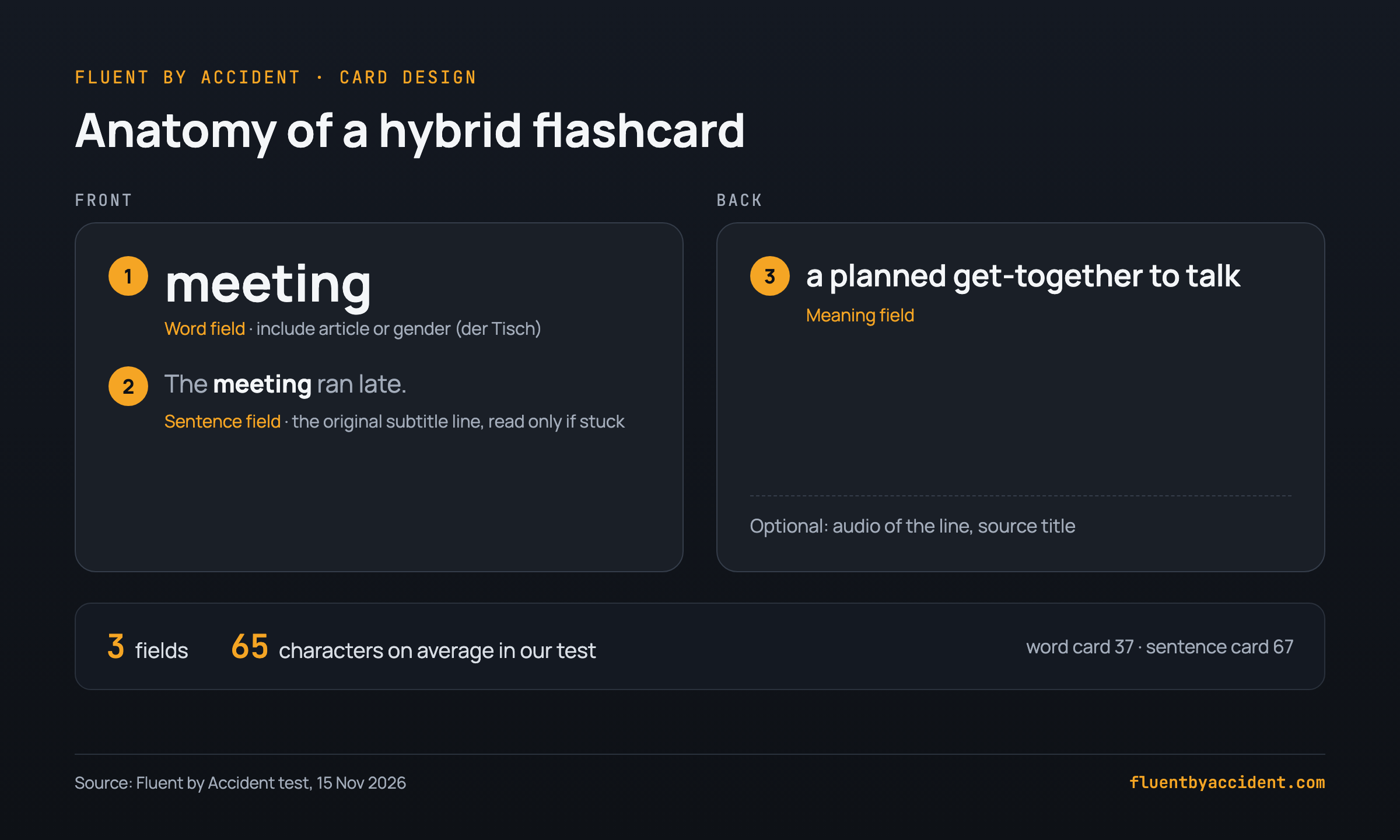
Here is the full template, ready to build in Anki desktop by cloning the Basic note type, renaming Front to Word and Back to Meaning, and adding a third field called Sentence:
| Field | What goes in it | Example |
|---|---|---|
| Word | The target word or phrase, with article or gender for nouns | meeting / der Tisch / run late |
| Sentence | The original line it came from, target word in bold | The meeting ran late. |
| Meaning | Translation or short gloss in your language; optional audio and source | a planned get-together to talk |
- Front template:
<div style="font-size:32px">{{Word}}</div>{{hint:Sentence}}. Anki's hint filter keeps the sentence hidden behind a click until you need it, which is the "click and hover" setup described above. - Back template:
{{FrontSide}}<hr id=answer>{{Meaning}} - Review rule: look at the word first, count a beat, and read the sentence only if nothing comes. If you needed the sentence, grade the card as hard, not good.
That review rule stops the sentence from becoming the cue. If you pull cards from shows, our guide to make flashcards from Netflix and YouTube with context shows how to keep the subtitle line attached.
Which card format should you use? A decision table
Choose by the word in front of you, then adjust once you see which cards you keep failing.
| Word type | Beginner | Intermediate | Advanced |
|---|---|---|---|
| Concrete noun (table, key) | Use: word card (with article) | Use: word card | Use: word card |
| Verb (pretend, decide) | Use: word card | Use: hybrid | Use: hybrid or cloze |
| Abstract or multi-meaning word (run, figure out) | Use: hybrid, short sentence | Use: hybrid or sentence | Use: sentence |
| Idiom or set phrase (run late) | Avoid for now: too early | Use: sentence | Use: sentence or cloze |
| Grammar pattern (verb endings, particles) | Avoid for now: learn the rule first | Use: cloze with hint | Use: cloze |
The logic: the more meanings a word has, the more context it needs; the lower your level, the shorter the sentence; and recognize a word before you drill producing it.
How to set up hybrid cards from shows you watch
The hybrid works best with a real sentence from something you watched and understood:
- Pick the word while watching. Note the word and copy the full subtitle line, nothing longer.
- Fill three fields. Word (with article or gender), Sentence (the line, word in bold), Meaning (your language).
- Paste, don't type, the sentence. The sentence was most of the extra cost in our count.
- Keep new cards low at first. Sentences on the front still slow some reviews. Tune your daily limits with our Anki settings for language learning, and if you use the FSRS scheduler, let it space the easy nouns out.
Tip: If a card fails three times in a row, the format is usually wrong, not your memory. Move it one step right in the decision table: word to hybrid, hybrid to sentence.
If you watch on Netflix, YouTube, Prime Video, Disney+ or Max, the Fluent by Accident Chrome extension lets you click a subtitle word to translate it and save it, and stores the subtitle line it came from with the saved word, so you have the sentence for your hybrid card.
FAQ
Are sentence cards better than vocab cards for beginners?
Usually not at the very start. A sentence card only works if you can read almost every word in the sentence except the target; otherwise you are testing the whole line, not one word. For your first few hundred high-frequency words, plain word cards (with the article or gender for nouns) are faster and clearer. As soon as you can read short, simple lines, switch verbs and multi-meaning words to hybrid cards: the word on the front and a short real sentence underneath as a fallback.
Should word flashcards include an example sentence?
Yes, for most words beyond basic concrete nouns. The risk is that you start recalling the sentence instead of the word. The fix is placement: keep the word big on the front and the sentence small below it, and read it only when the word alone does not trigger the meaning. Research on learning words while reading (van den Broek et al., 2022) found that rich context was at least as good as retrieval practice, and better in one experiment, which is why a card that gives you both is a reasonable default.
Is cloze deletion good for learning vocabulary?
Cloze is good for producing words you already know, not for meeting new ones. Because you must fill the gap with the right word in the right form, it trains spelling, conjugation and grammar patterns. For a brand-new word it turns into guessing, and many gaps have more than one correct answer. Use Anki's hint syntax, such as {{c1::ran::run, past}}, which names the base form, to rule out wrong but plausible answers, and add cloze cards only after the word feels easy on a recognition card.
How do I stop memorizing the sentence instead of the word?
Make the word the first thing you see and the sentence the last resort. On a hybrid card, look at the word, pause, and only then glance at the sentence if nothing comes. If a card only works with its sentence after several reviews, turn it into a full sentence card on purpose rather than fooling yourself.
How long should a sentence on a flashcard be?
Short enough to read in one glance and with only one unknown word. In practice that means one subtitle line, not a paragraph: our test lines were 4 and 7 words. If the line you found is long, trim it to the clause that contains the word, as long as it still makes sense. A sentence that needs its own translation before you can find the target word is too long for a card.
Can I mix word cards and sentence cards in one Anki deck?
Yes. Anki schedules every card on its own, so word, sentence, cloze and hybrid cards can live in the same deck without problems. If your daily reviews start to feel heavy, lower new cards per day before you change formats, and keep the fast word cards for the words that do not need context.
Sources
- van den Broek, G. S. E., Wesseling, E., Huijssen, L., Lettink, M., and van Gog, T. (2022). Vocabulary Learning During Reading: Benefits of Contextual Inferences Versus Retrieval Opportunities. Cognitive Science, 46(4), e13135. pmc.ncbi.nlm.nih.gov/articles/PMC9285746. Checked 15 November 2026.
- Anki Manual, Editing: Cloze Deletion. docs.ankiweb.net/editing.html. Checked 15 November 2026.
- Tatsumoto Ren (2021). Discussing various card templates. tatsumoto.neocities.org. Opinion and estimates. Checked 15 November 2026.
- mikumino (edited 2023). Deciding on a card type. mikumino.neocities.org. Opinion. Checked 15 November 2026.
- Chinese-forums.com (2017). The advice "don't drill word lists, drill sentences" is wrong. chinese-forums.com thread 54260. Forum opinions. Checked 15 November 2026.
- Fluent by Accident test, 15 November 2026: three subtitle lines from our test page, four Anki formats per word, fields and characters counted by script; Fluent by Accident popup and save timed in Chrome 157.0.8103.52 with Playwright on test/watch/81234567.html.