Best Anki settings for language learning in 2026 (FSRS)
The Anki settings that matter for vocabulary in 2026: FSRS on, 90% desired retention, one short learning step and a new-card limit sized to the minutes you really have.

You download a popular vocabulary deck, keep Anki's default of 20 new cards a day, and a month later you face around 80 reviews a day, still climbing. The advice you find contradicts itself, and much of it predates Anki's FSRS scheduler. One r/Anki user learning several languages had already cut new cards to 2 or 3 a day and was still asking when the reviews would go down (r/Anki).
The best Anki settings for language learning in 2026 are: FSRS on, desired retention 90% (85% if you are short on time), one 15m learning step, one 10m relearning step, and a new-card limit that matches your real daily time. Ten new cards a day is a safe start; in our simulation it grows to about 38 minutes a day after a year. Keep the default maximum interval, optimize monthly, and press Again whenever you forget (Anki Manual, FSRS FAQ).
Why these: the manual calls desired retention "the most important setting in FSRS" and wants learning steps shorter than one day (Anki Manual). Almost everything else is a default you can keep or an SM-2 option that disappears once FSRS is on.
Last checked: October 9, 2026, against Anki 26.09.3 and the current Anki manual (Anki 26.09 release notes).
The best Anki settings for language learning (quick table)
Open the settings with the gear icon next to a deck, then Options. Settings live in presets, and several decks can share one preset (Anki Manual). The labels below match Anki 26.09 (Anki source, UI strings), and the defaults come from Anki's own code (Anki default config).
| Setting (exact label) | Where | Set it to | Anki default | Why |
|---|---|---|---|---|
| FSRS (toggle) | Bottom of Deck Options | On | Off | More accurate scheduling, all presets |
| Desired retention | FSRS | 0.90 (0.85 if short on time) | 0.90 | Sets your whole workload, see below |
| Optimize Current Preset (button) | FSRS | Click once a month | n/a | Fits FSRS to your own review history |
| Reschedule cards on change | FSRS | Off when you first switch | Off | Not recommended on the first switch from SM-2 |
| Learning steps | New Cards | 15m (one step; 10m to 30m all fine) | 1m 10m | Steps should finish the same day |
| Relearning steps | Lapses | 10m | 10m | Same rule as learning steps |
| New cards/day | Daily Limits | 10 to start, then see the time table | 20 | Decides your future review load |
| Maximum reviews/day | Daily Limits | About 20x your new cards/day (200 is fine for 10 new) | 200 | Anki: at least 10x your new cards; our simulation hits 12x after a year |
| Maximum interval | Advanced | Leave at 36500 days | 36500 | Shorter means more reviews; Anki warns below 6 months |
| Bury new siblings, Bury review siblings | Burying | On if you use reversed (two-way) cards | Off | Keeps both directions of a word off the same day |
| Leech threshold, Leech action | Lapses | 8, and pick Tag Only or suspend on purpose | 8 | Flags words you keep failing so you can rewrite them |
| Easy Days | Deck Options | Optional: Reduced on your busiest day | Normal | Moves reviews away from days you choose |
If you study a Japanese kanji deck and a vocabulary deck, give them separate presets so each gets its own FSRS parameters; two vocabulary decks for the same language can share one (FSRS FAQ).
How to turn on FSRS in Anki without breaking your deck
FSRS is Anki's newer scheduler, an alternative to the old SM-2 algorithm. It predicts when you are likely to forget each card, and the manual says it can help you remember more in the same study time (Anki Manual). Anki 25.07 brought FSRS-6 (release notes), and 26.09 updated it to 6.6.2 (release notes).
The Anki FSRS settings to change, in order:
- Update Anki on every device, which also gets you the security fixes in 26.09.
- Back up: export with scheduling included. One r/Anki helper notes this checkbox is off by default (r/Anki).
- Turn on FSRS at the bottom of Deck Options. It applies to every preset.
- Set one short learning step and one relearning step (see below).
- Click Optimize Current Preset, or Optimize All Presets from the dropdown next to Save (Anki source). Since Anki 24.06.3 it works with any number of reviews (FSRS FAQ).
- Leave Reschedule cards on change off; the manual advises against it when you first leave SM-2.
- Leave the FSRS parameters alone. Never edit them by hand or copy someone else's. Since Anki 26.05, editing takes three clicks to unlock (release notes).
After the switch, SM-2 options such as graduating interval and starting ease disappear. A first Good interval of 3 to 5 days is normal (FSRS FAQ).
Before you switch: check every device you sync. Anki and AnkiMobile need 23.10 or newer, AnkiDroid needs 2.17 or newer, or FSRS will not work correctly.
What desired retention should you use for vocabulary?
Anki desired retention is your chance of remembering a card when Anki shows it. At 90%, you should fail about 1 review in 10 (Anki Manual). The manual calls 90% a good balance, says workload rises very quickly above it, and advises staying under 97%. Anki's tooltip adds that low values can be discouraging (Anki source).
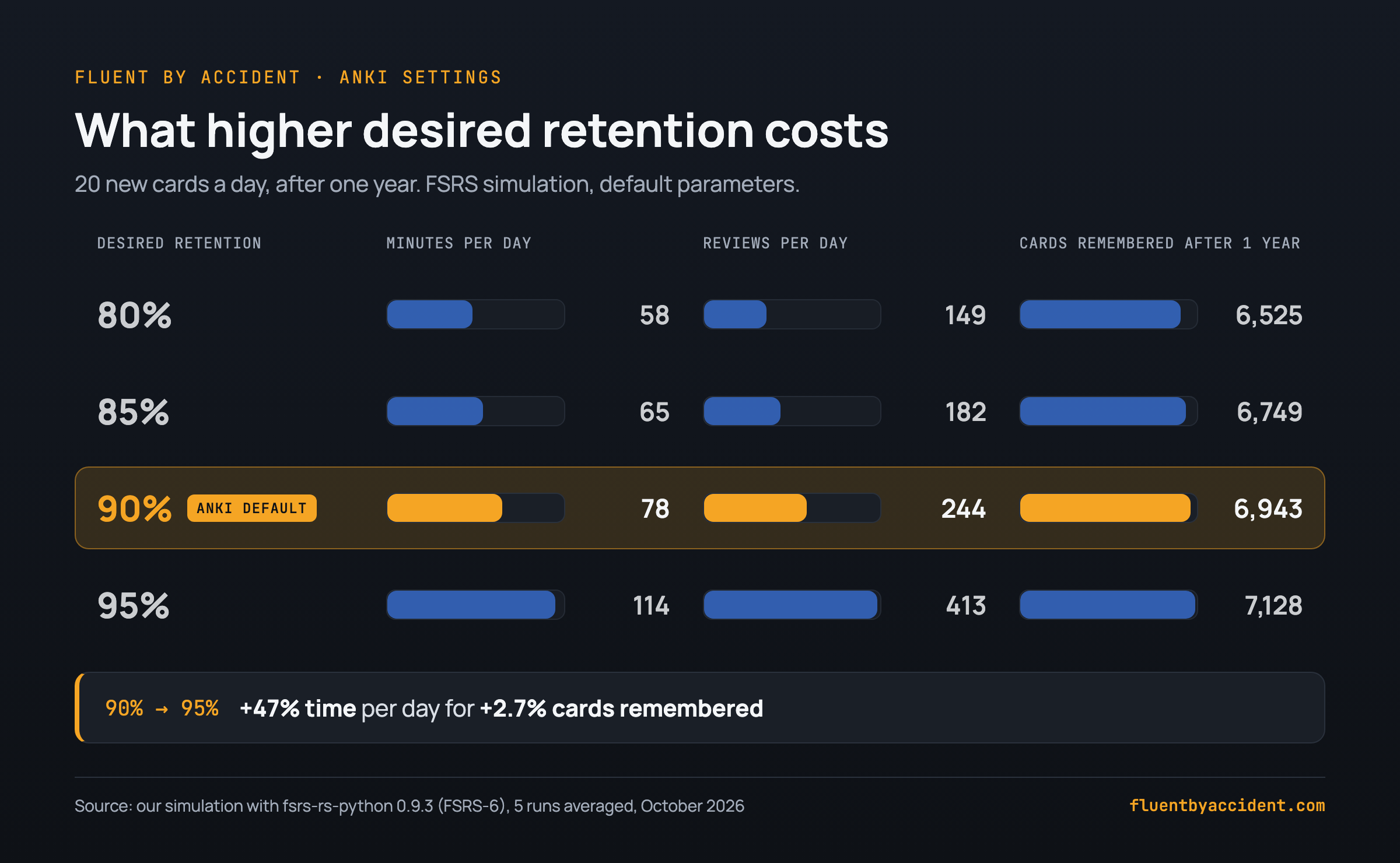
We ran the numbers with the FSRS engine Anki uses (fsrs-rs-python). At 20 new cards a day, after one year:
- 80%: 58 minutes a day, 6,525 cards remembered
- 85%: 65 minutes a day, 6,749 cards remembered
- 90%: 78 minutes a day, 6,943 cards remembered
- 95%: 114 minutes a day, 7,128 cards remembered
Going from 90% to 95% costs 47% more daily time and 69% more reviews for 2.7% more remembered cards. Dropping to 85% saves 16% of the time and keeps 97% of what 90% keeps.
So: use 90% if you can, 85% if reviews crowd out your listening and reading time, and 95% only for a short stretch before an exam. Go much lower and extra forgetting and relearning eat into the time you save (FSRS4Anki wiki). On r/Anki, a regular helper called 96% "extraordinarily high" (r/Anki).
To personalize it, click Help Me Decide (Experimental) in the FSRS section. It simulates your own workload at different values and replaced Compute minimum recommended retention, removed in 25.07 (Anki Manual). Since Anki 25.09 you can set desired retention per deck inside one preset (release notes).
Check it in a month: open Stats, find the True Retention table and look at mature cards (interval of 21 days or more) by month. With FSRS it should land close to your desired retention. If not, optimize again and press Again on every miss (Anki Manual, Statistics).
How many new cards per day in Anki can you keep up with?
The manual warns that 20 new cards a day leads to roughly 200 reviews a day (Anki Manual). FSRS itself works the same at 5 or 50 new cards a day (FSRS FAQ), so the real limit is your time.
Our rule of thumb at 90%, after one year: daily reviews are about 12 times your new cards per day, and daily time is about 4 minutes per new card. Ten new cards means about 38 minutes, twenty about 78. At 85% it is about 9 times and 3.2 minutes. The manual's 200 reviews sits between our month-3 (135) and month-12 (244) figures, so we agree on scale. Reviews keep climbing in year two: at 20 new a day and 90%, they rose from 244 to about 330 a day.
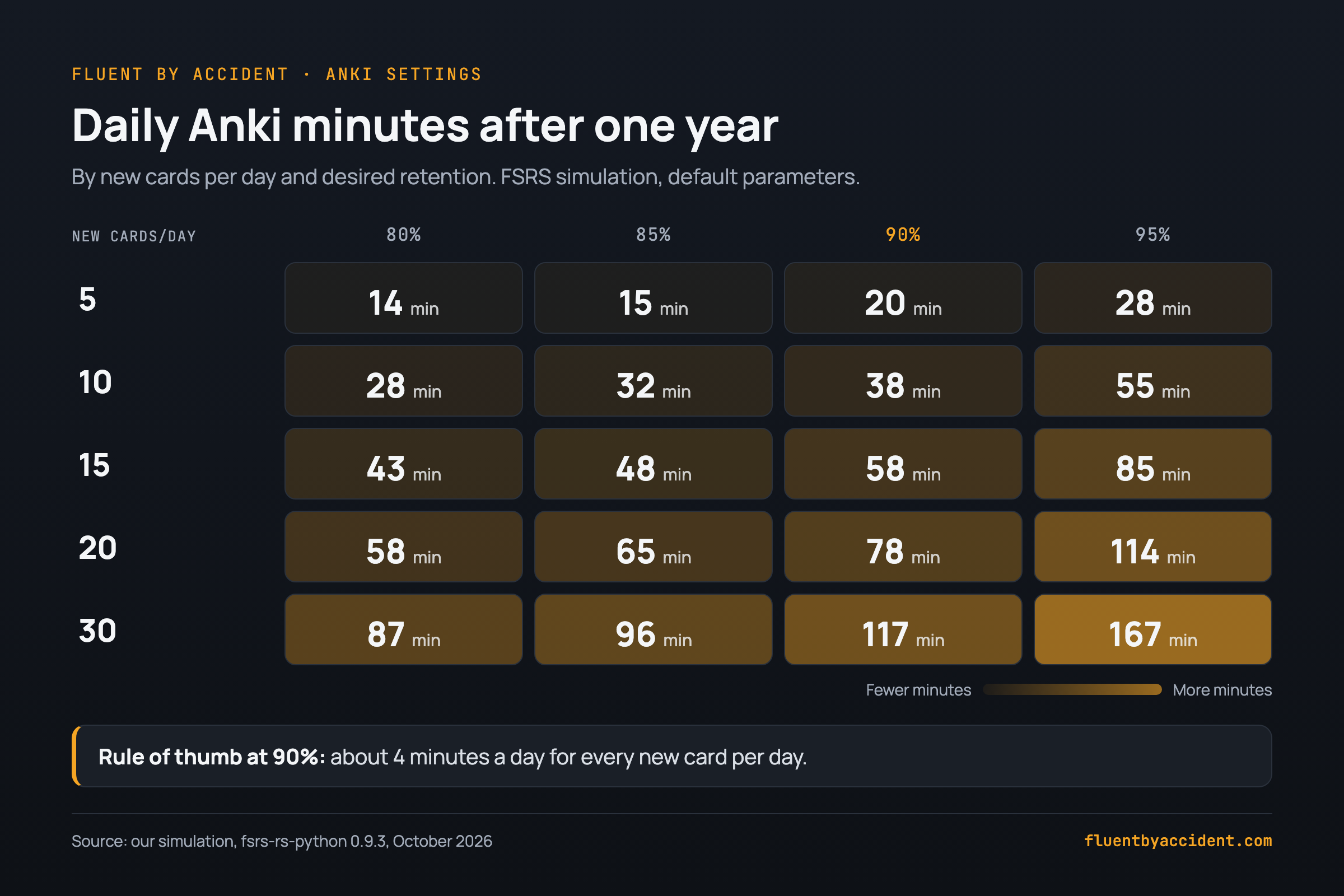
Pick your row by the time you can really give Anki each day (our simulation, default FSRS parameters, minutes after one year):
| Time you can give Anki daily | New cards/day | Desired retention | Minutes/day after a year |
|---|---|---|---|
| About 15 min | 5 | 0.85 | 15 |
| About 30 min | 10 | 0.85 | 32 |
| About 45 min | 15 | 0.85 | 48 |
| About 60 min | 15 | 0.90 | 58 |
| About 80 min | 20 | 0.90 | 78 |
- Set the limit before you import a big shared deck, not after.
- With a backlog, stop adding new cards until you catch up, as the manual suggests.
- Reversed cards count twice. A "Basic (and reversed card)" note makes two cards, front to back and back to front (Anki Manual), so 10 new notes can mean 20 new cards.
How we got these numbers: fsrs-rs-python 0.9.3 (the Python binding of the FSRS library Anki uses), default FSRS-6 parameters, five runs averaged (fsrs-rs-python). Review times are the library's defaults, about 8 to 20 seconds per press, and every card behaves like an average card (fsrs-rs simulator). Audio and long sentences take longer, so run Help Me Decide on your own deck.
What learning steps should you use with FSRS?
The rule for Anki learning steps with FSRS: keep every learning and relearning step short enough to finish the same day. The manual names 10m or 30m as good and advises against even 23h (Anki Manual); Anki warns if you enter 1 day or more (Anki source). Long steps also stop FSRS from choosing the first interval.
Fewer steps is better: the manual says same-day repeats add little to long-term memory. In our simulation, one learning step instead of two cut about 12% of the year's study time (18,923 minutes instead of 21,427). The simulator does not model same-day memory, so read that as time saved only.
Blank steps? Anki allows them since 24.11, but the manual calls this experimental. FSRS author Jarrett Ye said FSRS-5 was not built to model short-term memory and that he "never suggested that anyone should leave learning steps blank" (r/Anki). A frequent r/Anki helper agrees it "isn't recommended for most users" (r/Anki).
For data-based steps, the FSRS Helper add-on's Steps Stats recommends steps from your own reviews (FSRS Helper). One AnkiWeb forum answer lists 10m, 15m, 20m or 30m as reasonable single steps (forum thread). With one 15m step, Again means 15 minutes, Hard about 23 minutes (1.5 times the step), and Good lets FSRS decide.
Tip: press Again whenever you forgot, even if you almost had it. Hard means you remembered with effort. If you press Hard on misses, all your intervals end up too long (Anki Manual, Studying). Using only Again and Good is fine; the FSRS FAQ says it can even be more accurate.
Anki settings advice you can ignore in 2026
Much of the advice that ranks today was written for SM-2. Here is what current Anki says instead.
| Common advice | What current Anki says | Source |
|---|---|---|
| "Use learning steps 1m 10m 1d (or 10m 1d 3d)" | Steps of 1 day or more are not recommended with FSRS; Anki shows a warning | Anki Manual |
| "Set graduating interval to 3-4 days, starting ease 250%, tweak the interval modifier" | Hidden under FSRS; they only apply to SM-2 | Anki Manual |
| "Cap maximum interval at 120-180 days" | "A maximum interval less than 6 months is not recommended." In our two-year simulation, a 180-day cap added about 8% more reviews for about 1% more remembered cards | Anki source, our simulation |
| "Use Compute minimum recommended retention" | Removed in Anki 25.07; use Help Me Decide instead | Anki Manual |
| "Leave learning steps blank, FSRS handles it" | Experimental; FSRS was not designed to model short-term memory | FSRS author on r/Anki |
| "Copy the FSRS parameters from a good guide" | Never copy or hand-edit them; optimize on your own reviews | Anki Manual |
| "Turn on Reschedule cards on change when you switch" | Not recommended for the first switch from SM-2; it adds a review entry to every card | Anki Manual |
| "Press Hard when you half-remember a word you got wrong" | Hard counts as a pass; any miss is Again | Anki Manual |
When a guide tells you to change a setting your Anki does not show, it was probably written for SM-2.
Your cards matter more than your settings
Settings decide when a card comes back. The card decides whether the word sticks. A card that reaches 8 lapses becomes a leech, and the manual says editing it is the most efficient fix (Anki Manual, Leeches). A leech is a signal to rewrite the card, not to change your settings. Make fewer, better cards: a real sentence you heard, ideally with audio.
If your cards come from shows, the habit of saving 5 to 10 words per episode keeps new cards inside the limits above. A word met in a scene comes with a voice and a situation, which is part of why TV shows work as comprehensible input. For card sources, try these Netflix shows for Spanish learners, sorted by level.
Weekly 5-minute check: Is your True Retention near your desired retention? Are your reviews per day under your time budget? Any new leeches to rewrite?
If you collect words while watching Netflix or YouTube with Fluent by Accident, you can export them as a CSV file and import them into Anki, then use the settings above.
FAQ
Should I use FSRS or SM-2 for language learning?
FSRS, for almost everyone on a current version of Anki. The manual describes it as more accurate than SM-2 and says it can help you remember more in the same study time (Anki Manual). The only reason to wait is a synced device you cannot update: FSRS needs Anki or AnkiMobile 23.10 or newer and AnkiDroid 2.17 or newer. FSRS learns from your existing review history when you optimize. Expect longer first intervals and shorter ones for mature cards than under SM-2 (FSRS FAQ).
Should I leave learning steps blank with FSRS?
Usually no. Anki has allowed blank steps since 24.11, but the manual calls the feature experimental, and the FSRS author has said FSRS-5 was not designed to model short-term memory (r/Anki). Set one learning step between 10m and 30m and one relearning step of about 10m instead. For steps based on your own data, the Steps Stats in the FSRS Helper add-on recommend at most two learning steps and one relearning step (FSRS Helper).
How often should I optimize FSRS parameters?
About once a month is enough, says the manual. The FSRS FAQ adds another rule: optimize again each time your total review count doubles (FSRS FAQ). Since Anki 24.06.3 the optimizer works with any number of reviews, so you can click it from day one. Use Optimize All Presets if you have several. Never paste parameters from a guide or a friend: they describe someone else's memory.
Do these settings work in AnkiDroid and AnkiMobile?
Yes. Deck options sync through AnkiWeb, so the same presets apply on your computer and phone. Every client you use must support FSRS: Anki and AnkiMobile 23.10 or newer, AnkiDroid 2.17 or newer (Anki source). Update all devices before you turn FSRS on, then sync. The best AnkiDroid settings for language learning are the same as on desktop: FSRS on, 90% desired retention, one short step, a new-card limit that fits your time.
What should my maximum interval be in Anki?
Leave it at the default of 36,500 days. Anki warns against anything under 6 months, and the manual notes that a shorter cap means more work (Anki Manual). In our two-year simulation at 20 new cards a day and 90%, a 180-day cap raised reviews from about 330 to 357 a day (8% more) for 1% more remembered cards. To see old words more often, raise desired retention a little instead, which shortens all intervals (FSRS FAQ).
Can I use only the Again and Good buttons?
Yes. The manual says you can use only Again and Good (Anki Manual, Studying), and the FSRS FAQ says FSRS may even be more accurate that way. The rule that matters is Again for every miss: if it would count as a fail in a real conversation, it is a fail in Anki. Pressing Hard on words you got wrong makes all your intervals too long.