Dubbed vs subtitled: which is better for language learning?
Original audio beats a dub for most learners, but a dub of a film you already know is a strong beginner tool. Here is which audio track to pick at each level, and why.
For learning, watch in the original audio of your target language with subtitles you can handle; a dub into your target language is a good second choice, especially a film you already know when you are a beginner. A dub into your own language with target-language subtitles helps only at the very start.
The strongest evidence on dubbed vs subtitled language learning points the same way. A 2025 study by Baumeister, Hanushek and Woessmann found that European countries which subtitle foreign TV, and so keep the original English audio, show "a large positive effect of subtitling on English-language skills of over one standard deviation," and the effect "is larger for listening and speaking skills than for reading." In other words, hearing the real voices matters more than reading the words.
How we tested: This is a research comparison, not a viewing experiment. On November 9, 2026 we read the 2025 IZA/NBER paper, The Conversation's summary of the Bairstow and Lavaur studies, and the top search results for this question. We did not run our own measurements, so every number below comes from a cited source.
Is it better to watch dubbed or subtitled to learn a language?
Most "sub vs dub" debates mix up the audio track and the subtitle track. For a learner, the audio choice comes first. Subtitles can be switched, faded and swapped later (we cover what research says about subtitles in a separate post, so we will not repeat it here).
There are three realistic audio setups when you sit down to watch:
| Setup | What you hear | What it trains | Best level |
|---|---|---|---|
| A. Original target-language audio (a Spanish show in Spanish) | Native actors, real rhythm, real intonation, lips that match the words | Listening as it is actually spoken; the closest thing to real conversation | Intermediate and advanced; beginners with easy content and support subtitles |
| B. Target-language dub of a foreign film (an American film dubbed into Spanish) | Professional voice actors reading an adapted script | Clear, studio-quality listening; works well when you already know the plot | Beginners and lower intermediates |
| C. Native-language dub + target-language subtitles (Spanish film dubbed into English, Spanish subtitles) | Your own language | Reading and word links between your language and the target language; almost no listening | The very start only |
Setup A is the goal. Setup B is a bridge many learners dismiss too quickly. Setup C helps beginners but trains reading, not your ear, so keep it short.
What the research says about dubbing vs subtitling
The best large-scale evidence comes from Europe, where each country picked dubbing or subtitling almost a century ago. The NBER summary of the 2025 paper explains that these choices "are historical, generally made soon after sound films emerged in the 1920s." Subtitling countries include the Nordic countries and the Netherlands; dubbing countries include France, Germany, Italy and Spain.
The key point for this article: "Subtitling exposes viewers to the English voice track, while dubbing does not." So the study is really a test of original audio vs dubbed audio, measured across whole populations.
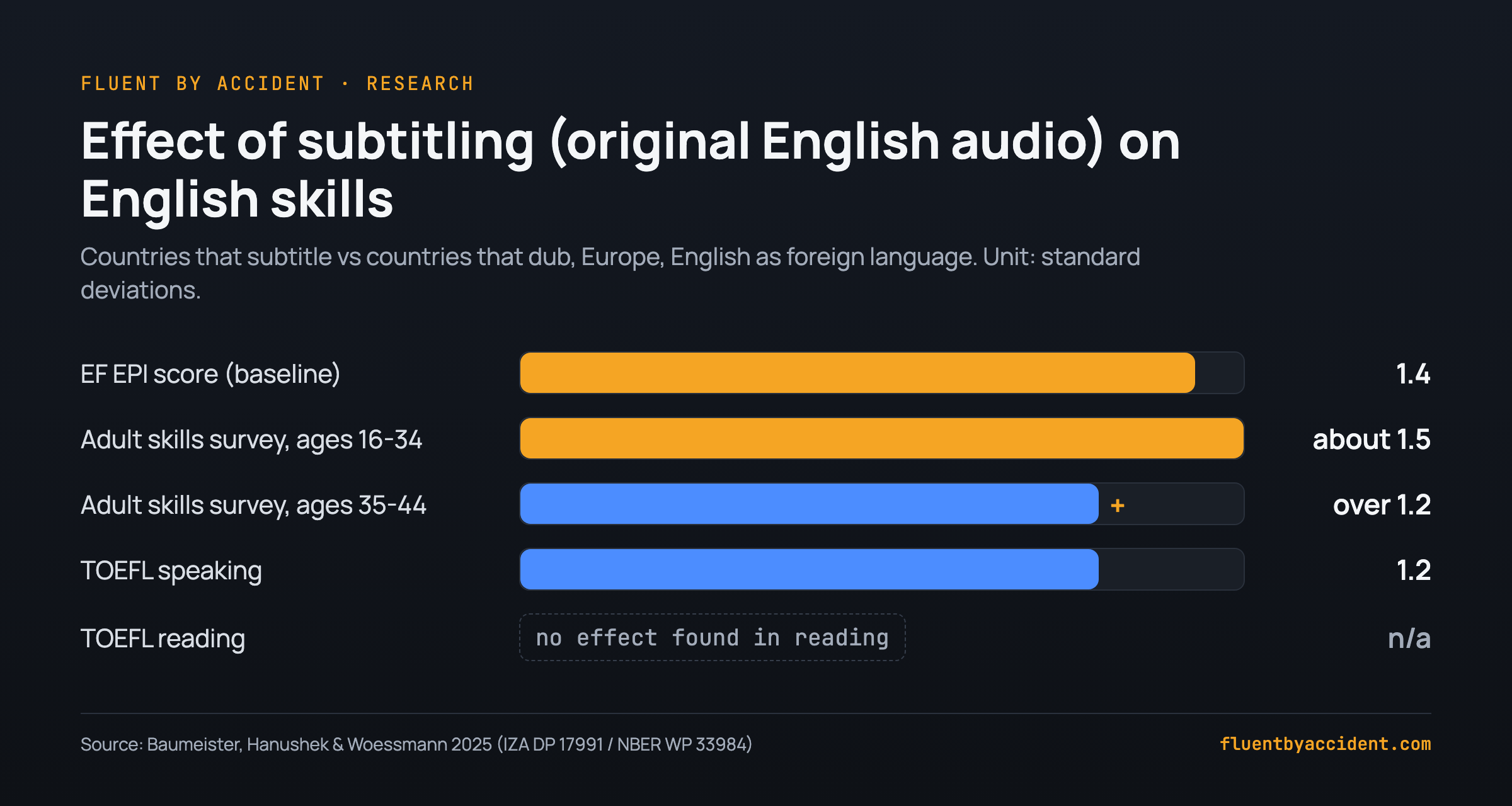
The numbers from the NBER digest:
- On EF EPI English scores, "the baseline estimate of the subtitling effect" is 1.4 standard deviations.
- In an adult skills survey, the effect is "about 1.5 standard deviations in the youngest group (aged 16–34) but also exceeds 1.2 standard deviations for those between ages 35–44."
- On TOEFL, the effect reaches "1.2 standard deviations in speaking but not reading."
That split matters: if subtitles alone did the work, reading would improve too. Instead, the gains show up in the skills you build by hearing a language. The digest even notes that in many developed countries, "time spent watching TV is equivalent to time spent in school."
Caveat: This is a country-level comparison with English as the foreign language, not an experiment on individual viewers. The authors note their estimates also include effects passed on through parents and teachers. It suggests that original audio helps; it does not prove that your next episode in Spanish will raise your score by a set amount.
How lip-sync dubbing changes what actors say
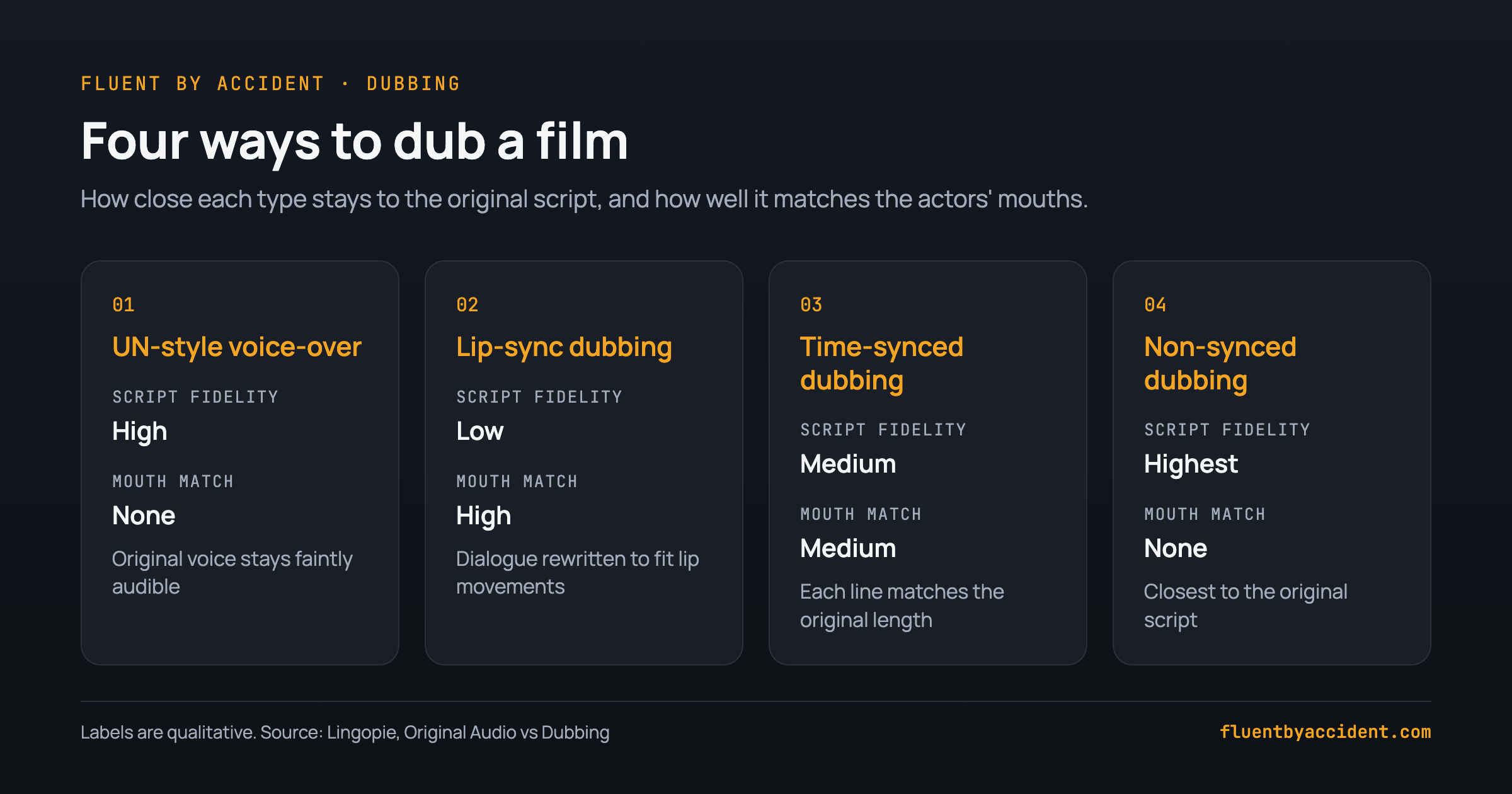
A dub is not a recording of the original script in a new language. It is a new script. Lingopie's guide to dubbing describes the main types:
- Lip-sync dubbing: "the foreign language dubbed audio is written to match the actor's lip movements as much as possible." The cost, in their words: "the original dialogue has to be changed quite significantly to make the lip movements work in the new language."
- Time-synced dubbing: each new line is "the exact same length as the line of the original speaker."
- Non-synced dubbing: no attempt to match mouths, which "can be the most faithful to the original script."
- UN-style voice-over: the original voice stays faintly audible under a translator's voice.
What this means for learning:
- Dub subtitles often do not match dub audio. Subtitles are usually translated from the original script, while the dub was rewritten to fit mouths. Expect lines that say the same thing in different words: two translations, not a player bug.
- Original audio matches the faces. Mouth shapes, pauses and emotion line up with the words.
- Tone and rhythm survive only in the original. Lingopie points out that for Chinese, "listening to the original voices in a Chinese-language show will benefit your understanding of how tone impacts meaning." The same logic applies to stress and intonation in any language.
None of this makes dubs useless: dub actors are native speakers with clear studio diction. You are just hearing a translation.
Should you watch a movie you know dubbed in your target language?
Yes, if you are a beginner or lower intermediate. Experts disagree here, so it helps to see both sides.
Migaku's 2026 guide says "Disney movies dubbed in your target language work surprisingly well because you probably already know the plot." The same page also says "Don't watch dubbed versions in your target language," warning that an American show dubbed into Japanese "teaches you weird, unnatural phrasing." Lingopie's view of the familiar-film trick is that "this is not a great idea either."
Both warnings are fair at higher levels. At the start, though, a known story frees all your attention for sound: you match words you hear to meaning you already have. Animated films are a good place to begin, because the dialogue is usually clear.
Here is a complete routine you can use tonight.
Known-film routine:
- Pick a film you have seen at least once in your own language, ideally one you liked enough to rewatch. Animated films and family films are easiest.
- Check that the platform offers both audio and subtitles in your target language for it. The two tracks will often differ in wording (see the dubbing section above).
- First pass: watch 20 to 30 minutes with target-language audio and your own language on the subtitles. Do not pause; just follow the story by ear.
- Second pass on the same scenes: switch subtitles to the target language. Pause on lines you nearly understood and save 5 to 10 useful phrases, not every unknown word.
- Rewatch one 3 to 5 minute scene with no subtitles. Note how much more you catch.
- Repeat over a few evenings until you finish the film.
- Then move on: pick a show originally made in your target language and use the same steps. That is your move from Setup B to Setup A.
A dub of a known film is training wheels for your ear, not a place to stay.
Dubbed or subtitled by level: beginner, intermediate, advanced
The most useful level data comes from two studies by Bairstow and Lavaur, summarized by The Conversation. In one, French speakers with modest English watched a film in several versions. The viewers who saw the "inverted version (French dialogue and English subtitles) got the best results in terms of being able to reconstruct the film dialogue."
In the second study (Lavaur and Bairstow, 2011), learners at three levels watched either the original film without subtitles, a same-language version (foreign audio and foreign subtitles), classic subtitles, or the inverse version (native audio, foreign subtitles). The results:
- Beginners "got their best results in the two 'different language' formats," and best of all with the inverse version.
- Intermediates scored "the same across the different versions."
- Advanced learners "saw their comprehension levels decline when subtitles appeared on the screen."
So the right audio track depends on where you are. Here is the "which track tonight" decision table, combining those findings with the audio setups above.
| Your level | Audio track | Subtitle setup | Example content |
|---|---|---|---|
| Absolute beginner (first weeks) | Your own language, short sessions (Setup C) | Target language | A target-language film dubbed into your language, or your own shows with target-language subtitles |
| Beginner | Target-language dub of a film you know (Setup B) | Your language first, then target language | Animated or family films you have already seen |
| Lower intermediate | Original target-language audio, easy content (Setup A) | Target language, or two lines at once | Sitcoms, slow dramas, kids' shows made in the target language |
| Intermediate | Original target-language audio (Setup A) | Target language; any setup works, so pick what keeps you watching | Original series in your target language |
| Advanced | Original target-language audio (Setup A) | Off, or only for hard scenes | Fast dialogue, regional accents, comedy |
The subtitle column is where most learners get stuck. For a full walkthrough of which language to put on each subtitle line, and for a plan to fade dual subtitles out as you improve, see those two guides. This article only settles the audio question.
Sub or dub for anime and Japanese?
Sub, with the original Japanese audio. Anime is made in Japanese, so the Japanese track is the original performance: the timing, the emotion and the speech patterns were all written for it. An English dub is an adapted script, with all the lip-sync rewriting described above.
Use an English dub only for a first look at a plot that is too dense for you.
Tip: Try a two-pass approach for a hard episode. Pass one: English dub or English subtitles, just to follow the story. Pass two: Japanese audio with Japanese subtitles (or Japanese plus English on two lines), pausing to save a few phrases. Because you already know the plot, the second pass works like the known-film routine above. For tools that work on each streaming site, see our guide to anime subtitle tools by platform.
Also note Migaku's warning: an American show dubbed into Japanese is weaker practice than content made in Japanese.
How to find original-audio shows and switch audio on Netflix
Two small skills make Setup A easy: finding shows originally made in your target language, and switching the audio track.
Steps:
- Find originals. Netflix's Browse by Language page lets you filter titles by their original language, separately from titles that only have a dub or subtitles in that language. Filter by original language for Setup A.
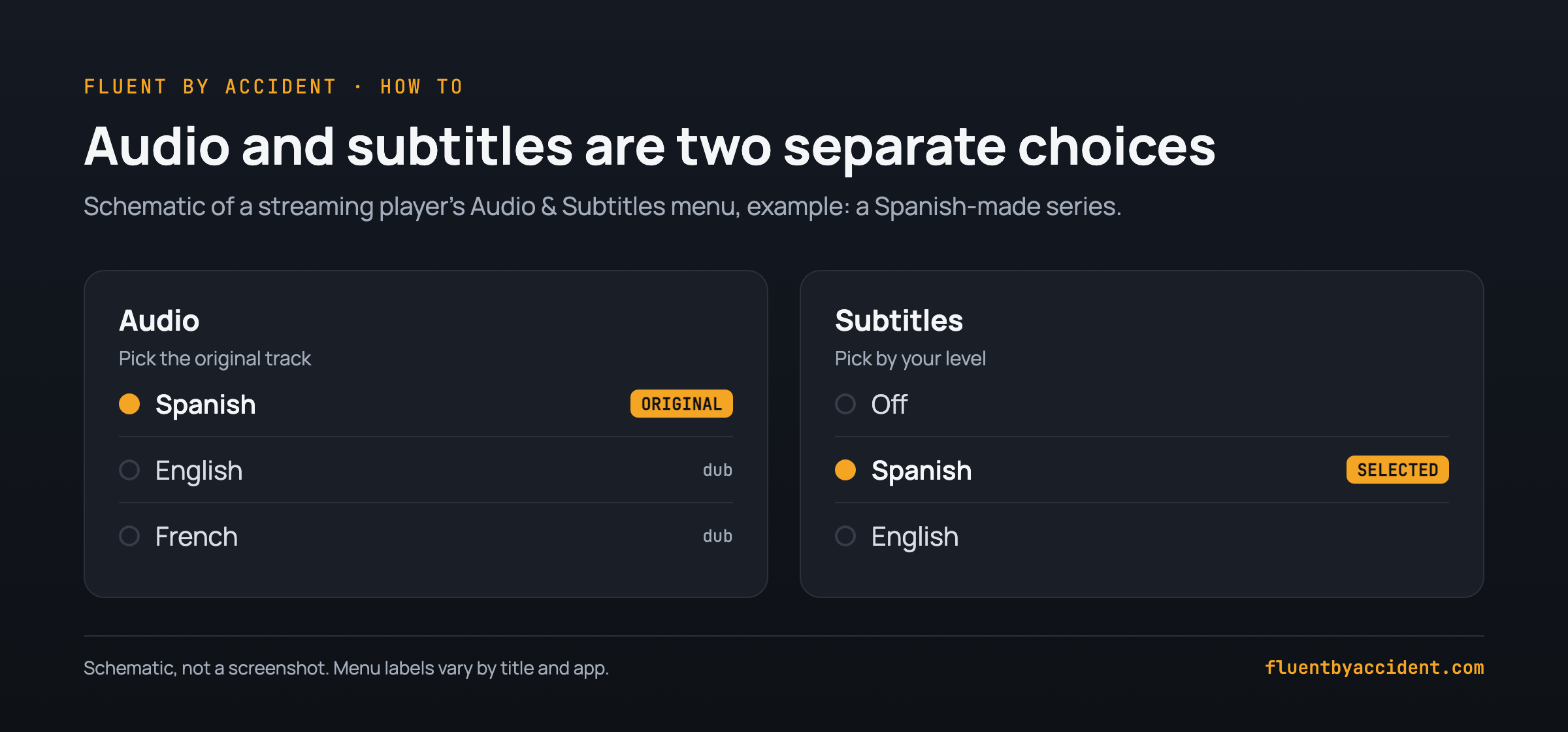
- Switch the audio. Start the title, open the player's Audio & Subtitles menu and pick the audio track. On many titles the original language is marked "Original."
- Pick subtitles separately. Audio and subtitles are independent choices in that same menu, so you can combine them the way the level table above suggests.
- Slow down hard scenes. If original audio feels too fast, slow down Netflix playback instead of switching to a dub.
- Choose by level. For Spanish, our list of Netflix shows for Spanish learners by level is a ready shortlist.
Before you start a new original-audio show, it helps to know the words that will come up most. You can pull the vocabulary from a subtitle file with the free subtitle vocabulary tool, or start with a list of the most common Spanish words. If you want two subtitle lines and click-to-translate on top of whatever audio track you chose, that is what Fluent by Accident does in Chrome; it reads subtitle tracks and leaves the audio choice to the player.
FAQ
Is watching dubbed movies good for learning a language?
It depends on which dub. A dub into your target language still gives you native-speaker audio, so it is real listening practice, especially for beginners watching a film they already know. Its weakness is that the script is adapted, often heavily for lip-sync, so the wording is not what people would naturally have written for that scene. A dub into your own language gives you almost no listening practice. Country-level research from 2025 found that populations that hear original English audio score over one standard deviation higher in English, with the biggest gains in listening and speaking. Treat target-language dubs as a stepping stone toward original audio.
Should I watch a movie I already know dubbed in my target language?
Yes, as a beginner. When you already know the plot, you do not spend attention on following the story, so you can focus on matching sounds to meaning. Animated and family films work well because the dialogue is clear. Some guides warn that dubs teach unnatural phrasing, and that is a fair point at higher levels. A good approach: watch with target-language audio and your own subtitles first, then rewatch scenes with target-language subtitles and save a handful of phrases. Once that feels comfortable, move to shows originally made in your target language and repeat the same steps.
Is sub or dub better for learning Japanese?
Sub, meaning original Japanese audio. Anime and Japanese dramas are performed in Japanese, so that track carries the real timing, emotion and speech patterns. An English dub is a rewritten script and gives you no Japanese listening practice. The one sensible use of an English dub is a quick first pass to understand a confusing plot, followed by a second pass in Japanese. Pair Japanese audio with Japanese or dual subtitles as your level allows.
Why do countries that subtitle TV speak better English?
Because subtitling keeps the original English voice track, while dubbing replaces it. A 2025 study by Baumeister, Hanushek and Woessmann compared European countries that subtitle (such as the Nordic countries and the Netherlands) with countries that dub (such as France, Germany, Italy and Spain). They found an effect of over one standard deviation on English skills, larger for listening and speaking than for reading. On TOEFL, the effect reached 1.2 standard deviations in speaking but not in reading. The comparison is country-level, so it describes populations, not individual viewers.
Do dubbed shows teach unnatural language?
Partly. Lip-sync dubbing rewrites dialogue so the new words fit the actors' mouths, which can push the script away from how a native writer would phrase the scene. Migaku's guide warns that an American show dubbed into Japanese "teaches you weird, unnatural phrasing." Dub actors are native speakers, though, so the risk is mostly in idioms and phrasing, and it grows as you advance. For beginners the clear studio audio often outweighs it. For intermediate and advanced learners, original audio is the better source of natural speech.
Can I watch with dubbed audio and target-language subtitles?
Yes, but expect mismatches. On most streaming titles, the subtitle track and the dub audio come from different translations: subtitles are usually translated from the original script, while the dub was rewritten to fit lip movements. So you will often read one sentence and hear another with the same meaning. If you want audio and text to match closely, use original target-language audio with target-language subtitles instead.
Sources
- Baumeister, Hanushek and Woessmann (2025). "Out-of-School Learning: Subtitling vs. Dubbing and the Acquisition of Foreign-Language Skills." IZA Discussion Paper No. 17991; also NBER Working Paper 33984. https://docs.iza.org/dp17991.pdf
- NBER Digest (October 2025). "Movie Subtitles and English Language Acquisition." https://www.nber.org/digest/202510/movie-subtitles-and-english-language-acquisition
- The Conversation. "Do subtitled films really help you learn languages?" (summary of Bairstow and Lavaur; Lavaur and Bairstow, 2011, International Journal of Psychology). https://theconversation.com/do-subtitled-films-really-help-you-learn-languages-216610
- Bairstow and Lavaur. "Audiovisual information processing by monolinguals and bilinguals: Effects of intralingual and interlingual subtitles." http://www.academia.edu/6093916/Audiovisual_Information_processing_by_monolinguals_and_bilinguals_Effects_of_Intralingual_and_interlingual_subtitles
- Lingopie. "Original Audio vs Dubbing: Why Dubbed Content Sucks for Language Learners." https://lingopie.com/blog/original-audio-vs-dubbing-why-dubbed-content-sucks-for-language-learners/
- Migaku. "How to Watch Foreign Movies to Learn Languages in 2026." https://migaku.com/blog/language-fun/how-to-watch-foreign-movies-for-language-learning
All pages checked on November 9, 2026.