Target language subtitles or native? A level-by-level roadmap
Native subtitles, dual, target language subtitles or none? A level-by-level roadmap with exit tests for each step, plus which subtitle track to pick per show, accent and language.

You start a Spanish show on Netflix, open the subtitle menu and see English, Spanish, Spanish (CC) and Off. With English on, you follow the plot but spend the episode reading. With Spanish on (target language subtitles), you catch words but fall behind on fast lines. With nothing on, you lose the thread in five minutes.
There is no single right setting, only a right one for your level and this show. The practical order: 1) native or dual subtitles while you follow the story through the translation; 2) dual with the target line in front once you recognize common words; 3) target language subtitles only once you understand most lines with them; 4) none once a familiar show still makes sense without them.
Why that order? In Birulés-Muntané and Soto-Faraco (2016), intermediate Spanish learners of English watched an hour-long episode of an English TV drama with English, Spanish or no subtitles. Listening improved most after the English-subtitled version, while plot comprehension was best with Spanish, their native language. Native subtitles help you follow the story; target subtitles help you learn the sounds.
Should you use target language subtitles or native subtitles? The roadmap at a glance
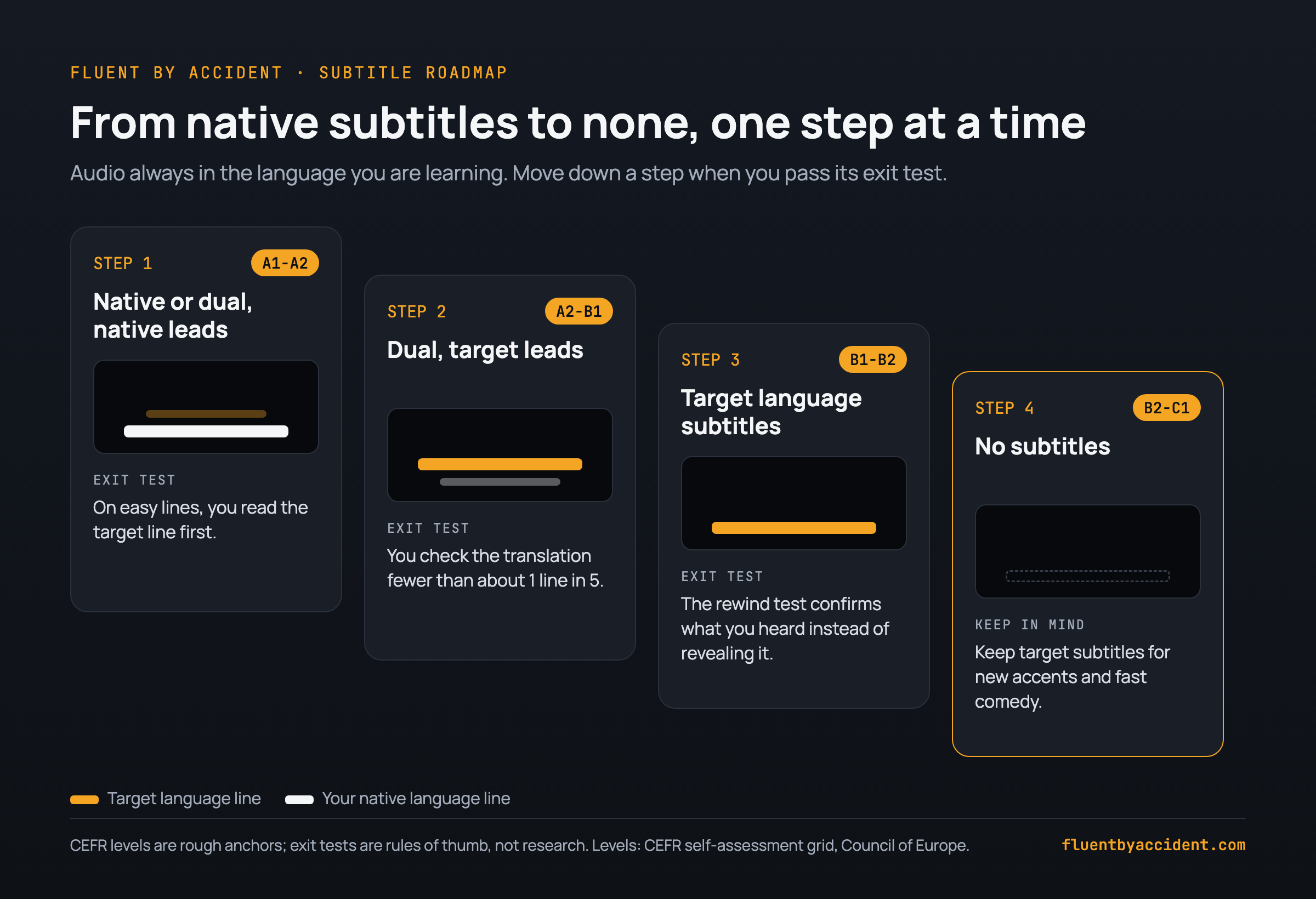
Four steps. The audio is always in the language you are learning; only the text changes.
- Native or dual, native line leading (about A1-A2). At A2 the CEFR expects you to "catch the main point in short, clear, simple messages and announcements" (CEFR self-assessment grid), so a full episode is still mostly out of reach. Watch learner content, children's shows, or a series you already know. Exit test: on easy lines, your eyes go to the target line first.
- Dual, target line leading (about A2-B1). Target line on top and bigger, native line smaller or blurred. Exit test: during a 2-minute scene, you check the native line for fewer than about 1 line in 5.
- Target language subtitles only (about B1-B2). At B1 you understand the main point of TV programs "when the delivery is relatively slow and clear". Exit test, the rewind test: watch 2 minutes with subtitles off, then rewind and watch the same 2 minutes with target language subtitles. If the second pass mostly confirms what you understood instead of revealing it, try a full episode without.
- No subtitles (about B2-C1). B2 means understanding "the majority of films in standard dialect", C1 "television programmes and films without too much effort". Keep target subtitles for new accents, fast comedy and mumbled dialogue.
The exit tests are our rules of thumb, not research findings. If a step does not work yet, step back up.
Tonight: pick the step that matches how you watch now, not the one you wish you were on, and run its exit test once.
Should you use English (native) subtitles? When they help and when they hold you back
Native subtitles earn their place in your first weeks, on a hard show you would otherwise quit, in the first episode of a new series and on tired evenings, because watching with support beats not watching.
The cost is that you read instead of listen. In Mitterer and McQueen (2009), Dutch listeners unfamiliar with Scottish and Australian accents were worse at repeating new fragments of that speech after Dutch subtitles and better after English ones. In a Norwegian classroom study, two age groups of teenagers watched Family Guy: both native and English subtitles beat no subtitles, though the authors found native subtitles "impact negatively on performance on the comprehension task"; in the older, more advanced group, the subtitle language made no difference (Vulchanova et al., 2015). One learner on the Language Reactor forum said that with native subtitles on, they "tend to read instead of listen" (March 2025).
For true beginners the picture is less clear-cut. Over a school year of 24 episodes, elementary-level teenagers showed no significant vocabulary advantage from captions (in research, same-language subtitles, not Netflix's [CC] track; Montero Perez, 2022) over native subtitles, and proficiency itself mattered (Muñoz, Pujadas and Pattemore, 2021). These studies are small and mostly short, so read them as a direction, not a law. Native subtitles in month one are fine; still using them in month twelve is the thing to fix.
| Setting | Best for | Watch out for | Evidence |
|---|---|---|---|
| Native subtitles | Following the plot, motivation | Reading replaces listening | Best plot comprehension (2016); worse accent learning (2009) |
| Dual subtitles | Learning what new words mean | Eyes drift to the translation | Beat native subtitles for meaning recall (2022) |
| Target language subtitles | Linking sounds to words, accents | Fast lines, condensed tracks | Listening (2016), accents (2009), vocabulary (2019) |
| No subtitles | Real-life listening | Missing too much stops being useful input | CEFR B2 and C1 (grid) |
Tonight: keep native subtitles for the first episode of anything new, and try dual from episode two. Or watch twice: first pass with native or dual subtitles for the story, second pass with target language subtitles for the sound.
Dual subtitles: the bridge between native and target
In an eye-tracking study with 112 intermediate to advanced Chinese learners of English, bilingual subtitles beat native subtitles for recalling word meanings but were weaker than captions for recognizing word forms. Learners spent more time on the translations, and only attention to the English words predicted learning (Wang and Pellicer-Sánchez, 2022). These were stronger learners than most people starting dual subtitles. So dual works when your eyes start on the target line.
Learners describe the opposite habit: one forum user says the native line keeps pulling their attention away from the target line (2023), another asked for a grayed-out native line (2026). The fix is to make the native line harder to read than the target one. For the full setup, see the dual subtitle method for Netflix.
Set up dual subtitles so they teach you:
- Put the target line on top, bigger and brighter.
- Make the native line smaller, dimmer or blurred until you need it.
- Reveal the translation one line at a time with a key.
- Once a week, watch one episode with the native line off.
Exit test (same as step 2 of the roadmap): during a 2-minute scene of an easy show, with the native line hidden, you reveal it for fewer than about 1 line in 5.
When to switch to target language subtitles only
Switch when you pass the step 2 exit test: you read the target line first and check the native line for fewer than about 1 line in 5. The payoff is listening. As Mitterer and McQueen put it, target subtitles show "which words (and hence sounds) are being spoken".
In Peters (2019), 142 Dutch-speaking learners watched an English documentary excerpt, and the captions group made the most vocabulary gains. One caveat: in Montero Perez, Peters and Desmet (2014), captions helped learners recognize word forms but did not affect comprehension, so do not expect understanding to jump the evening you switch.
Which track to pick. In the show's original language, Netflix has long offered a [CC] track (dialogue plus audio cues). Since April 2025, new Netflix originals also get a plain track that shows only the spoken dialogue.
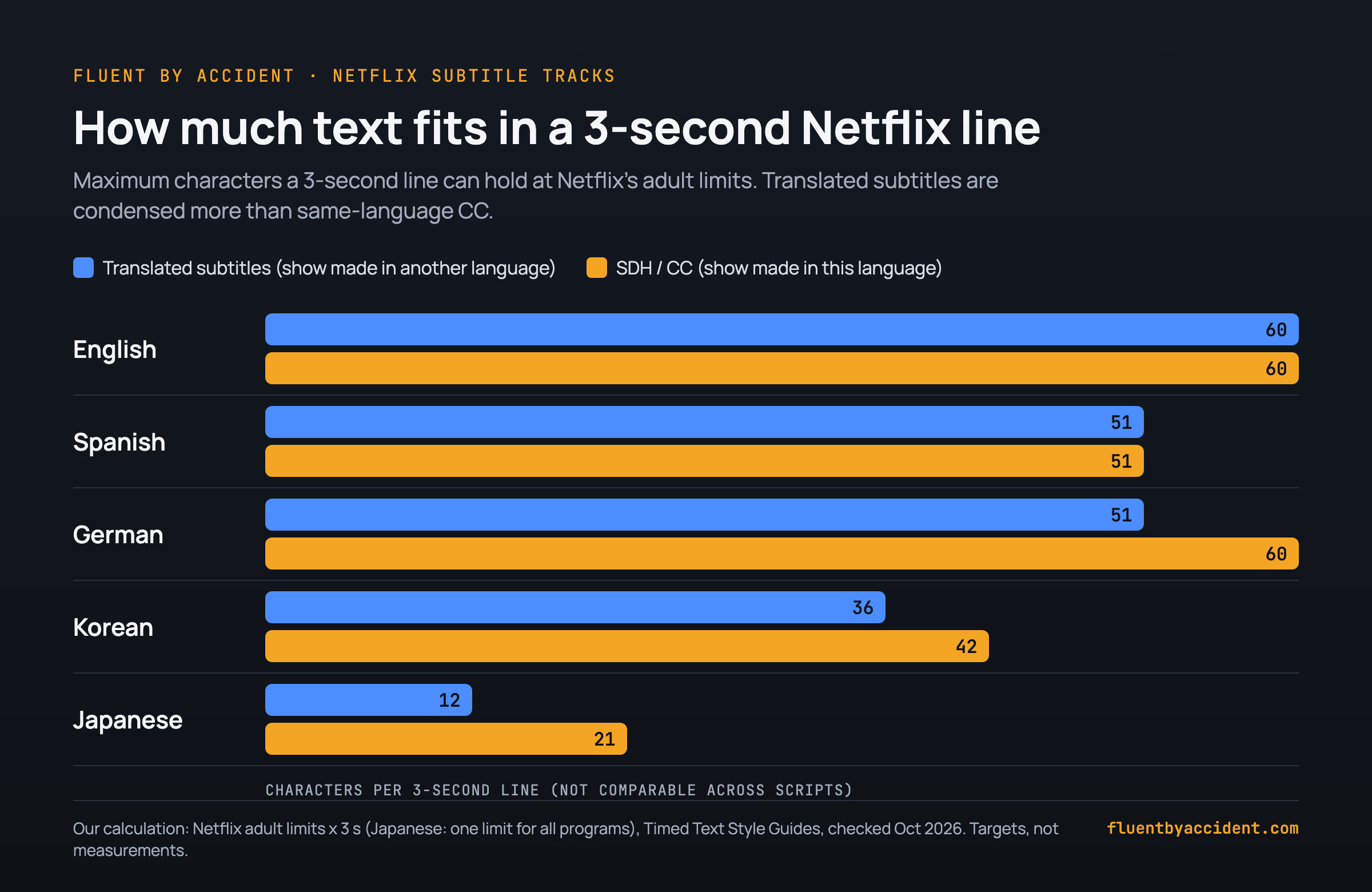
Translated subtitles, made for shows originally in another language, are capped at 4 characters per second in Japanese and, for adult programs, 17 in German and 12 in Korean. Same-language SDH (subtitles for the deaf and hard of hearing), the [CC] track that transcribes the audio, allows 7, 20 and 14 (Japanese, German, Korean guides). Spanish (17) and English (20) use one limit for both.
So a non-[CC] target-language track on a show made in another language is a translation, not a transcript of the dub. On a show made in your target language, [CC] is the transcript, though even German CC on Dark did not always match the audio for one user (2023). These limits are Netflix's targets, not measurements of every title.
Avoid dubbed audio for this step. On a dub, regular subtitles are translated from the original, not from the dub, and even SDH only matches it "as much as reading speed and timings allow" (English guide). Even original-language films can drift: one learner found Korean subtitles on Netflix in their country translated from the English ones, not from the Korean audio. A reply said subtitles usually match on films originally produced in the target language (2022-2023).
The safe rule: pick shows originally made in your target language. Not every title offers your target language subtitles in every country (Netflix Help).
Tonight: on a show originally made in your target language, watch one scene with the plain target track and then with [CC], and keep whichever is closer to what you hear.
When to stop using subtitles completely
The CEFR anchors are B2, "the majority of films in standard dialect", and C1, "television programmes and films without too much effort". Vocabulary is the other reality check. Across 88 TV programs, the most frequent 3,000 word families plus proper nouns gave about 95% coverage, and 98% took about 7,000 (Webb and Rodgers, 2009a); for movies, 98% took about 6,000 (American) to 7,000 (British) (Webb and Rodgers, 2009b). In a listening study, non-native participants showed relatively good comprehension at 95% coverage (van Zeeland and Schmitt, 2013).
So drop subtitles in slices, easiest material first: rewatches first, then a familiar series, then new shows in the same genre, then new genres. Subtitles are not only for learners: nearly half of all viewing hours on Netflix in the US happen with subtitles or captions on.
Ready to drop subtitles on this show? Answer yes or no:
- You can retell the point of each scene in a sentence.
- You rewind less than about once a minute.
- The rewind test confirms what you heard instead of revealing it.
- You are not exhausted after 20 minutes.
- You still enjoy the show.
Four or five yeses: next episode without subtitles. Fewer: another week on target subtitles.
Which subtitles for which show: genre, accent, dubs and rewatches
The setting belongs to the show, not to you. Webb and Rodgers found the vocabulary needed for 95% coverage ranged from 2,000 to 4,000 word families by TV genre, with "great variation in coverage between episodes" (2009a). So the same learner can be target-only on a slow drama and back on dual for a fast sitcom. Start from your usual step, then adjust:
| Situation | Start with | Why |
|---|---|---|
| Rewatch of an episode you saw | One step less support | You know the plot, so attention is free for the sound |
| New series, episode 1 | One step more support | New names and voices; step back down from episode 2 |
| New accent (Spain to Argentina, Paris to Quebec) | Target language subtitles for the first episodes | They helped listeners adapt to unfamiliar accents (2009) |
| Fast comedy, slang, mumbled crime drama | One step more support | Hard to hear even for advanced learners |
| Children's show or slow drama | One step less support | Vocabulary needs vary by genre (Webb and Rodgers) |
| Dubbed audio | Switch to the original audio; if you keep the dub, use [CC], which is meant to follow it | Non-CC subtitles are translated from the original, not the dub; even CC only matches "as much as reading speed and timings allow" (Netflix English guide) |
| Tired or background viewing | Whatever keeps you watching | Count it as relaxed input, not study |
Learning Spanish? Our Netflix shows to learn Spanish, by level sorts shows by difficulty.
Tonight: pick the row that matches tonight's show and adjust one step.
Learning Japanese, Korean or Chinese: should you use target language subtitles?
Yes, but later than in Spanish or French: target subtitles help listening only once you can read them at speed. On a show made in Japanese, the Japanese [CC] track follows the SDH limit: up to 7 characters per second and 16 per line. Japanese subtitles on shows made in another language are translations, capped at 4 per second (Japanese guide). Translated Simplified Chinese subtitles allow 9 per second (Chinese guide).
Worked example (our arithmetic from those limits): a 3-second line holds at most 7 x 3 = 21 characters on the Japanese [CC] track and 4 x 3 = 12 in translated Japanese subtitles. One kanji can carry a whole word, so these counts are not comparable with English letters.
Rule of thumb for non-Latin scripts: until you can read kana and common kanji (or hanzi) without stopping, target subtitles are reading practice, not a listening aid. Stay on dual longer and try target-only subtitles on rewatches first. Hangul is an alphabet, so for Korean the standard roadmap usually kicks in sooner.
A 4-week plan to move down one step
From any step, plan on 3 to 5 sessions a week, about one episode each.
| Week | What you watch | Setting | Check at the end |
|---|---|---|---|
| 1 | One easy series you like | Your current step | Note how often you rewind or reveal a line |
| 2 | Same series | Next step for the first 10 minutes, current step after | Run the rewind test once |
| 3 | Same series | Next step all episode, current step only for the hardest scenes | Can you retell each episode in 3 sentences, in either language? |
| 4 | A new episode of a familiar show, plus one rewatch | Next step everywhere | Understood fewer than about 3 lines in 4? Stay one more week |
The "3 in 4" cut-off is our rule of thumb, but the principle is solid: input you mostly do not understand stops teaching you, which is why watching shows teaches you a language only when you follow most of it. If a step leaves you lost, go back up one.
We build Fluent by Accident, a Chrome extension that shows both lines on Netflix, YouTube, Prime Video, Disney+ and Max.
FAQ
Should I use English subtitles when learning a language?
Early on, yes, if they keep you watching. In a 2016 study, plot comprehension was best with native subtitles (Birulés-Muntané and Soto-Faraco), so English subtitles help you follow a story you could not follow otherwise. The cost is that you read instead of listening, and native subtitles made it harder to adapt to an unfamiliar accent (Mitterer and McQueen, 2009). Use them in your first weeks and for the first episode of a new series, then move to dual subtitles with the target line on top.
Is it better to learn a language with or without subtitles?
It depends on your level and the show. Intermediate learners improved their listening more with target-language subtitles than with none (Birulés-Muntané and Soto-Faraco, 2016), and in another study the captions group made the most vocabulary gains (Peters, 2019). Watching without subtitles is the goal, which the CEFR places around B2 to C1 for films and TV. Until then, target subtitles usually teach more than none. If subtitles only confirm what you already heard, try without.
Are target language subtitles good for beginners?
They can overload you. One beginner on the Language Reactor forum, reading subtitles in the new language under English videos, said a full sentence "would overwhelm me" (2024). A year-long study with elementary-level teenagers also found no significant vocabulary advantage of captions over native subtitles at that level (Muñoz, Pujadas and Pattemore, 2021). For beginners, dual subtitles with easy content and rewatches usually work better. Switch to target-only once you read the target line first on most easy lines.
Why don't the subtitles match what they say?
Often the track is a translation, not a transcript: Netflix's guides treat regular subtitles as translations of content made in another language, and SDH/[CC] as the same-language transcript (German guide). Translated subtitles are also condensed harder (Japanese: 4 characters per second vs 7 for SDH, Japanese guide). Since April 2025, new Netflix originals also offer dialogue-only original-language subtitles. For the closest match, watch titles originally made in your target language.
Should I use subtitles when watching a show in a new accent?
Yes, target-language ones for the first few episodes, even if you normally watch without. In Mitterer and McQueen (2009), Dutch listeners unfamiliar with Scottish and Australian English got better at repeating new speech after watching with English subtitles and worse after Dutch ones. Target subtitles show which words are being spoken, so your ear learns how the new accent sounds them. Once you stop needing the text for most lines, step back to your usual setting.
Sources
- Birulés-Muntané and Soto-Faraco (2016), PLOS ONE
- Mitterer and McQueen (2009), PLOS ONE
- Vulchanova et al. (2015), Frontiers in Psychology
- Wang and Pellicer-Sánchez (2022), Language Learning
- Muñoz, Pujadas and Pattemore (2021), Second Language Research
- Peters (2019), TESOL Quarterly
- Montero Perez (2022), Language Teaching
- Montero Perez, Peters and Desmet (2014), Language Learning & Technology
- Webb and Rodgers (2009), TV programs and movies
- van Zeeland and Schmitt (2013), Applied Linguistics
- Council of Europe, CEFR self-assessment grid
- About Netflix, new subtitle experience (April 2025)
- Netflix Timed Text Style Guides: English, Spanish, German, Korean, Japanese, Simplified Chinese (checked October 2026)