Are dual subtitles good, or a crutch? How to fade them out
Are dual subtitles good for learning, or a crutch? What eye-tracking studies show about where your eyes really go, plus a 5-stage plan to fade the native line out.

You've watched a whole season with two subtitle lines and understood every joke. Then a clip plays without the bottom line, and you catch maybe half of it. Or you pause mid-episode and realize you read every line of the translation but couldn't repeat a single sentence you heard.
So, are dual subtitles good for learning? They are good for understanding a show you couldn't follow otherwise. In an eye-tracking study of 112 learners, dual subtitles matched native-language subtitles for comprehension and beat both target-language captions and no subtitles at all.
They turn into a crutch when your eyes live on the native line. In the same group of learners, the native line, shown on top, got about twice the reading time of the target line, and only attention to the target-language words predicted vocabulary gains. The fix is not to quit dual subtitles. It's to fade the native line out on purpose: put the target line on top, hide the translation until you need it, and count how often you peek.
Research checked: October 2026.
Are dual subtitles good for learning a language?
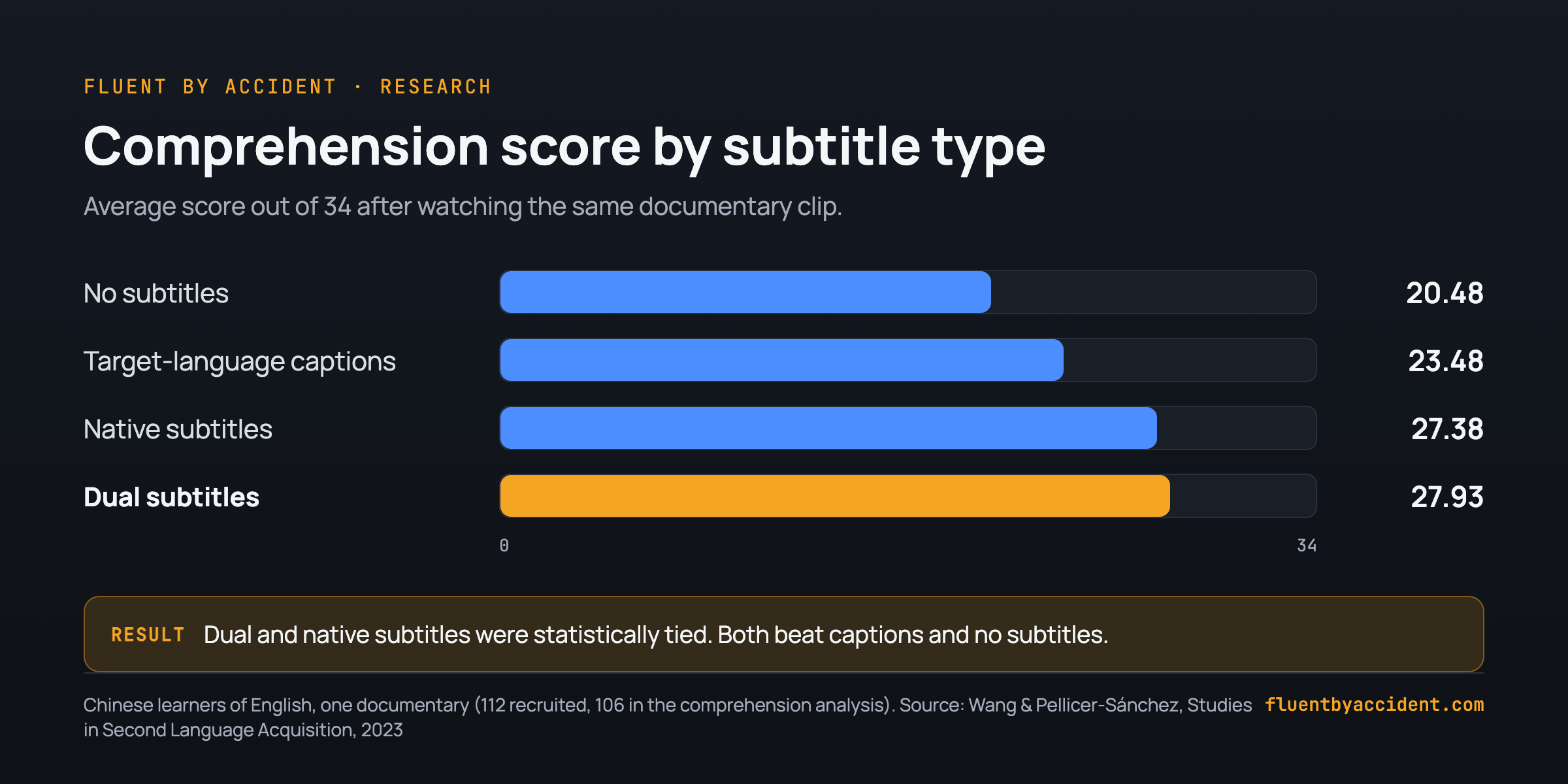
Start with the case for them, because it's stronger than Reddit suggests. In Wang and Pellicer-Sánchez (2023), 112 Chinese learners of English were split across four conditions and watched the same documentary; in the comprehension test (scored out of 34, 106 learners analyzed), the no-subtitle group averaged 20.48, the captions group 23.48, the native subtitle group 27.38 and the dual subtitle group 27.93. The dual and native groups were statistically tied, and both beat captions and no subtitles.
A second study points the same way. Dizon and Thanyawatpokin (2021) had 96 students in Japan watch one sitcom episode on Netflix in three groups of 32. The dual subtitle group scored highest on listening comprehension, and both the native and dual groups beat the captions group on vocabulary.
The first study used high-intermediate to low-advanced learners and one documentary. Its authors note that the Netflix study's dual group may have been more proficient, and that other studies found no consistent edge for dual subtitles. The fair verdict: good for comprehension, unproven as a shortcut to learning.
Why do people say dual subtitles are a crutch?
The same complaint comes up again and again on learner forums. A learner on the Language Reactor forum wrote in 2025 that with native subtitles on, they read instead of listening. Another, in 2026, said a translation shown up front in Language Reactor's flashcard review becomes an unavoidable crutch, because your eyes jump to what's familiar. One poster on r/languagelearning said that with English subtitles they feel they're just reading, while target-language subtitles leave them lost.
Not everyone treats it as all or nothing. One r/languagelearning commenter called native subtitles a crutch, but sometimes a valuable one. Another blurs the English line so the meaning doesn't get spoiled. One learner even listens better with native subtitles, because target-language text pulls them into reading.
Some claims go too far, like a 2022 comment that studies show native subtitles give 0% improvement.
| What learners say | What the research shows |
|---|---|
| "I end up reading, not listening" | Partly true. Dual subtitle viewers spent about 60% of viewing time on the subtitle area (Wang & Pellicer-Sánchez, 2023). |
| "My eyes go straight to the English line" | True in that study, though the native line sat on top. It got 42% of viewing time, the target line 20% (Wang & Pellicer-Sánchez, 2023). |
| "Native subtitles teach you nothing" | Overstated. Native and dual groups learned more words than a captions group (Dizon & Thanyawatpokin, 2021). |
| "Just don't look at the translation" | Hard to do. Viewers read subtitles whatever the condition (Bisson et al., 2014). |
Where do your eyes actually go with two subtitle lines?
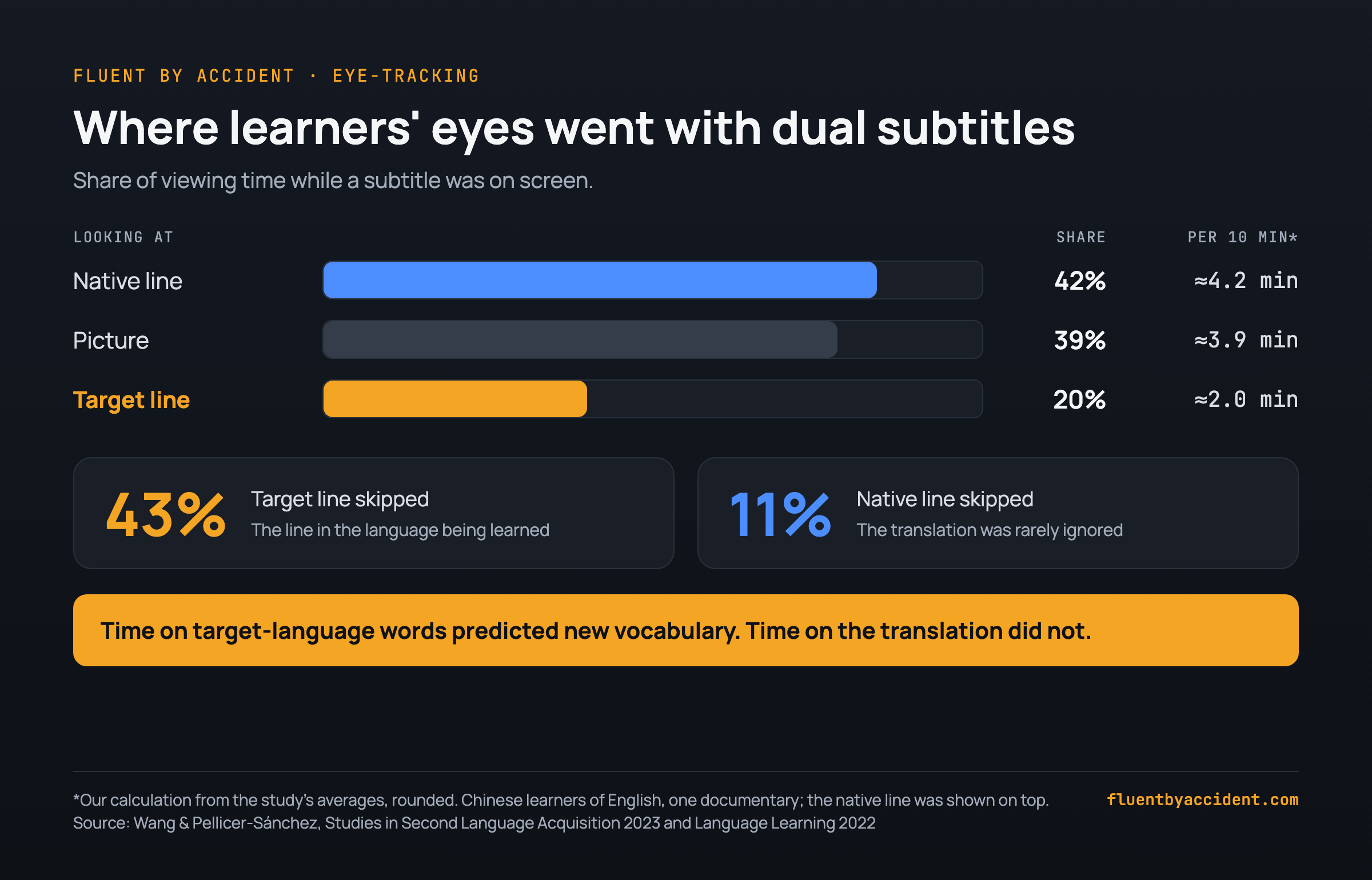
The 2023 eye-tracking study measured it: while a subtitle was on screen, the dual subtitle group spent 42% of viewing time on the native line and 20% on the target line. They skipped the target line 43% of the time and the native line only 11% of the time. One detail matters: the native line sat on top, which the authors flag as untested. They also caution that Chinese and English lines are read at different speeds, so the split is not a pure measure of preference.
The companion paper on vocabulary is where "crutch" stops being an opinion. With the same 112 learners, the dual group spent more time reading the translations of new words than the new English words themselves (English being the language they were learning). And the amount of attention to the English target words, not to the translations, predicted who learned them.
Here's what that looks like in everyday terms. This is our own arithmetic on the study's averages, not a result from the paper:
- Native line: 0.42 × 10 minutes = about 4.2 minutes
- Picture: 0.39 × 10 minutes = about 3.9 minutes
- Target line: 0.20 × 10 minutes = about 2.0 minutes
So for every 10 minutes with subtitles on screen, roughly 2 minutes go to the language you're trying to learn. The shares come from two tables and are rounded, so they add up to slightly more than 10.
Two caveats. A smaller study (16 viewers, cited in the 2023 paper) found a more even split. And the 2023 viewers watched to understand, not to study, which is how most couch viewing works: the native line wins unless you change the setup.
Do dual or native-language subtitles hurt your listening?
In Mitterer and McQueen (2009), 121 Dutch participants fluent in English watched 25 minutes of Scottish or Australian English with English, Dutch or no subtitles, then repeated audio fragments. On new Australian English fragments, the English subtitle group repeated 79% of the words correctly, the no-subtitle group 77% and the Dutch subtitle group 72%.
The authors read this as: subtitles in the spoken language help you tune in to an unfamiliar accent, while native-language subtitles get in the way. The gap was much smaller with the Scottish clips (83% with Dutch subtitles, 84% with none, 86% with English), though the authors found the accent did not change the overall pattern statistically. It was a lab task on accent adaptation in proficient listeners, not a verdict on all learning.
Words repeated correctly, new Australian English clips Dutch (native) subtitles 72% No subtitles 77% English (target) subtitles 79% Three groups of 20 Dutch listeners fluent in English (121 in the full study). Source: Mitterer & McQueen, PLoS ONE, 2009.What this means on the couch: when a show's accent, speed or slang is new to you, switch to target-language subtitles for a few episodes.
How to set up dual subtitles so they don't become a crutch
If you haven't set up two lines yet, start with our guide to setting up the dual subtitle method on Netflix. Then change four things.
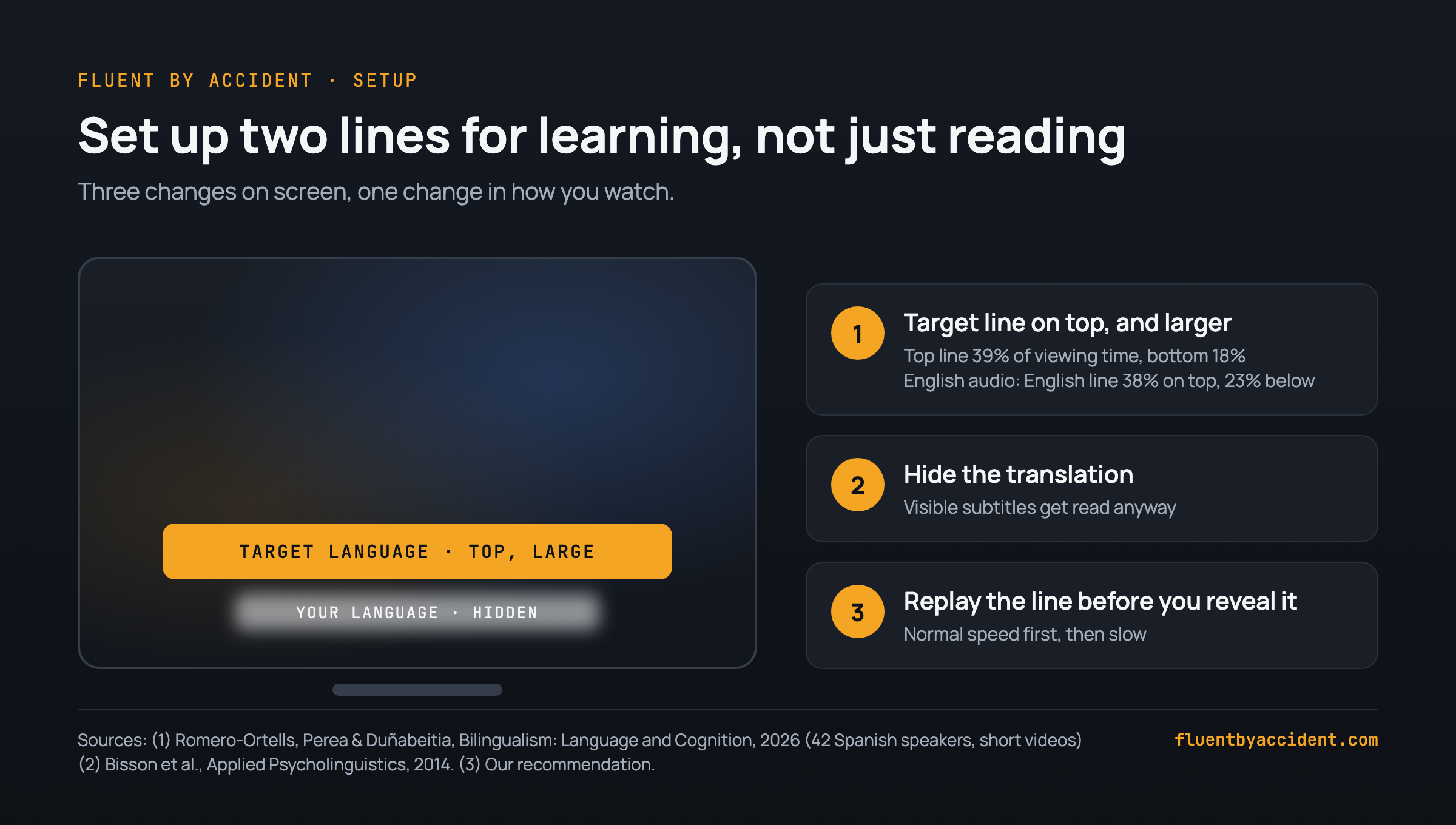
1. Put the target language on the top line. In a 2026 eye-tracking study of 42 Spanish speakers watching short videos, the top line got about twice the attention of the bottom one, whatever its language: 39% of viewing time on the top line against 18% on the bottom. With English audio and the native line on top, the native line got 49% of viewing time and the English line 23%, close to the 42% vs 20% split above. Swapping the lines moved the English line up to 38% and the native line down to 31% (Table 2).
It's a trade: the same study found slightly better comprehension with the native line on top. Moving the target line up is our reading of this study plus the vocabulary finding above, not something either paper tested.
2. Make the target line bigger and brighter. If your tool styles each line separately, give the target line the larger size and stronger color, and make the native line smaller and dimmer.
3. Hide the native line until you ask for it. People read visible subtitles irrespective of the subtitling condition, so promising yourself not to look won't hold. Hiding the line will: one learner even wrote a CSS blur userscript to hide the target line too, so they had to listen before reading.
4. Replay before you reveal. When you miss a line, rewind and hear it again, slower if your tool allows. Language Reactor, for example, pauses on a line for as long as you hold a key, so you can stop and replay before you look. Only reveal the translation after the replay fails.
How to fade out the native subtitle line: a 5-stage plan
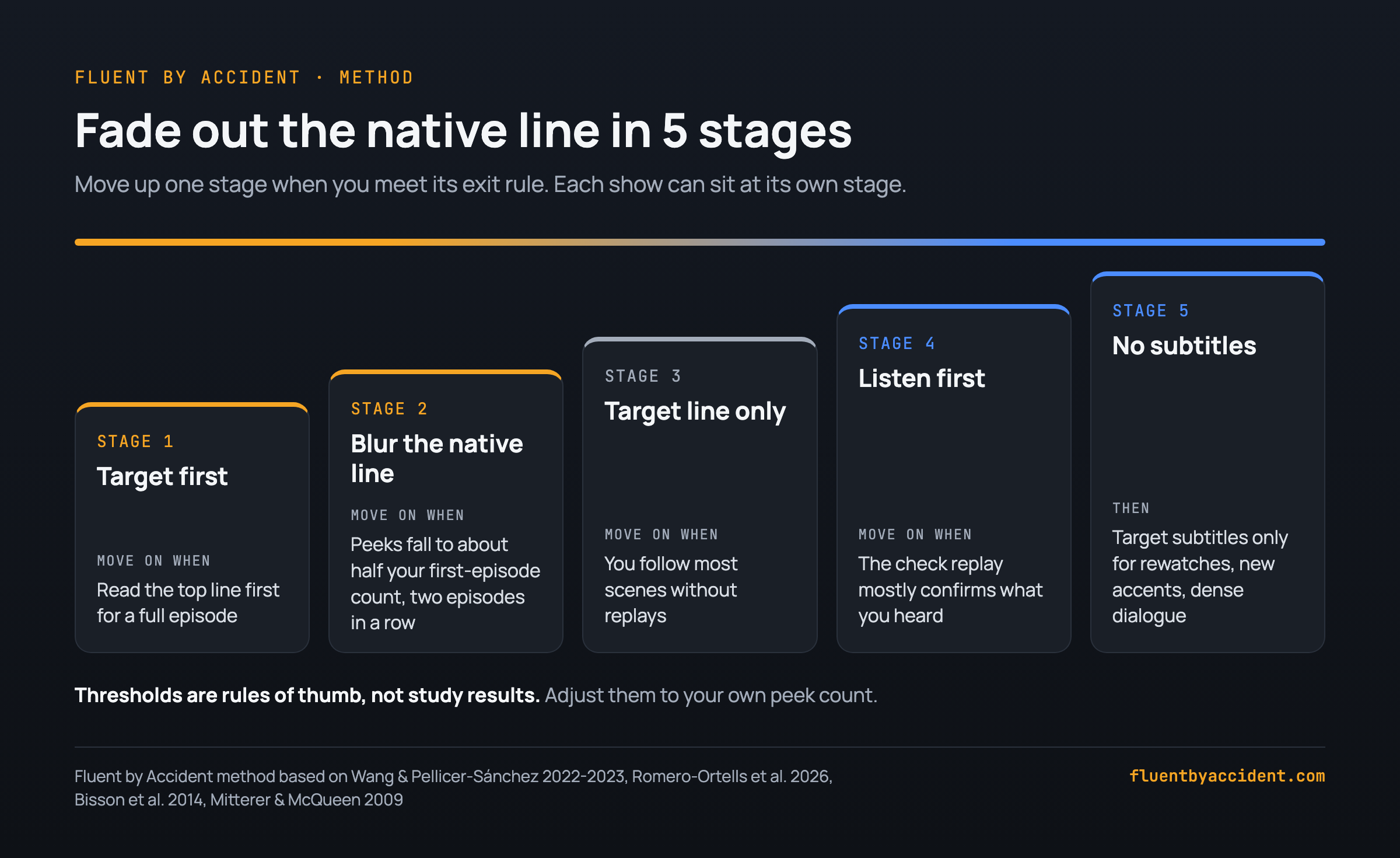
This plan is ours, built from the research above; adjust the thresholds to your own numbers. A "peek" is one reveal of the hidden translation.
| Stage | What's on screen | Your rule while watching | Move on when | Drop back when |
|---|---|---|---|---|
| 1. Target first | Both lines, target on top and larger | Read the top line first, every time. Glance down only after. | You read the top line first without effort for a full episode | Not needed |
| 2. Blur the native line | Translation hidden, revealed on hover or a key | Count every peek | Peeks per episode fall to about half your first-episode count, two episodes in a row | You peek on most lines: switch to an easier show instead of unblurring for good |
| 3. Target line only | Native line off | When lost, replay the line (normal, then slow). Turn the translation on only for a scene you still can't follow after two replays. | You follow most scenes without replays | A new show with a new accent or slang: back to stage 2 for a few episodes |
| 4. Listen first | No subtitles, then target subtitles on the replay | Watch a scene without text, then replay it with target subtitles to check. Easiest with an episode you've already seen at stage 2 or 3. | The check replay mostly confirms what you heard | You miss the gist of most scenes: back to stage 3 |
| 5. No subtitles | Nothing, by default | Use target subtitles for rewatches, new accents or dense dialogue | Stay here | Any show that feels like stage 2 again |
You can sit at different stages for different shows. A familiar sitcom might be at stage 4 while a slang-heavy crime drama is at stage 2.
The stage 2 drop-back rule matters most. If you peek on nearly every line, the show is too hard, and unblurring only trains reading. Pick something you mostly understand; here's why understandable input matters more than effort, and if you're learning Spanish, a list of easier Spanish shows sorted by level.
Stage 4 leans on the 2009 accent study, where target-language text helped listeners tune in. Stage 5 isn't a test of virtue, and there's no rush to reach it: one r/languagelearning commenter kept target-language subtitles until a few weeks before passing a B2 exam.
How do you know you're ready to drop the translation?
Keep a peek log: a tally of reveals per episode. It's a self-check, not a study finding.
Worked example (assumed numbers): you start stage 2 and peek 48 times in episode 1. Half of that is 48 ÷ 2 = 24, so your target is 24 or fewer, two episodes in a row.
Episodes 2, 3 and 4 come in at 41, 30 and 22. Episode 4 is under 24, but that's only once, so you watch one more at stage 2. Episode 5 lands at 23: two in a row at or under 24, so you move to stage 3.
Copy this template; the first five rows show the example.
| Date | Show and episode | Stage | Peeks | Replays | Note (accent, slang, new words) |
|---|---|---|---|---|---|
| Mon | Example show, ep. 1 | 2 | 48 | 12 | Baseline. Target: 24 or fewer |
| Tue | Example show, ep. 2 | 2 | 41 | 15 | Fast dialogue in the bar scene |
| Thu | Example show, ep. 3 | 2 | 30 | 14 | Peeks mostly on jokes |
| Sat | Example show, ep. 4 | 2 | 22 | 11 | Under 24: once |
| Sun | Example show, ep. 5 | 2 | 23 | 10 | Two in a row at or under 24: move to stage 3 |
Signs that the fade is working:
- You start noticing that the translation is loose, or plainly wrong.
- Your hand goes to the replay key before the reveal key.
- Your peeks cluster on idioms, jokes and slang, not on ordinary lines.
When dual subtitles are the right call
Keep both lines, guilt-free, for:
- A show far above your level that you're watching for fun.
- A brand-new language where you can't parse a line yet.
- Jokes, wordplay and dense plot, where missing one line loses the scene.
- Checking a line you've already replayed twice.
Rule of thumb: use the native line to understand, the target line to learn, and replay before you reveal.
If you use Fluent by Accident, its "Blur translation" setting keeps the bottom line hidden until you point at it or press T, and setting "Subtitles shown" to "Original only" gives you stage 3.
FAQ
Are dual subtitles good for beginners?
They help beginners understand what's happening on screen. In a 2023 study, dual subtitles matched native subtitles for comprehension, but the learners were high-intermediate to low-advanced, and the authors caution the results may not apply to lower levels or to people not used to reading two lines. A 2021 Netflix study did test beginners (A1-A2 students in Japan), and its dual subtitle group scored highest on listening comprehension, though that group may have been stronger to begin with.
If you're new to a language, start at stage 1 of the fade-out plan, with easier shows and slower, everyday dialogue.
Are dual subtitles better than target-language subtitles?
For understanding the plot, yes in one study: the dual group scored 27.93 out of 34 against 23.48 for target-language captions. For learning the words themselves it's less clear. In the companion vocabulary study, captions did better than dual subtitles at helping learners recognize the written form of new words, while dual subtitles did better at recognizing what new words meant. A practical split: use dual subtitles when you need to follow the story, and target-only subtitles when you want the words to stick.
How do I stop relying on subtitles?
Hide the line instead of resisting it, because research shows people read visible subtitles whatever they intend. Blur the translation so it appears only on hover or a key. When you miss a line, replay it once at normal speed and once slowly before you reveal anything.
Count your reveals per episode, and move to the next stage when the count falls to about half of your starting number two episodes in a row. If you're revealing almost every line, switch to an easier show rather than turning the translation back on.
Is it bad to watch with English subtitles when learning a language?
It isn't bad for enjoyment or for following the story, and native subtitles helped vocabulary in at least one Netflix-based study. The risk is listening. In a 2009 lab study, Dutch listeners who had subtitles in their own language adapted to an unfamiliar English accent less well than those who had English subtitles (the language they were hearing) or none. So use your native language when the content is far above your level, and switch to target-language subtitles whenever a show's accent or speed is new to you.
Should the translation be on the top or bottom line?
On the bottom, if your goal is learning. A 2026 eye-tracking study of 42 Spanish speakers found that viewers looked at the top line about twice as much as the bottom one. With English audio, the English line got 23% of viewing time at the bottom and 38% on top, while the native line fell from 49% to 31%.
The cost is small: comprehension was slightly better with the native line on top. To enjoy a hard show, native on top is fine; to learn from it, put the target language up there.
Sources
- Wang, A. & Pellicer-Sánchez, A. (2023). Examining the effectiveness of bilingual subtitles for comprehension: An eye-tracking study. Studies in Second Language Acquisition, 45(4), 882-905.
- Wang, A. & Pellicer-Sánchez, A. (2022). Incidental vocabulary learning from bilingual subtitled viewing: An eye-tracking study. Language Learning, 72(3), 765-805.
- Romero-Ortells, I., Perea, M. & Duñabeitia, J. A. (2026). Hearing once, reading twice: How dual subtitles shape visual attention in bilingual viewing. Bilingualism: Language and Cognition.
- Mitterer, H. & McQueen, J. M. (2009). Foreign subtitles help but native-language subtitles harm foreign speech perception. PLoS ONE, 4(11), e7785.
- Dizon, G. & Thanyawatpokin, B. (2021). Language learning with Netflix: Exploring the effects of dual subtitles on vocabulary learning and listening comprehension. CALL-EJ, 22(3), 52-65.
- Bisson, M.-J., van Heuven, W. J. B., Conklin, K. & Tunney, R. J. (2014). Processing of native and foreign language subtitles in films: An eye tracking study. Applied Psycholinguistics, 35(2), 399-418.