Do subtitles help you learn a language? What research says
Yes, with a catch. Four meta-analyses and the classic Mitterer and McQueen study show which subtitles help listening, which help vocabulary, and where native subtitles hold you back.

You are halfway through a season in Spanish and wonder whether the English line at the bottom is doing all the work. One forum post calls subtitles a crutch; another says they are why the Dutch speak such good English.
So, do subtitles help you learn a language? Yes, but which subtitles matters. Across dozens of experiments, subtitles in the language you are hearing (researchers call them captions) helped listening and vocabulary more than watching with nothing on screen (Montero Perez et al., 2013; Reynolds et al., 2022; Kurokawa et al., 2025). Subtitles in your own language mainly help you follow the story. In lab tests they helped with lines people had already heard but did nothing for new speech, or made it worse (Mitterer and McQueen, 2009; Birulés-Muntané and Soto-Faraco, 2016). The table further down shows which kind of subtitle wins for listening, word form, word meaning and plot.
The catch: many of these studies test a single viewing session. Over years the picture changes. In countries that subtitle TV instead of dubbing it, even native-language subtitles over the original audio beat dubbing by a wide margin (Baumeister, Hanushek and Woessmann, 2025; Rupérez Micola et al., 2019).
Last reviewed: October 2026 (studies from 2009 to 2026).
Do subtitles help you learn a language? What four meta-analyses found
First, the words. Researchers say captions for text in the same language as the audio (Spanish audio, Spanish text) and subtitles for text in the viewer's own language (Spanish audio, English text), as a 2022 review by Montero Perez defines them. Dual or bilingual subtitles show both lines.
Four meta-analyses, each pooling many experiments, cover this question. Their effect sizes (g or d) measure how far the average learner moved, in standard deviations. Compare them within one study, not across studies.
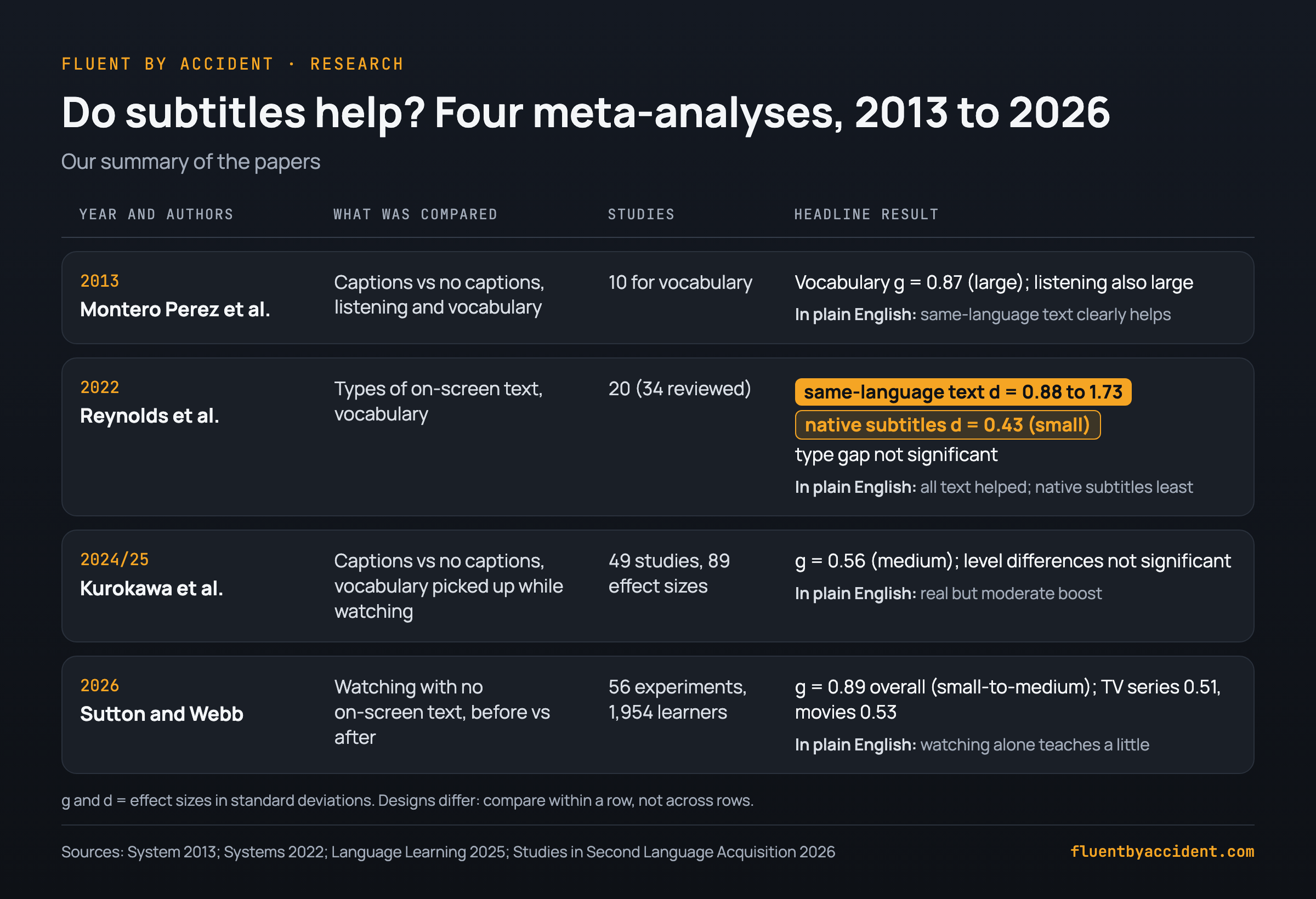
- 2013, Montero Perez, Van Den Noortgate and Desmet. Captions beat no captions with a large effect on both listening comprehension and vocabulary, as Peters, Heynen and Puimège (2016) summarize it. For vocabulary, 10 studies gave g = 0.87, as reported by Kurokawa et al.
- 2022, Reynolds, Cui, Kao and Thomas. 20 of the 34 studies reviewed were pooled. Any on-screen text helped vocabulary overall (d = 0.88, results varied widely). By type: same-language captions with sound and speaker notes d = 1.73 (5 studies), plain same-language subtitles d = 0.88 (7 studies), native-language subtitles d = 0.43, which the authors call small (6 studies). Under the authors' main model, the gap between types was not statistically significant.
- 2024/2025, Kurokawa, Hein and Uchihara. The biggest of the three captioning analyses here: 49 studies, 89 effect sizes, g = 0.56, "medium" in the authors' words. The captioning advantage looked largest for intermediate learners (g = 0.81 vs 0.28 to 0.29), though not significantly; the significant difference was by school level, with primary pupils at g = 1.36. In studies that pretested the target words, the captioning advantage was much smaller (g = 0.29 to 0.35) than in studies without a pretest (1.01); the authors suggest a pretest makes both groups pay attention to those words.
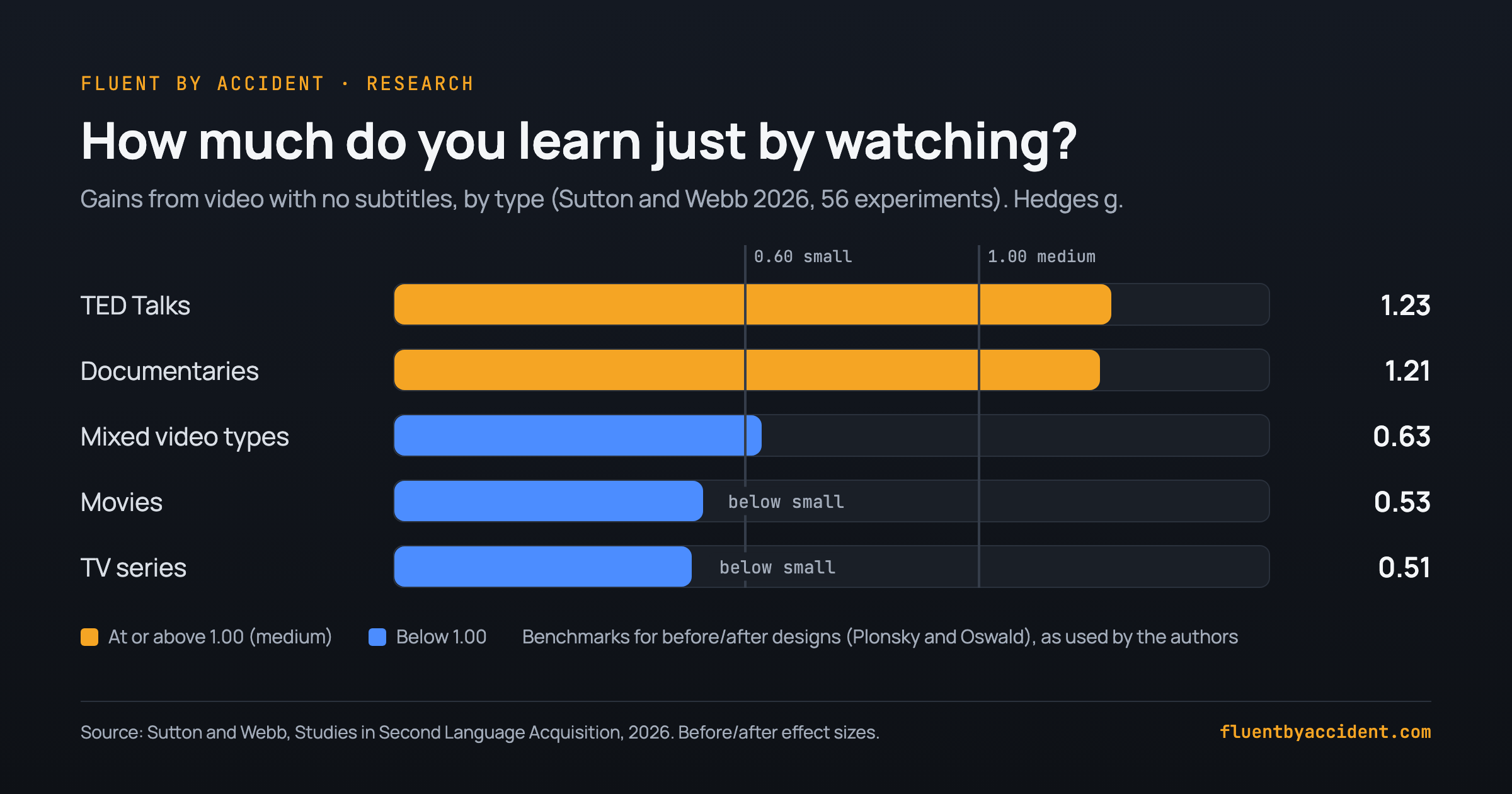
- 2026, Sutton and Webb. The baseline: 56 experiments and 1,954 learners watching with no on-screen text. The overall gain was "small-to-medium" (the abstract says small; g = 0.89 on a before/after design, where the authors' benchmarks put 0.60 at small and 1.00 at medium). TV series and movies sat around 0.5 (Sutton and Webb, 2026).
Target-language vs native subtitles: the Mitterer and McQueen experiment
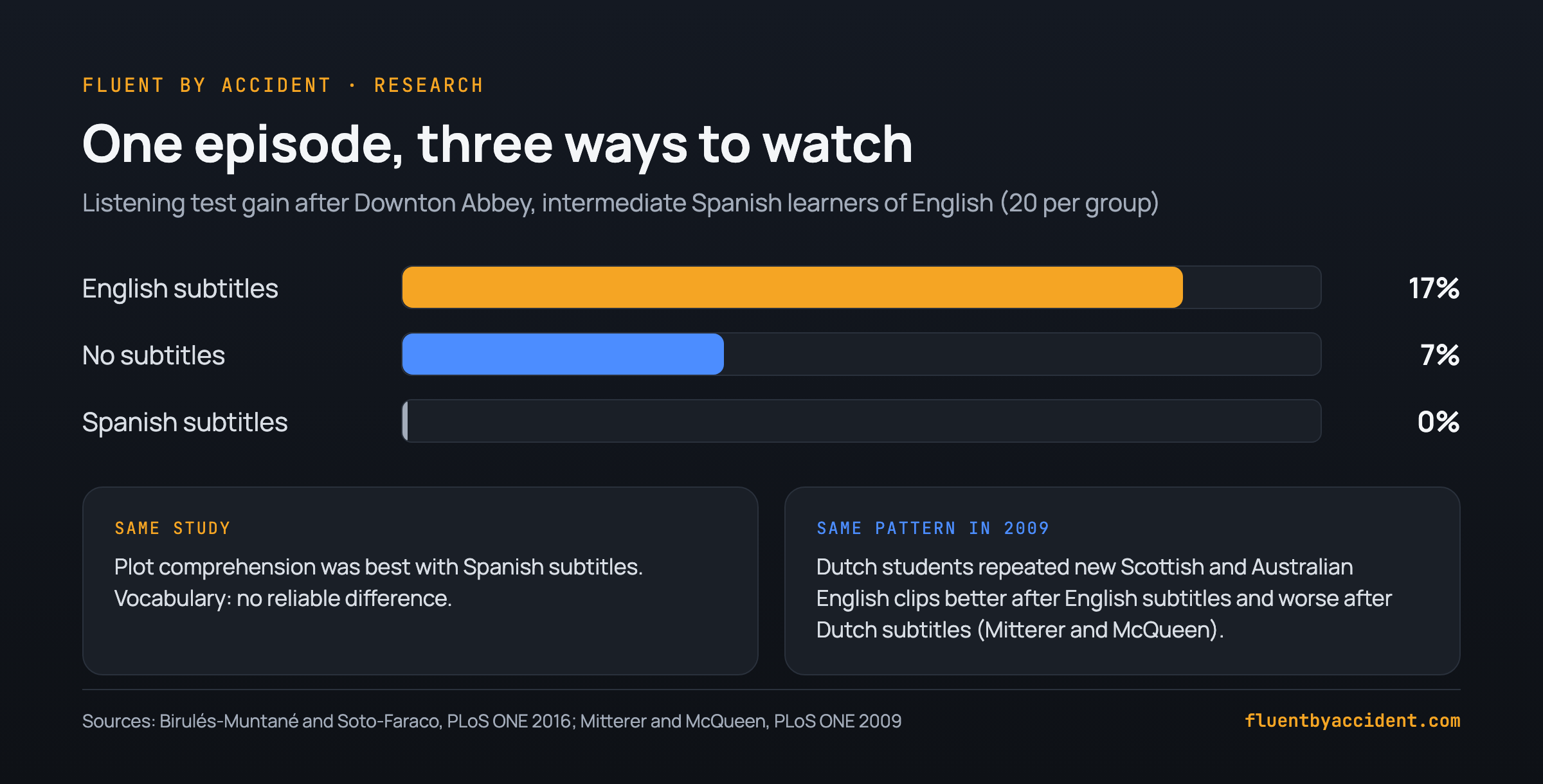
In 2009, Mitterer and McQueen took 120 Dutch students who knew English well but had no experience with Scottish or Australian accents. Each watched 25 minutes of Trainspotting (Scottish) or Kath & Kim (Australian) with English, Dutch or no subtitles, then repeated short audio clips, including ones they had never heard.
English subtitles made them better at repeating the new clips. Dutch subtitles made them worse than no subtitles at all. The authors' explanation: foreign-language subtitles show "which words (and hence sounds) are being spoken", while native ones get in the way.
A 2016 study in Spain found the same pattern. Birulés-Muntané and Soto-Faraco showed 60 intermediate Spanish learners of English the first episode of Downton Abbey (68 minutes), 20 per group. Listening scores rose 17% with English subtitles, 7% with none and 0% with Spanish subtitles. Vocabulary showed no reliable difference. Plot comprehension was best with Spanish subtitles.
If you have seen a "17% better comprehension" line in blog posts, this is its source: a listening gap-fill test after one episode, not general comprehension.
Level matters too. In a 2015 study of 114 Norwegian teenagers watching Family Guy, the older, more advanced group showed no difference between subtitle languages.
Do native-language subtitles hurt your listening? It depends what you measure
Part of the problem is where your eyes go. In a 2012 eye-tracking study with the SpongeBob movie, viewers read the subtitles in every condition, even when they understood the soundtrack. One learner on the Language Reactor forum said in 2025 that with native subtitles on, he tends "to read instead of listen".
That does not make native subtitles useless. They were best for following the plot in the Downton Abbey study, and in Reynolds et al. they still had a small positive effect on vocabulary.
Then the country-level twist. Countries that subtitle TV, mostly with native-language text under the original English audio, have far better English than countries that dub. Rupérez Micola et al. (2019) put the effect at one and a half standard deviations, strongest for listening; in a 2006 EU survey they cite, 87% of Dutch people said they could hold a conversation in English, against 53% of Austrians. A 2025 NBER working paper, not yet peer-reviewed, found over one standard deviation after accounting for language similarity and economic incentives.
How do both hold? Dubbing removes the foreign audio; native subtitles keep it, and over years that is a lot of listening. In a 25-minute experiment, target-language text simply trains the ear faster.
Short version: for your ear, original audio with target-language subtitles beats original audio with native subtitles, and both beat dubbing, which removes the foreign audio entirely. Lab tests measure minutes; the country studies measure years.
| Skill | Target-language subtitles (captions) | Native-language subtitles | No subtitles |
|---|---|---|---|
| Hearing words in new speech | Best (Mitterer 2009; Birulés-Muntané 2016) | No gain or worse in lab tests (same studies) | Some gain (same studies; Sutton 2026) |
| Learning how new words look and sound | Best (Peters 2016; Wang 2022) | Weaker (Peters 2016) | Small gains (Peters 2018; Sutton 2026) |
| Learning what new words mean | Good (Reynolds 2022; Kurokawa 2025) | Similar to captions in some studies (Peters 2016; Birulés-Muntané 2016) | Small gains (Peters 2018) |
| Following the story | Good, if you read fast enough | Best (Birulés-Muntané 2016) | Hardest |
| English skills across a country | Not measured | Strong vs dubbing (Rupérez Micola 2019; Baumeister 2025) | Not comparable (dubbing removes the original audio) |
Why do same-language subtitles help listening comprehension?
Native speech has no spaces between words. Reading the words as you hear them shows where one ends and the next begins, and your brain adjusts how it hears those sounds. Mitterer and McQueen call this lexically guided learning.
Captions also make new word forms stand out, which is one reason they help more with spelling and sound than with meaning (Peters et al., 2016). In a 2022 eye-tracking study of bilingual subtitles, learners who looked longer at the English words, not the translations, learned more. Attention to the target line seems to be the active ingredient.
There are limits. Beginners can be overloaded by reading and listening at once (Kurokawa et al.). In a 2020 pronunciation study with 90 adults who watched regularly for 8 weeks, captions improved pronunciation, except when learners were also told to focus on it, likely too much at once.
What captions do for your ear: speech arrives as one unbroken stream of sound, the caption shows where each word starts and ends, and your brain maps each chunk of sound to a word 1. What you hear: one long stream dondeestáelbaño 2. What the caption shows: where words begin and end ¿Dónde está el baño? 3. What your brain learns Each chunk of sound maps to a wordWhat about dual subtitles? The research is small but promising
Dual subtitles show the target line and a translation together. Only a handful of studies test them.
In Wang and Pellicer-Sánchez (2022), 112 Chinese learners of English watched a documentary in one of four conditions. Both lines beat captions for recognizing word meanings and beat native subtitles for recalling them; captions beat both lines for recognizing word forms.
A 2014 pilot by Kovacs and Miller found that 8 learners of Chinese correctly defined over twice as many new words with on-demand definitions as with plain dual subtitles.
The closest study to real life is from 2021. Fievez and colleagues had 65 Dutch-speaking learners of French watch six episodes of Call My Agent! (307 minutes) on Netflix at home within three weeks, with a Chrome extension for looking up words in the captions. More look-ups and a bigger starting vocabulary meant more learning, yet the average learner looked up just 6 of the 78 target words.
| Study | Who and what | Main finding | Catch |
|---|---|---|---|
| Wang and Pellicer-Sánchez, 2022 | 112 Chinese learners of English, one documentary | Both lines best for word meaning; captions best for word form | One session; Chinese and English only |
| Kovacs and Miller, 2014 | 8 learners of Chinese, 5-minute clips | Definitions on demand: over twice as many new words defined | Tiny sample, immediate test only |
| Fievez et al., 2021 | 65 learners of French, 6 Netflix episodes at home | About 35% of meanings and 28% of forms recalled; more look-ups, more learning | The control group only took the tests, and also improved |
Can you learn a language just by watching TV with subtitles?
Start with the baseline: TV with no text at all. In Sutton and Webb's meta-analysis, TV series (g = 0.51) and movies (g = 0.53) fell below the authors' "small" benchmark, which they report as no effect, while documentaries and TED Talks reached medium (about 1.2). In a 2018 study by Peters and Webb, learners who watched a one-hour BBC documentary without subtitles picked up about 4 of 64 tested words, against about 1.5 for a control group that only took the tests.
The reason is vocabulary load. Knowing the 3,000 most frequent word families (plus names) covers about 95% of the words in TV programs; 98% takes about 7,000 (Webb and Rodgers, 2009). Below that, many lines are noise, with or without subtitles. For the broader idea, see why watching TV shows teaches you a language.
What moved the needle in the studies:
- Target-language text on screen, as three of the four meta-analyses show.
- Doing something with the words. Pre-teaching helped 106 teenagers in a school-year TV study, whatever the text language (Pujadas and Muñoz, 2019); look-ups helped in the Netflix study. In Sutton and Webb, viewing plus activities (g = 1.09) and viewing alone (g = 0.76) pointed the same way, though the difference was not significant.
- Words that come back were learned better in several studies (Peters and Webb, 2018; Fievez et al.).
What the research doesn't tell you yet (and what it suggests for your next episode)
The evidence has clear gaps:
- Most measured effects come from one viewing session: 46 of 75 effect sizes in Sutton and Webb, often with an immediate test.
- Most participants are adults learning English: in Sutton and Webb, 69 of 75 effect sizes came from adults and 71 of 75 from English learners.
- Some samples are tiny, such as the 8 learners in the Kovacs and Miller pilot.
- Dual-subtitle research is mostly Chinese and English, and studies of people streaming at home are rare.
Five questions turn those gaps into a quick test for the next headline you read:
Before you trust a subtitle study, ask:
- Captions or native subtitles, and compared with what: no text, a different kind of text, or no video at all?
- How long did people watch: one clip or months?
- What was tested: listening, word form, word meaning or the plot? Each subtitle type wins at something different.
- Who were the learners: what level, what age, which languages? Kurokawa found the biggest gains at intermediate level, though that level difference was not significant.
- Was the test immediate or weeks later, and did a pretest alert learners to the words? In Kurokawa's analysis it shrank the measured captioning advantage.
What the evidence suggests, without turning it into a routine:
- When you can read the target-language line fast enough, that is the line that trains your ear (Mitterer and McQueen; Birulés-Muntané and Soto-Faraco; Reynolds et al.).
- A native line keeps you with the story and still beats dubbing, but your eyes will go to it, so keep it from being the only thing you read.
- A little active work helps: look up and save the words that keep coming back (Fievez et al.; Sutton and Webb).
For the practical side, see the dual subtitle method, step by step, and pick something at your level from these Netflix shows to learn Spanish, by level. If you want both lines without letting the translation do the work, Fluent by Accident can keep the bottom line blurred until you point at it or press T.
FAQ
Is it better to watch with or without subtitles when learning a language?
Studies usually favor target-language subtitles over none. Meta-analyses from 2013, 2022 and 2025 found that same-language text on screen helped vocabulary, and the 2013 analysis found it helped listening too. A 2026 meta-analysis of watching with no on-screen text found an overall small-to-medium gain and no effect for TV series and movies. One large analysis saw the biggest captioning advantage at intermediate level, though the difference was not statistically significant.
Do subtitles in your native language hurt your listening?
In short lab tests, sometimes. In the 2009 Mitterer and McQueen study, Dutch subtitles left students worse at repeating new English clips than no subtitles, and in a 2016 Downton Abbey study, Spanish subtitles gave a 0% listening gain. People read subtitles automatically, as eye-tracking shows. But native subtitles helped viewers follow the plot best, and countries that subtitle TV instead of dubbing it have much better English. They beat losing the foreign audio; they are just weaker for training your ear.
Do subtitles help with pronunciation?
Possibly, if you watch regularly. In a 2020 study by Wiśniewska and Mora, 90 adult learners of English watched video regularly for 8 weeks, with or without captions. Captioned viewing improved their pronunciation, unless they were also told to focus on how words sound; the authors suspect that was too much at once. Their ability to split speech into words improved with or without captions. Sutton and Webb's 2026 meta-analysis of watching without on-screen text found no difference in gains between skill areas, pronunciation included.
Why do Dutch and Scandinavian people speak such good English?
TV is part of the answer. Countries that subtitle films and shows instead of dubbing them have much higher English skills, strongest for listening. A 2019 study put the effect at 16.9 percent of the average English score, about one and a half standard deviations, and a 2025 NBER working paper, not yet peer-reviewed, found over one standard deviation. Both papers control for some other factors, such as how close the languages are. Viewers in those countries mostly read native-language subtitles under the original English audio.
What is the difference between captions and subtitles?
In research, captions are text in the same language as the audio, for example Spanish audio with Spanish text. Subtitles are a translation into the viewer's own language, for example Spanish audio with English text. Dual or bilingual subtitles show both lines at once. Streaming apps usually call all of these "subtitles". When you read a study, check which kind it tested, because results for captions and for native subtitles often point in different directions.
Sources
- Montero Perez, Van Den Noortgate and Desmet, 2013, System (meta-analysis)
- Reynolds, Cui, Kao and Thomas, 2022, Systems (meta-analysis)
- Kurokawa, Hein and Uchihara, 2025, Language Learning (meta-analysis)
- Sutton and Webb, 2026, Studies in Second Language Acquisition (meta-analysis)
- Montero Perez, 2022, Language Teaching (review)
- Mitterer and McQueen, 2009, PLoS ONE
- Birulés-Muntané and Soto-Faraco, 2016, PLoS ONE
- Vulchanova et al., 2015, Frontiers in Psychology
- Peters, Heynen and Puimège, 2016, System
- Bisson et al., 2012, Applied Psycholinguistics
- Pujadas and Muñoz, 2019, The Language Learning Journal
- Wiśniewska and Mora, 2020, Studies in Second Language Acquisition
- Wang and Pellicer-Sánchez, 2022, Language Learning
- Kovacs and Miller, 2014, CHI 2014
- Fievez, Montero Perez, Cornillie and Desmet, 2021, Computer Assisted Language Learning
- Webb and Rodgers, 2009, Language Learning
- Peters and Webb, 2018, Studies in Second Language Acquisition
- Baumeister, Hanushek and Woessmann, 2025, NBER Working Paper 33984
- Rupérez Micola, Aparicio Fenoll, Banal-Estañol and Bris, 2019, Journal of Economic Behavior & Organization
- Language Reactor forum thread, 2025