Best Anki decks for Japanese: Kaishi, Core 2k/6k, kanji
Kaishi 1.5k is the starter deck r/LearnJapanese commenters keep recommending, then mining your own cards. We opened the deck file, counted what is inside, and set an order for Core and kanji decks.
The best Anki deck for Japanese in 2026 is Kaishi 1.5k: 1,500 frequency-sorted beginner words, each with an example sentence, native audio and furigana, built from Core 2k, Core 10k and Tango N4/N5 data, re-sorted by frequency and fixed (Kaishi README). Finish it, then stop downloading premade decks and start mining your own cards; add a kanji deck such as Recognition RTK only if kanji keep blocking you.
Last tested: November 2026.
How we tested: On 16 November 2026 we downloaded Kaishi 1.5k v2.4.3 from its official GitHub releases page on an Apple Silicon Mac (macOS), unpacked it with the sqlite3 and zstd command-line tools, and counted every note, field and media file. We also ran the Kaishi file through the same parser our web app uses for Anki imports (run in Node v26.5, 3 runs; parse time only, not a browser import). We did not download Core 2k/6k or the kanji decks, so their sizes below come from the Migaku deck guide and the Kaishi README.
What is the best Anki deck for Japanese?
For a beginner who already knows hiragana and katakana, the pick is Kaishi 1.5k. Migaku, which sells a competing flashcard tool, reaches the same conclusion: it calls Kaishi "the best deck for beginners who want a polished, comprehensive starting point" and "an improved version of what the Core decks were trying to do" (Migaku, updated December 2025).
Here is how the common decks compare. Sizes for decks other than Kaishi are as stated by Migaku; we did not count them.
| Deck | Size | Best for | Verdict |
|---|---|---|---|
| Tofugu Hiragana / Katakana | The two kana sets | Week one, before any vocabulary | Use first, then retire |
| Kaishi 1.5k | 1,500 words (we counted) | Your first vocabulary deck | The pick |
| Core 2000 Step 01 + Step 02 | 2,000 + 2,000 words | Learners already halfway through it | Fine, but older and with known errors |
| Core 6000 | 6,000 words | People who refuse to mine their own cards | Skip for most learners |
| Tango N5 (then N4) | Roughly 1,000 words for N5, per Migaku | JLPT-focused learners | A reasonable alternative to Kaishi |
| Recognition RTK | 2,136 jouyou kanji, meaning only | Learners stuck on kanji shapes | Optional, alongside vocabulary |
| All in One Kanji | Meanings, readings, stroke order, words | Very patient learners | Comprehensive but heavy |
The rule that matters more than the pick: use one beginner vocabulary deck, not two. Stacking Kaishi on top of Core 2k gives you the same words twice.
How we tested the Kaishi deck
We opened Kaishi 1.5k v2.4.3, released on 15 September 2026 (GitHub releases). The .apkg file is 108,692,963 bytes, about 108.7 MB. Download took 43 seconds on our connection, which will differ on yours.
What we found inside:
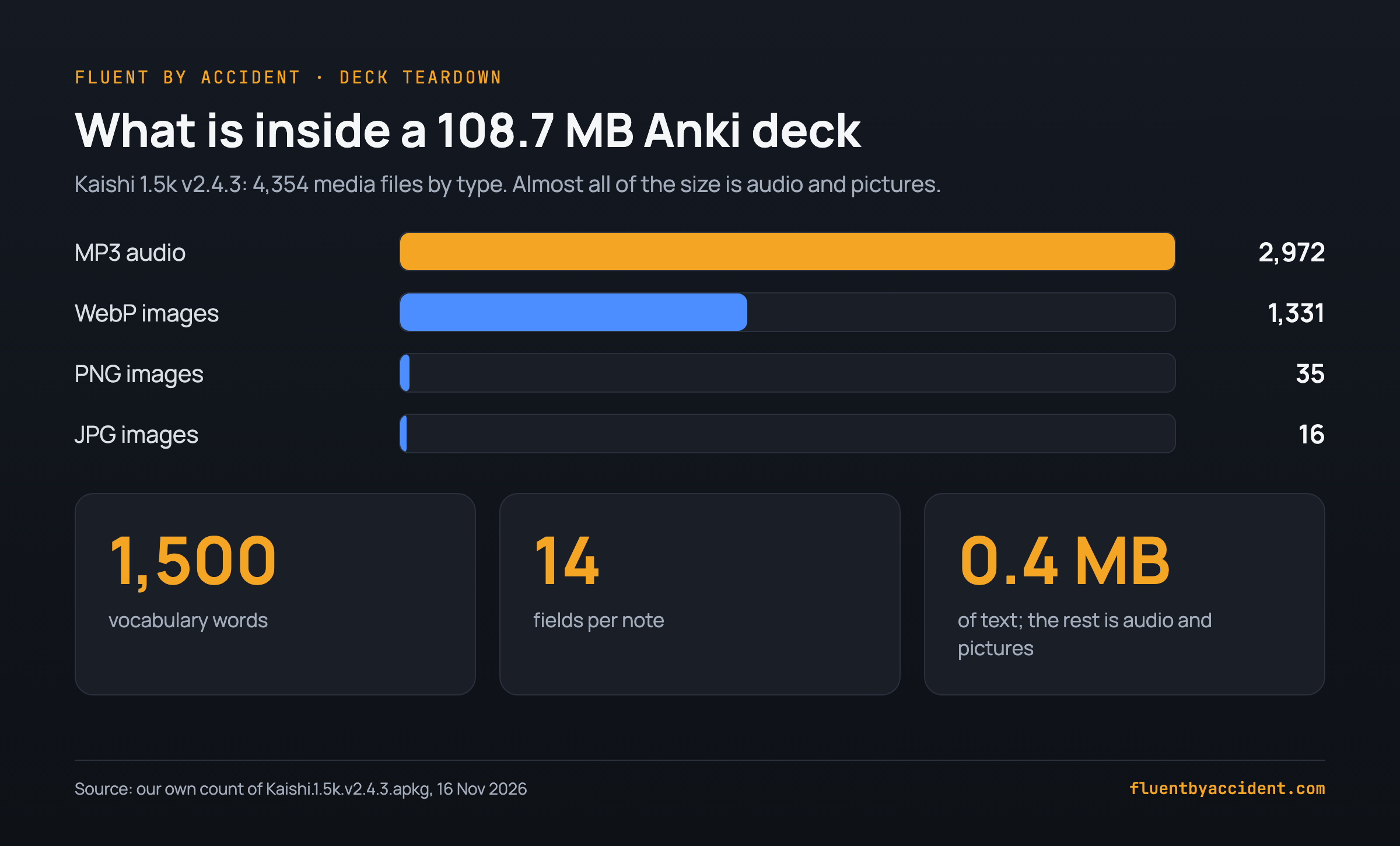
- 4,354 media files: 2,972 MP3, 1,331 WebP, 35 PNG and 16 JPG.
- 1,501 notes, 1,501 cards: one card per note. One note is a "Welcome to Kaishi 1.5k!" info card, so there are 1,500 vocabulary notes. All 1,500 carry an audio reference; 1,499 have both word and sentence audio.
- 14 fields: Word, Word Reading, Word Meaning, Word Furigana, Word Audio, Sentence, Sentence Meaning, Sentence Furigana, Sentence Audio, Notes, Pitch Accent, Pitch Accent Notes, Frequency, Picture.
- Text is tiny: the collection itself is 403,859 bytes compressed (about 0.4 MB) and 1.9 MB as an SQLite database. The other 108 MB is audio and pictures.
- First card: 私 (わたし), "I (polite, general)", with the sentence 私はアンです。 "I am Ann." The word audio file name ends in "NHK-2016", the sentence audio comes from the Tango N5 set, and the welcome card credits the illustrations to Irasutoya.
Our web app's Anki import parser (the same code the browser runs, here run in Node v26.5) read all 1,501 rows and all 14 columns in 85, 90 and 94 ms across three runs. That is the parse step only. Media did not come through: audio fields arrived as text like [sound:...mp3], and pictures were left out. If you want to check any deck's fields before committing to it, you can export any Anki deck to CSV to see its fields.
Kaishi 1.5k vs Core 2k/6k: which should you use?
Use Kaishi unless you are already deep into Core. The Kaishi maintainers built it because "beginners kept getting confused when using Core 2k and Tango due to various issues" (Kaishi README). Their criticism of Core 2k is specific: "multiple mistranslations, missing or unrelated pictures", and sentences that sometimes did not reflect the meaning of the word. Tango, they note, had obscure words such as ナンプラー, a Thai fish sauce.
How Kaishi was assembled, per the README:
- Data from Core2k, Core10k, Tango N4 and Tango N5, combined and sorted by frequency with Yomichan/Yomitan frequency dictionaries, then cut to about 1,500 words.
- Roughly 120 of the 1,500 sentences had to be fixed.
- Furigana gives the reading of the word, with the meaning right below; pitch accent is opt-in.
- The deck needs Anki 2.1.50 or newer.
Kaishi is not flawless. The README admits that finding 1,500 consistent free pictures was hard and "a bunch of pictures do not align perfectly with the sentence or the word."
Core has one fair advantage: length. Migaku describes Core 2000 Step 01 as "probably the most popular beginner vocab deck out there", followed by Step 02 (another 2,000 words) and Core 6000 (Migaku). If you want a premade path to 6,000 words, Core is the only one in this list that goes that far.
| Kaishi 1.5k | Core 2k (Step 01) | |
|---|---|---|
| Words | 1,500 (we counted) | 2,000 (per Migaku) |
| Word order | Sorted by modern frequency dictionaries | Older frequency data, per Reddit commenters |
| Known errors | About 120 sentences fixed; some pictures off | Mistranslations and unrelated pictures, per the Kaishi README |
| Audio | Audio on all 1,500 notes; word and sentence audio on 1,499 (we counted) | Not tested by us |
| Where it leads | Mining your own cards | Step 02, then Core 6000 |
| Anki version | 2.1.50+ | Not tested by us |
If you already started Core 2k or Tango, the Kaishi README has step-by-step instructions for switching without relearning what you know.
What does r/LearnJapanese recommend? (Reddit consensus)
Opinions on r/LearnJapanese lean clearly toward Kaishi, but they are opinions, not data. We read comments in the subreddit's daily "simple questions" threads from 2025, read via mirror front-ends because Reddit blocked our fetch; links point to the original comments (January 14, January 21, January 30 and April 2025).
Reddit consensus, across those four 2025 threads:
- Kaishi 1.5k is described as more up to date, with better sentences and fewer odd words than Core.
- Core 2k/6k is criticised for old frequency data and for having too many cards to count as a "core" deck.
- Some commenters say Core's word choice reflects newspaper lists, heavy on streets, traffic, buildings and manufacturing.
- Pick one starter deck, not both: the overlap is large.
- After the starter deck, the usual next step is mining your own cards.
- Dissent: some learners prefer Tango N5 and N4, and some find Kaishi too easy if they already know a lot of basic words.
The dissent matters. If you are studying for the JLPT and like having levels, Tango is a defensible choice. If Kaishi's first 300 cards are all words you know, suspend them in bulk rather than grinding through.
Which kanji Anki deck should you use (and do you need one)?
Most learners do not need a separate kanji deck at the start, because Kaishi already shows kanji inside real words. Add one only if kanji shapes keep blurring together, and run it alongside vocabulary, not before it. Migaku suggests exactly that pairing: "Recognition RTK for kanji meanings alongside Kaishi 1.5k for vocabulary and readings" (Migaku).
| If you... | Use | Watch out for |
|---|---|---|
| Read words fine and kanji are not slowing you down | No kanji deck. Keep going with vocabulary. | Nothing; revisit if that changes |
| Keep confusing similar-looking kanji | Recognition RTK (kanji to English meaning, 2,136 jouyou kanji) | It teaches no readings or vocabulary, so pair it with Kaishi |
| Struggle with kanji while doing Kaishi | The radicals deck by ねむい that the Kaishi README links, in parallel | Keep its daily new cards low |
| Want meanings, readings and stroke order in one place | All in One Kanji | Migaku calls it comprehensive but overwhelming |
On RTK specifically, Migaku says a disciplined learner can finish the Recognition version "in a few months", and that the downside is it "doesn't teach you readings or vocabulary." That is why we do not recommend doing RTK first and vocabulary later.
In what order should you use Japanese Anki decks?
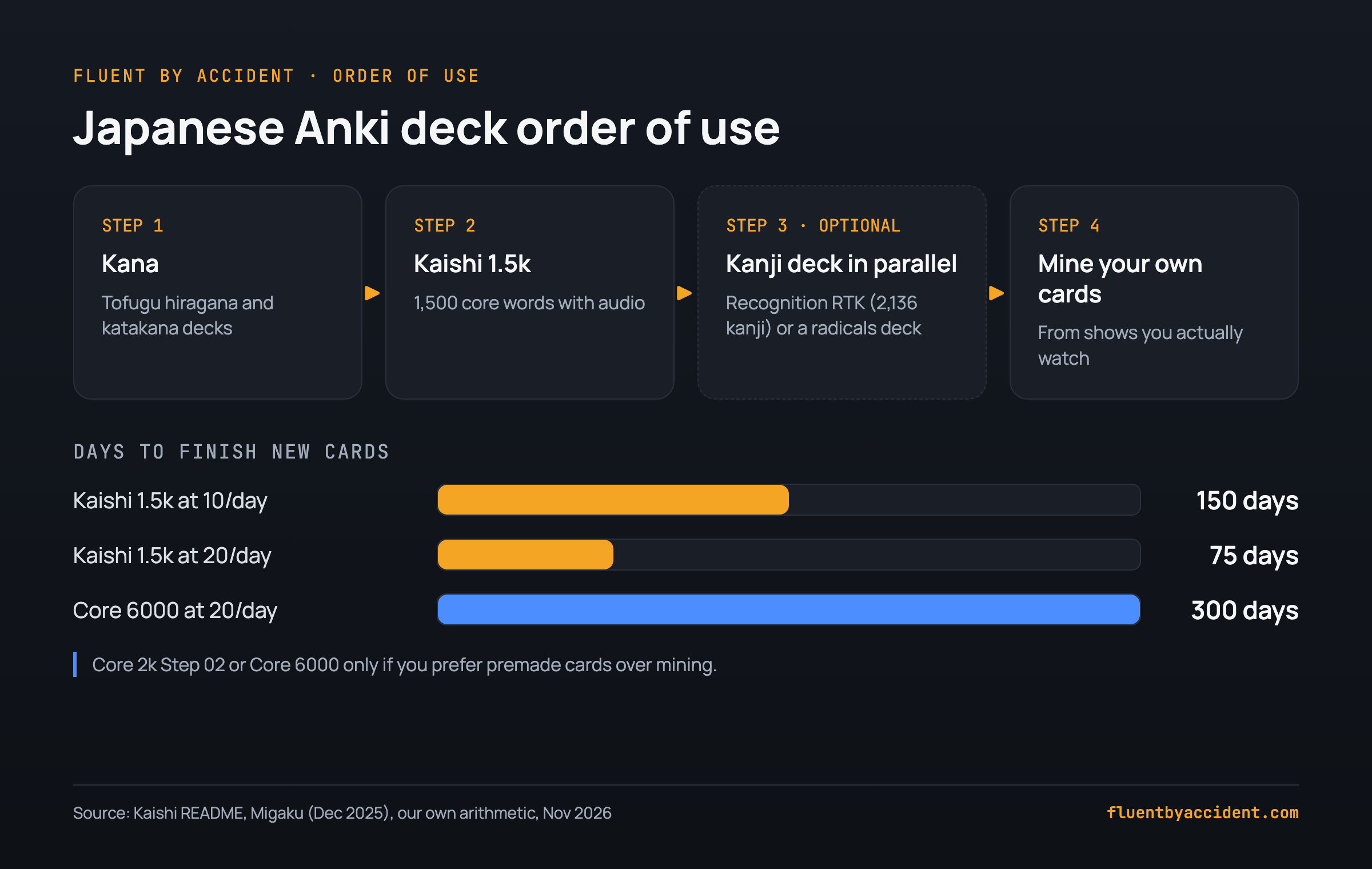
Here is the order we recommend, from zero to independent:
- Kana: Tofugu Hiragana and Katakana decks, which Migaku calls "solid choices".
- Kaishi 1.5k: your one beginner vocabulary deck.
- Optional kanji deck in parallel: Recognition RTK or the radicals deck, only if kanji block you.
- Mining: build your own cards from shows and anime. The Kaishi README's own answer to "what do I do after this deck?" is to start mining. Our sentence mining guide walks through it.
Core 2k Step 02 and Core 6000 belong in this list only if you prefer premade cards over mining. The time cost is the reason most learners skip them.
Our own arithmetic (example, new cards only, reviews not counted):
- Kaishi 1.5k at 10 new cards a day: 1,500 / 10 = 150 days.
- Kaishi 1.5k at 20 new cards a day: 1,500 / 20 = 75 days.
- Core 6000 at 20 new cards a day: 6,000 / 20 = 300 days.
How to set up a premade Japanese deck so it does not bury you
A premade deck fails when the daily reviews pile up, not when the cards are bad. Before your first session, go through this checklist. Our guide to Anki settings for language learning explains each option in more depth.
Setup checklist for Kaishi (or any premade Japanese deck):
- Download only from the official Kaishi GitHub releases or its AnkiWeb page.
- Check you are on Anki 2.1.50 or newer before importing.
- Set new cards per day to 10 or 20 (see the arithmetic above) and keep it there for at least two weeks.
- Leave new cards in sequential order so the frequency sorting works for you.
- Turn on the FSRS scheduler if your Anki version offers it.
- Suspend cards for words you already know instead of reviewing them for months.
- Do not add a second beginner vocabulary deck on top.
- If kanji block you, add one kanji deck with a low new-card limit, not two.
- Plan a lighter week instead of skipping days; if you fall behind, here is how to clear an Anki backlog.
If Anki itself is the problem rather than the deck, our roundup of Anki alternatives covers other options.
What to do after Kaishi
After 1,500 words, the gains come from words you meet in things you actually watch or read. That is where premade decks stop and your own cards start. If anime is your main input, see how to learn Japanese with anime subtitles, then turn the words you look up into cards with the sentence mining guide.
| Premade deck (Kaishi) | Your own mined cards | |
|---|---|---|
| Words chosen by | Frequency lists | What you actually met |
| Context | One example sentence per word | The scene or line where you heard it |
| Setup effort | One download | A few seconds per card |
| Audio | Native audio included | Depends on your tools |
| Best stage | First 1,500 words | Everything after |
If you mine from Netflix or YouTube, Fluent by Accident shows two subtitle lines and lets you click a word to save it into a flashcard deck (the free plan holds 100 cards, more on Pro), though it imports Anki decks as text only, without audio or pictures, so a full Kaishi import needs Pro.
FAQ
Is Kaishi 1.5k better than Core 2k?
For most beginners, yes: it is newer, re-sorted by modern frequency dictionaries and fixes known Core 2k errors (Kaishi README). It is also 500 words shorter, so you reach mining sooner. If you are already far into Core 2k, finishing it is still reasonable.
Is Core 6k worth finishing?
For most learners, no. Core 6000 covers 6,000 words (Migaku), which at 20 new cards a day is 300 days of new cards alone, before counting reviews (our arithmetic). Commenters on r/LearnJapanese have criticised its old frequency data and newspaper-style vocabulary. By the time you have 1,500 to 2,000 words, mining cards from shows and books you actually consume usually teaches more relevant words. Core 6k makes sense only if you strongly prefer premade cards and have the daily time.
Should I learn kanji with RTK before vocabulary?
We do not recommend it. Recognition RTK teaches only the meaning of each of the 2,136 jouyou kanji, and Migaku notes it does not teach readings or vocabulary (Migaku). Doing it first delays the words you need to read anything. If kanji confuse you, run Recognition RTK alongside Kaishi with a low new-card limit, which is the pairing Migaku itself suggests. Many learners never need a separate kanji deck, because they learn kanji inside the words of their vocabulary deck.
Can I do Kaishi and Core 2k at the same time?
You can, but you should not: Kaishi draws its words from Core2k, Core10k and Tango, so you would review many words twice. To move from Core 2k to Kaishi without relearning known words, follow the README section How to import Kaishi on top of another deck.
How many new cards per day for Kaishi?
Ten to twenty is a sensible range for most people. At 10 new cards a day you finish Kaishi's 1,500 words in 150 days; at 20 a day, in 75 days (our arithmetic, new cards only). Reviews grow with every new card you add, so the higher number also means a heavier daily review load a few weeks in. Pick the number you can keep on your worst day, not your best. If reviews start piling up, lower new cards first rather than skipping review days.
Where do I download Kaishi safely?
Only from the official Kaishi GitHub releases page or its AnkiWeb listing, which the README links. The maintainers warn in capitals that any other deck not mentioned on their page is not affiliated with them, "including any AI or paid modifications." The current release we tested, v2.4.3, is a 108.7 MB .apkg file published on 15 September 2026, and it needs Anki 2.1.50 or newer. Community translations into languages such as Spanish, French and German are listed in the README.
Sources
- donkuri, Kaishi 1.5k README, GitHub, accessed 16 November 2026: https://github.com/donkuri/Kaishi
- donkuri, Kaishi releases (v2.4.3, 15 September 2026), GitHub: https://github.com/donkuri/Kaishi/releases/
- Kaishi 1.5k on AnkiWeb: https://ankiweb.net/shared/info/1196762551
- Migaku, "Best Japanese Anki decks", last updated 20 December 2025: https://migaku.com/blog/japanese/best-japanese-anki-decks
- r/LearnJapanese: https://www.reddit.com/r/LearnJapanese/
- r/LearnJapanese daily thread, 14 January 2025: https://www.reddit.com/r/LearnJapanese/comments/1i0snk5/daily_thread_simple_questions_comments_that_dont/m70npp1/
- r/LearnJapanese daily thread, 21 January 2025: https://www.reddit.com/r/LearnJapanese/comments/1i65703/daily_thread_simple_questions_comments_that_dont/m8b10ft/
- r/LearnJapanese daily thread, 30 January 2025: https://www.reddit.com/r/LearnJapanese/comments/1id8okb/daily_thread_simple_questions_comments_that_dont/ma3iwer/
- r/LearnJapanese daily thread, April 2025: https://www.reddit.com/r/LearnJapanese/comments/1jq3w10/daily_thread_simple_questions_comments_that_dont/ml49k4c/
- The four Reddit threads were read via a Reddit mirror on 16 Nov 2026 because Reddit blocked automated fetches.
- Our own measurement of Kaishi.1.5k.v2.4.3.apkg, 16 November 2026 (macOS, sqlite3, zstd, Node v26.5).