Duolingo Alternatives: What to Switch To, by Goal
Duolingo builds a habit but stalls for many learners near A2. Here is why people leave (streaks, energy, AI-made content) and what to switch to for speaking, grammar, real content or vocab.
The best Duolingo alternative depends on what Duolingo failed to give you. For speaking, use a tutor on italki or an AI speaking app like Speak. For grammar, use Babbel, Busuu or the free Language Transfer course. For real content, use LingQ or TV with dual subtitles. For vocabulary, use Anki or Clozemaster. Most learners who leave end up stacking two tools instead of finding one replacement, and Duolingo can stay on as a free daily habit.
By Derek Mita. Last checked: November 24, 2026.
Maybe your streak is at 400 days and you still freeze when a real person says something to you at a bar. That gap between app progress and real use is the most common reason people look for a Duolingo alternative. This guide maps each job Duolingo was supposed to do to a replacement, with prices and catches. For a general ranking of apps by goal, see our full ranking by goal. This post is narrower: it is for people who are already leaving Duolingo.
Why are people leaving Duolingo?
Four reasons come up again and again. Some are verifiable facts, some are claims from companies that sell a competing product, and some are user reports. The table separates them so you can weigh each one.
| Reason | What people say | Source | Our verdict |
|---|---|---|---|
| Streak and engagement design | The streaks, gems, leaderboards and notifications are "engagement mechanics, not teaching methodology." | StoryLearning (sells courses) | Claim. The author sells competing courses. |
| Energy limits on the free plan | Free users have an energy meter that drains with each exercise and refills over time, with ads or with gems. | Languatalk (competitor-affiliated blog) | Reported as a current feature. We did not verify exact numbers, so we quote none. |
| AI-made course content | Some users say that after Duolingo switched to generative AI the service is "no longer worth using," and that AI-written courses are lacking or wrong. | BGR (opinion piece) | User reports. No independent audit of error rates in our sources, and we did not read the Reddit thread BGR cites. |
| Plateau near A2 | "Most learners stop making real progress with it around the A2 level." | LingQ (sells LingQ) | Claim, no data given. StoryLearning says B2 courses were added in April 2026 in nine languages, so this is changing. |
BGR cites an r/duolingo thread where users question Duolingo's use of AI. It is a pointer, not proof.
Here is what that looks like in practice. It is 8 p.m., you miss the lesson, and the streak warning arrives at 9. Switchers usually do not fix that by willpower. They keep the 10-minute slot and put a different job in it, such as one episode segment with two subtitle lines or ten flashcards.
One more change helps Duolingo's case. Languatalk reports that "Explain My Answer," which tells you why an answer was wrong, used to be part of Duolingo Max and has been free for all learners since January 2026. If lack of explanations was your complaint, that part may already be fixed.
Is leaving Duolingo the right call?
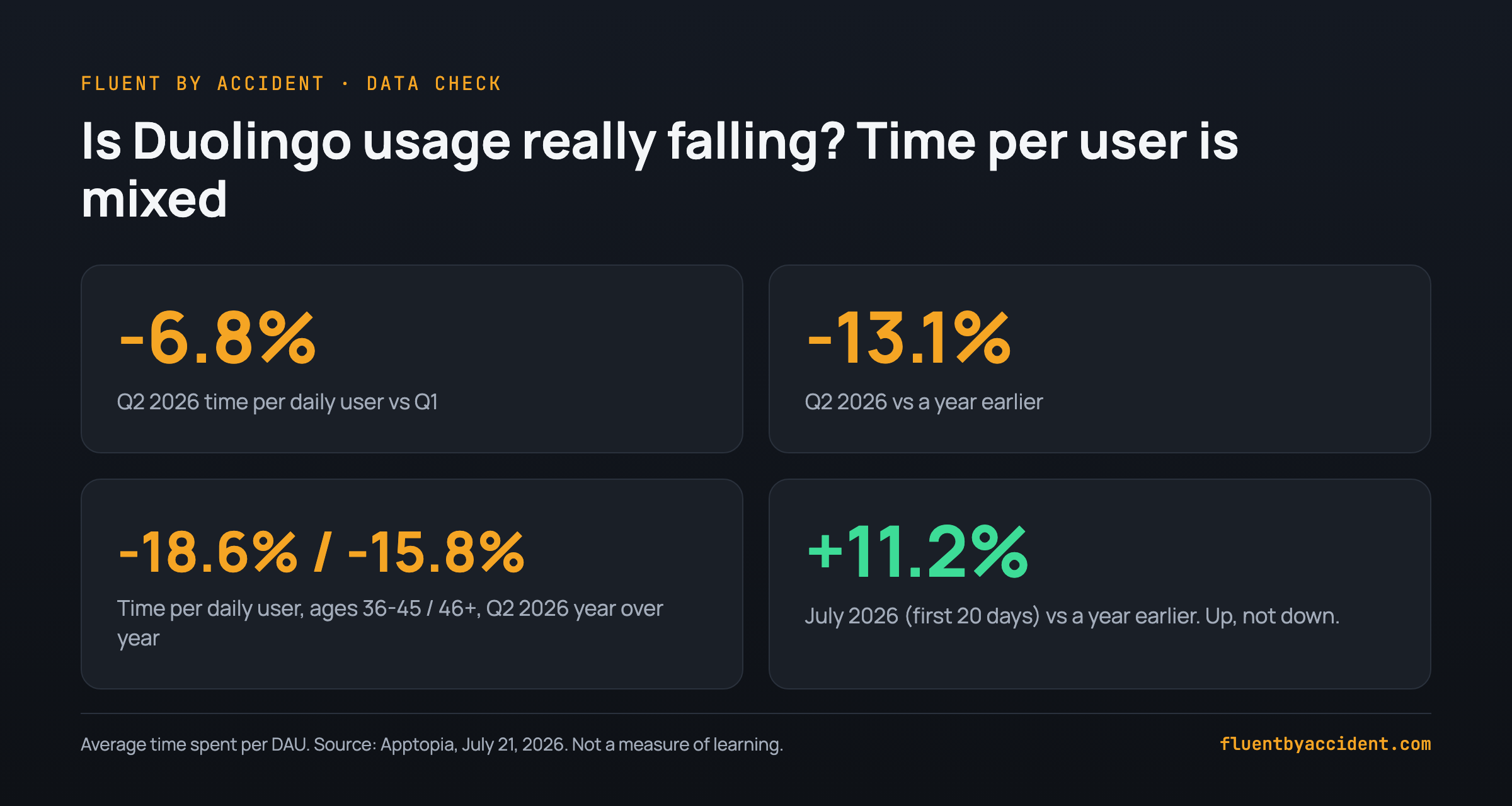
Not always. If the habit works for you and you only want a light daily session, leaving costs you something real. Usage data is mixed: time per user fell in Q2 but rose in early July.
Apptopia, an independent analytics firm, reported on July 21, 2026 that average time spent per daily active user fell 6.8% quarter over quarter in Q2 2026 and 13.1% year over year. The biggest drops were in older cohorts: 18.6% for ages 36 to 45 and 15.8% for 46 and up. But through the first 20 days of Q3, time per user was up 11.2% year over year in July (all figures from Apptopia).
Fair warning: Duolingo says its own studies show it works, including that "completing five sections of Duolingo teaches as much as five semesters of university language classes" (Duolingo's own claim). That is a company statement, not an independent result. Time spent in an app also says nothing about whether you learn. Use the numbers as context, not as a verdict either way.
If you want a free, low-pressure daily habit, Languatalk's own comparison says Duolingo is the right choice. The trouble starts when you expect it to carry you past beginner level on its own.
What should I use instead of Duolingo for my goal?
Pick by the job you were missing, not by the app with the best marketing. Prices below are as reported by StoryLearning (as of October 2026) and Languatalk (2026, US App Store), and they change often. Check each pricing page before you pay.
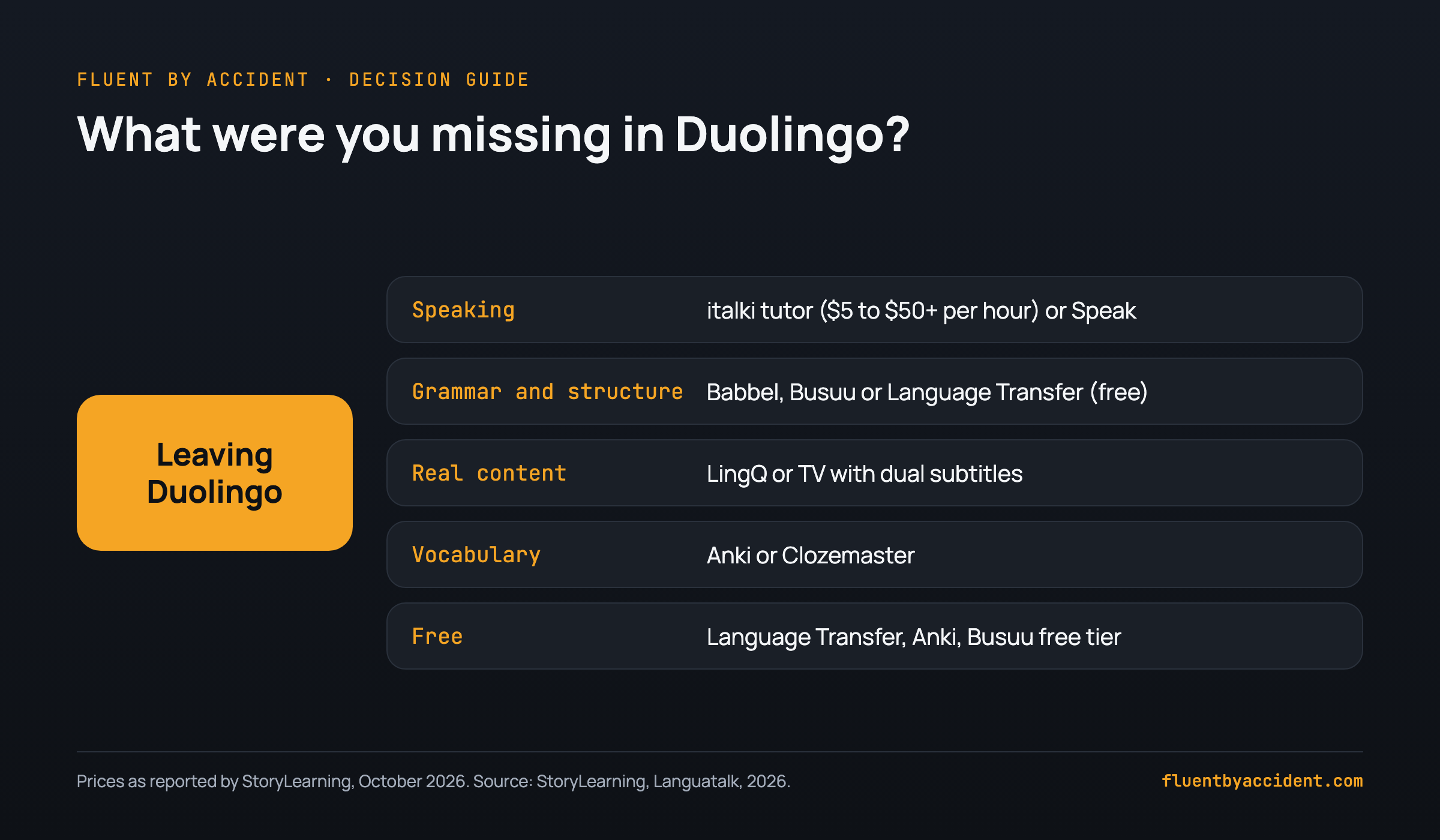
| You were missing | Switch to | Cost as reported | The catch |
|---|---|---|---|
| Speaking | italki tutor, or Speak | italki: $5 to $50+ an hour, pay per lesson. Speak: price not listed in our sources, checked Nov 24, 2026. | Speak's pronunciation checking is "checked on every answer, but lenient" per Languatalk. Tutors cost per hour. |
| Grammar and structure | Babbel, Busuu, Language Transfer | Babbel: about $8.95 a month on the 12-month plan, Lifetime $299.99. Busuu Premium: about $69.99 a year, with a free tier. Language Transfer: free, donation-supported. | Per StoryLearning, Babbel content stops at A2 in several languages, such as Indonesian, Norwegian, Polish and Turkish. |
| Real content | LingQ, or shows with dual subtitles | LingQ: price not listed in our sources, checked Nov 24, 2026. TV: your existing subscriptions. | Both need some base vocabulary to be comfortable. LingQ is sold by the author of its own comparison, so weigh that. |
| Vocabulary | Anki, Clozemaster | Anki: free on desktop (per Anki's site). Clozemaster: price not listed in our sources, checked Nov 24, 2026. | You build the habit yourself. Anki does not teach grammar. |
| Audio-first learning | Pimsleur | Premium $19.95 a month, All Access $20.95 a month | Audio-first format. Check what it covers before paying. |
LingQ advises combining tools. It says "the best answer is combining two or three tools rather than relying on any single app." Our reading: pick one tool for input (content), one for output (speaking or feedback), and one for memory (flashcards) if you want a full replacement. Do not buy all five.
If you came for the vocabulary side, our guides to Anki alternatives and flashcard apps ranked cover that branch in detail.
What is the best free Duolingo alternative?
There is no single free replacement, but several free tools cover different jobs. Here is what you get and what you give up.
| Free option | What you get | The catch |
|---|---|---|
| Language Transfer | Free, donation-supported (per StoryLearning) | Check which languages it offers |
| Anki (desktop) | A free desktop flashcard program that schedules your reviews (per Anki's site) | You write or import the cards, and the setup takes effort |
| Busuu free tier | Structured lessons from A0, with a free tier per StoryLearning | Premium (about $69.99 a year) unlocks the rest. Free is limited |
| YouTube and TV | Unlimited real content | No structure. You need enough vocabulary to follow |
Duolingo itself is also free, with ads and energy limits, so the question is really what you want from a free tool. A free stack that works for many self-taught learners: Language Transfer for structure, Anki for memory, and shows for input. Our post on spaced repetition for language learning explains why the Anki piece matters.
What should I use after Duolingo to reach B1 or B2?
Move from exercises to real content. StoryLearning says Duolingo's own course now runs from A0 to A2 or low B1, with B2 courses available in nine languages since April 2026, so the A2 plateau is softer than it was, though still real for many learners. Beyond that, the usual path is input: things you actually want to read or watch, with a way to capture the words you do not know.
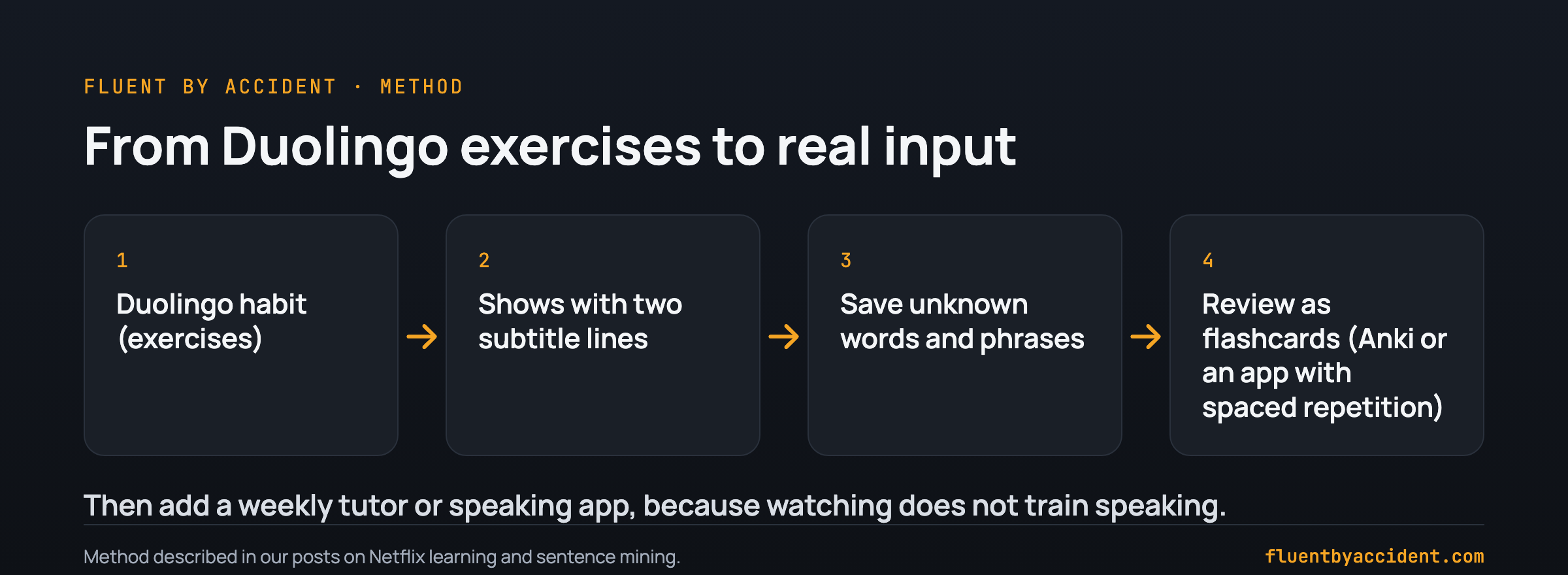
The steps:
- Pick a show you would watch anyway, in your target language.
- Turn on two subtitle lines, target language and your native language, so you can check meaning without leaving the scene. See how to learn with Netflix using two subtitle lines.
- Save sentences, not single words, using the method in our sentence mining guide.
- Review the saved cards as flashcards. Our list of comprehensible input TV shows helps you pick shows at the right level.
Review the saved cards daily, because ten minutes beats one hour on Sunday. Add a tutor or speaking app once a week, since watching does not train speaking.
If you are weighing Lingopie as a paid shortcut, see our Lingopie review. The no-new-app option is also real: if you already pay for Netflix, YouTube or Max, the content is already there.
Can I quit Duolingo without losing my streak habit?
Yes, if you replace the streak with a smaller, more honest counter. The streak counts days you opened the app. You want a number that counts work you did.
Tip: Keep one 10 to 15 minute slot at the same time as your old Duolingo session. Do not leave it empty on day one. Fill it with the replacement.
- Keep Duolingo for two weeks, but limit it to one short lesson per day, as a warm-up only.
- Add one replacement for your missing job, for example a card review in Anki or one episode segment with subtitles.
- Switch the streak to a review count: "cards done today," not "days in a row."
- After two weeks, drop Duolingo if the new routine holds, or keep it as a free warm-up if it still helps.
- If your Anki queue piles up after a few missed days, read how to fix an Anki backlog before you quit the tool in frustration.
You will lose the number. You will not lose the habit if the slot stays in your day.
How we tested
How we tested: desk research on November 24, 2026. We read public pages and pricing as reported by each source. We did not hands-on test the paid apps.
This article is a research and comparison piece, and we want to be plain about its limits. On November 24, 2026 we read the public pages listed in the Sources section: the vendor comparison posts from LingQ and StoryLearning, the Languatalk comparison, the Apptopia analysis, the BGR opinion piece and Duolingo's own effectiveness post. We checked the prices they report against the date each page gives.
We did not hands-on test the paid apps (Babbel, Busuu Premium, Speak, LingQ, italki, Pimsleur, Clozemaster), so we make no claims about their quality beyond what the sources say. Two of our main sources sell competing products, and we labeled their statements as claims.
Fluent by Accident is our own Chrome extension that shows two subtitle lines on streaming sites and saves words as flashcards; it is a watch-and-save tool, not a course (see pricing).
FAQ
What is the best alternative to Duolingo?
There is no single winner. Choose by what you were missing: a tutor on italki or Speak for speaking, Babbel, Busuu or Language Transfer for grammar and structure, LingQ or shows with dual subtitles for real content, and Anki or Clozemaster for vocabulary. LingQ, which sells a product, suggests combining two or three tools. For a wider ranking, see our best language learning app guide.
Is there a good free alternative to Duolingo?
Yes, but it comes in pieces. Language Transfer is free and donation-supported, per StoryLearning. Anki's desktop version is free for flashcards. Busuu has a free tier, and YouTube and TV give you unlimited content. Together they cover structure, memory and input. The catch is that you have to assemble the routine yourself, which takes more effort than opening one app.
Can Duolingo make you fluent?
Duolingo claims its courses are as effective as classroom learning, but that is the company's own statement. LingQ, a competitor, says most learners stop making real progress around A2, and StoryLearning says Duolingo covers A0 to A2 or low B1, with B2 courses added in nine languages as of April 2026. Neither source is neutral. Fluency in practice usually needs real input and speaking on top of any app.
What should I use after Duolingo to reach B1 or B2?
Shift toward input and output. Watch or read content you enjoy with a way to look up and save unknown words, review those words with spaced repetition, and add regular speaking practice with a tutor or an AI speaking app. A grammar course such as Busuu, which StoryLearning says goes to B1 with some B2 content, can fill structural gaps.
Is Babbel or Busuu better than Duolingo?
It depends on your goal. Both are more structured than Duolingo, and Busuu has a free tier plus feedback features. StoryLearning reports Babbel's content ends at A2 in several languages, such as Indonesian, Norwegian, Polish and Turkish, and Busuu takes you from A0 to B1 with some B2 content. If you want a free low-pressure habit, Languatalk says Duolingo is still the better pick.
Is Duolingo getting worse because of AI?
Some users say so. BGR reports users who feel the move to generative AI made the service not worth using. Apptopia found usage mixed: time per user fell in Q2 2026 but rose in July, and it argued the AI threat may be overstated.
Sources
All pages checked November 24, 2026.
- Tolman, T. "Best Duolingo Alternatives for Intermediate Learners (2026)." LingQ blog, April 20, 2026 (updated November 23, 2026). lingq.com/blog/duolingo-alternatives. Vendor source.
- Richards, O. "The Best Duolingo Alternatives For Serious Learners (An Honest 2026 Guide)." StoryLearning, July 2026, prices as of October 2026. storylearning.com. Vendor source.
- Blacker, A. "AI's Threat to Duolingo May Be Overstated." Apptopia, July 21, 2026. apptopia.com.
- BGR. "I Ditched Duolingo For A Simple Reason." bgr.com. Opinion piece.
- Languatalk. "Speak vs Duolingo (2026)." Prices from the US App Store. languatalk.com. Competitor-affiliated blog.
- Anki. "Anki: powerful, intelligent flashcards." apps.ankiweb.net. "The free computer version is available for all major platforms."
- Duolingo. "Does Duolingo work?" 2024. blog.duolingo.com. First-party claim.
- r/duolingo thread, "How exactly does Duolingo use AI and why is it so..." reddit.com. Cited via BGR, not read directly.