Best Language Learning App in 2026: Reddit's Picks by Goal
There is no single best language learning app. We ranked apps by goal (vocabulary, listening, speaking, grammar), checked what r/languagelearning actually recommends, and noted where gamified apps fall short.
There is no single best language learning app in 2026, so pick one per goal: Anki for vocabulary, LingQ or real TV and YouTube with a subtitle tool for listening, a tutor platform such as italki for speaking, and Babbel, Busuu or the free Language Transfer for grammar. Duolingo is a fine habit starter, not a finish line.
That is the same "stack" advice Reddit learners keep repeating. Even italki's own roundup of Reddit threads sums it up as "no single best platform", and one learner who tried 27 apps over 8 years on r/languagelearning concluded that no one app carries you to fluency.
Last checked: November 2026.
What is the best language learning app for each goal?
Most "best app" lists pick one winner, and the winner is often the company that wrote the list. Below, each skill gets its own pick, a free option, and the thing that app will not do for you.
| Goal | Our pick | Free option | What it won't do |
|---|---|---|---|
| Vocabulary | Anki (spaced repetition) | Anki | Teach you to understand speech or speak |
| Listening and input | LingQ, or Netflix/YouTube with a dual subtitle tool | YouTube, podcasts, free subtitle extensions | Correct your mistakes or make you talk |
| Speaking | A tutor on italki | Tandem or HelloTalk exchanges | Give you a structured syllabus by itself |
| Grammar and structure | Babbel or Busuu | Language Transfer | Give you hours of real listening |
| Daily habit | Duolingo | Duolingo free tier | Get you conversational on its own |
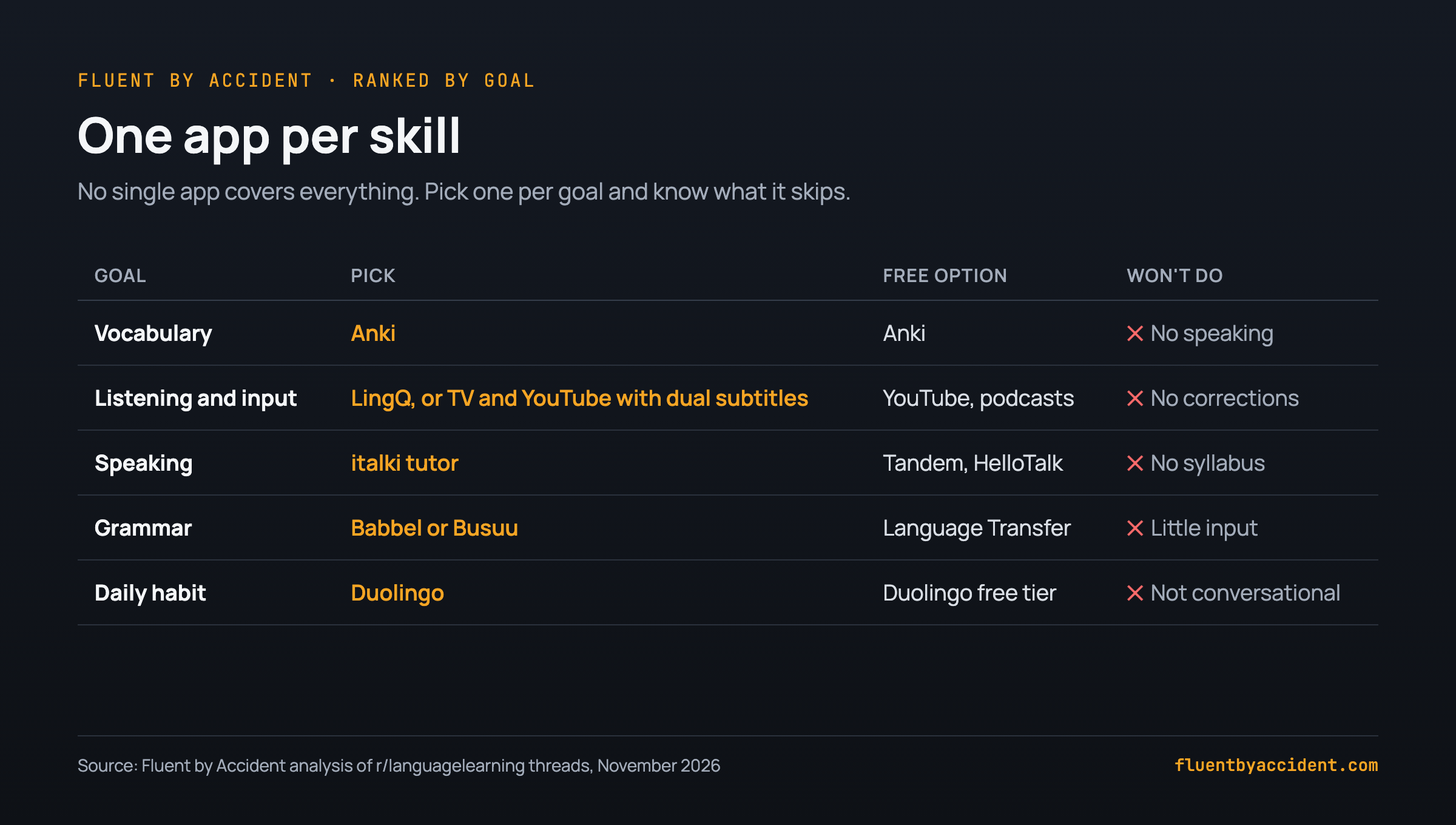
The table lines up with the goal list in italki's Reddit summary and with LingQ's 2026 ranking, which names Anki the best free vocabulary app, Language Transfer the best free structured course and italki the best for speaking. Both vendors rank their own product first, so we kept their category picks and dropped their self-rankings.
How we tested (November 2026)
We wanted one thing the top results skip: a dated check instead of copied marketing. Here is exactly what we did and what we did not do.
How we tested: On November 19, 2026 we read the vendor roundups and study reports cited here. Reddit blocked our fetch, so the Reddit quotes come from the threads as quoted and linked in italki's roundup; we link each thread so you can check it. For Fluent by Accident we read the free-plan limit from our plan code (100 saved words) and the prices from our pricing page that day: Pro at $6.99 a month or $49 a year. We did not verify other vendors' prices on their own pricing pages, so this article lists no competitor prices. Third-party roundups disagree: LingQ's table puts Duolingo Super at about $7 a month, while OpenL's April 2026 list shows Duolingo Max at $12.99 a month. Check the vendor's page before you pay.
Why so strict? OpenL states openly that its evaluation is based on official product pages and published reviews, and Lingopie's list names Lingopie "Best Overall". Neither is wrong to do that, but you should know which picks come from testing and which come from a sales page.
Best app for vocabulary
Pick Anki. LingQ's 2026 ranking calls it the best free app for vocabulary, it uses spaced repetition (it shows each card right before you would forget it), and italki's Reddit roundup calls it one of Reddit's most respected language-learning tools. On r/Anki, one user called it the best flashcard app with a spaced repetition algorithm, while another added a fair warning: it is a great memorization tool, but not the whole of language learning.
We will not re-rank flashcard apps here. If Anki's learning curve puts you off, our flashcard app ranking compares the options side by side, and our list of Anki alternatives covers apps that are easier to start with.
Tip: Cards built from whole sentences you actually heard stick better in context than isolated words, and they quietly teach grammar too. See sentence cards vs word cards for how to build them and when single words still make sense.
Best app for listening and real input
Listening is where most course apps are thinnest, because a lesson app gives you minutes of audio and a TV show gives you hours. Your choices fall into three groups.
- LingQ. A reader and listening library. The 27-apps learner on r/languagelearning praised its content offer: short-form material, audiobooks and news. Keep in mind LingQ's own ranking puts LingQ at #1.
- Free input. YouTube channels and podcasts made for learners cost nothing. italki's summary lists LingQ, YouTube and podcasts together under input for that reason. If you want a starting list, see our TV shows for comprehensible input.
- Lingopie. A streaming service built for learners, with its own catalog. Read our Lingopie review for what the library covers and where it falls short.
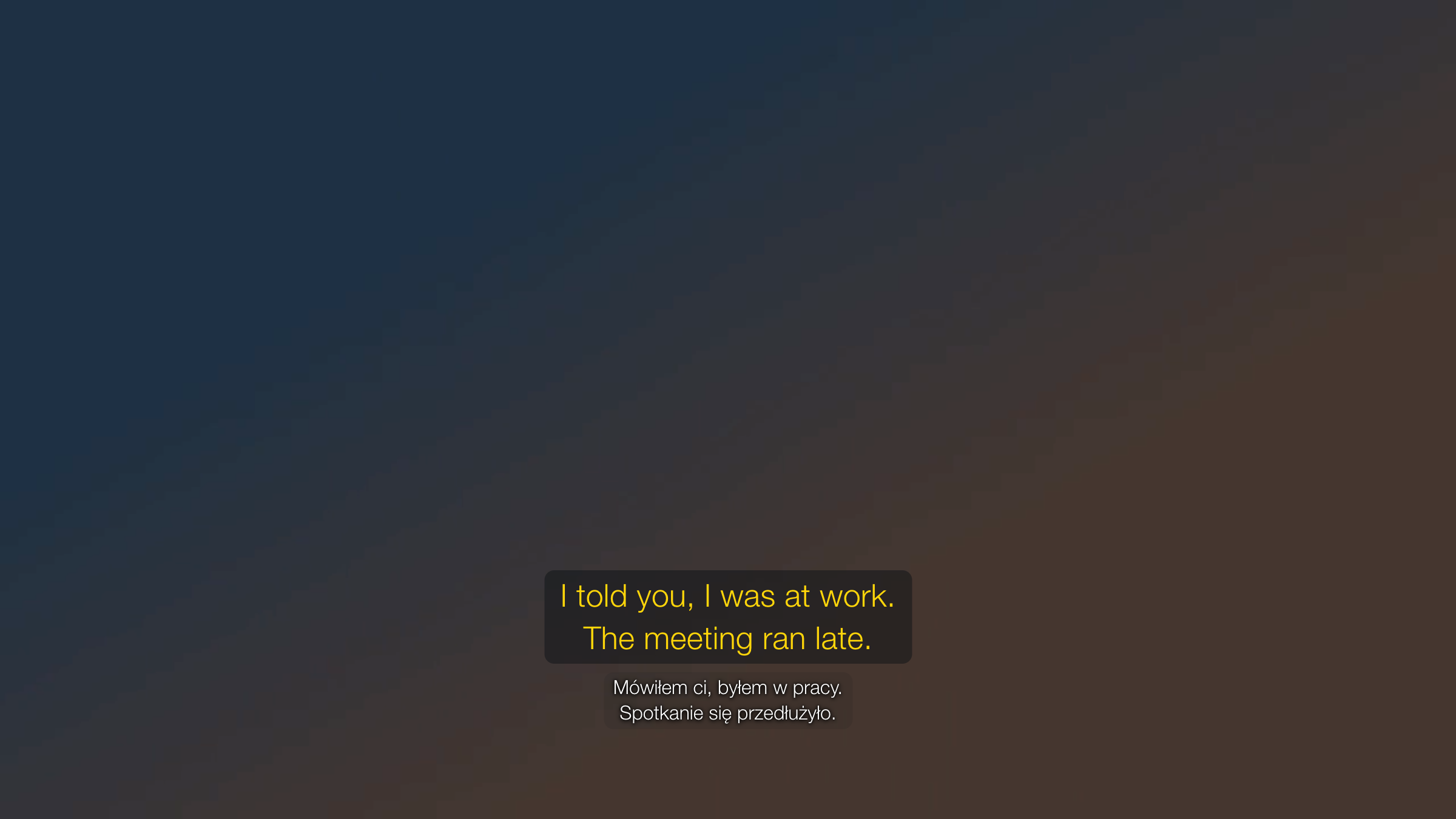
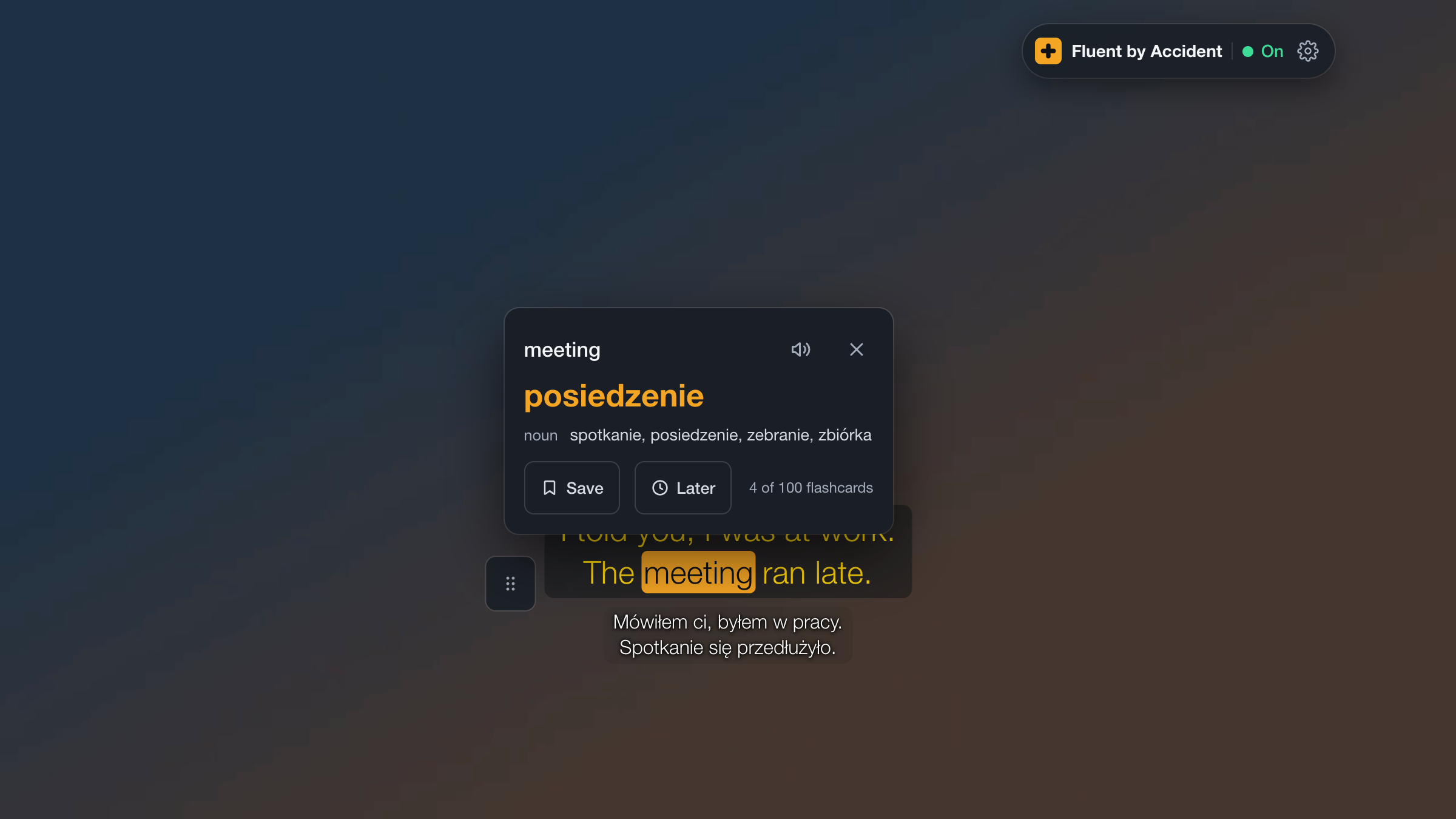
Fluent by Accident. We make this one, so weigh our take accordingly. It is a Chrome extension that shows two subtitle lines on Netflix, YouTube, Prime Video, Disney+ and Max, so you keep watching what you already watch. Click a word to translate it, drag or Shift+click for a phrase, and save it into a deck that you review with spaced repetition in the web app. Real limits: it runs in Chrome only, sign-in is required, and the free plan has no AI. Our plan code allows 100 saved words on the free plan, but the pricing page still said 20 when we checked, so treat 20 as the safe number. Pro adds AI film translation with scene context and unlimited words for $6.99 a month or $49 a year (pricing, checked November 19, 2026). It is not a course and will not teach you grammar or speaking, which is why it sits here and nowhere else. If you are comparing subtitle tools, start with dual subtitle extensions compared.
Disclosure: Fluent by Accident is our product. We placed it under listening only, because that is the one skill it actually serves.
Best app for speaking practice
Apps alone rarely get you talking. That is the clearest pattern in the threads italki collected: apps help you study, live conversation helps you speak. Remember that italki sells tutoring and ranks itself first, so read the Reddit threads directly too.
- On r/languagelearning, one learner said a private tutor gets them more speaking time per hour than group classes.
- In another thread, the advice was simple: if speaking is your focus, try italki.
- On r/SpanishLearning, a learner urged trying a couple of teachers before settling on one.
Free exchange apps get a cooler reception. The 27-apps learner described HelloTalk as X and Instagram for language learners and Tandem as mostly a chat app. They can still work if you push the chat toward voice calls.
| Type | Example | Who corrects you | Cost model | Best for |
|---|---|---|---|---|
| Paid tutor | italki | A teacher, live | Pay per lesson | Real conversation, fast feedback |
| Language exchange | Tandem, HelloTalk | A native speaker, if they choose to | Free tier | Casual practice, texting |
| AI chat | AI tutor features in course apps | The software | Usually a paid tier | Low-pressure rehearsal |
| Audio course | Pimsleur | Nobody; you repeat after a recording | Subscription | Pronunciation, speaking on commutes |
LingQ's list calls Pimsleur the best pick for audio-first learners, and italki's summary groups Pimsleur, Glossika and Speechling under pronunciation.
Best app for grammar and structure
If you want lessons that explain why a sentence works, choose Babbel or Busuu. A comparison quoted on r/Anki described Babbel as having a textbook-like emphasis on grammar, and the 27-apps learner called Busuu's community section the best part of the app (it is where other users correct your exercises). On a zero budget, LingQ's ranking names Language Transfer the best free structured course.
Does a grammar app work on its own? The best-known study is useful and limited at the same time.
Study box: In a study published in 2019, two researchers from Yale's Center for Language Study, commissioned by Babbel, followed 117 Spanish learners. Over 12 weeks they averaged 48 hours in the app and completed 110 lessons. On an ACTFL oral interview most still scored novice, and 24 reached the intermediate level. The authors themselves said prior experience with a related language or extra resources may have played a role. Babbel paid for the study, and the result is old enough (2019) to describe an earlier version of the app.
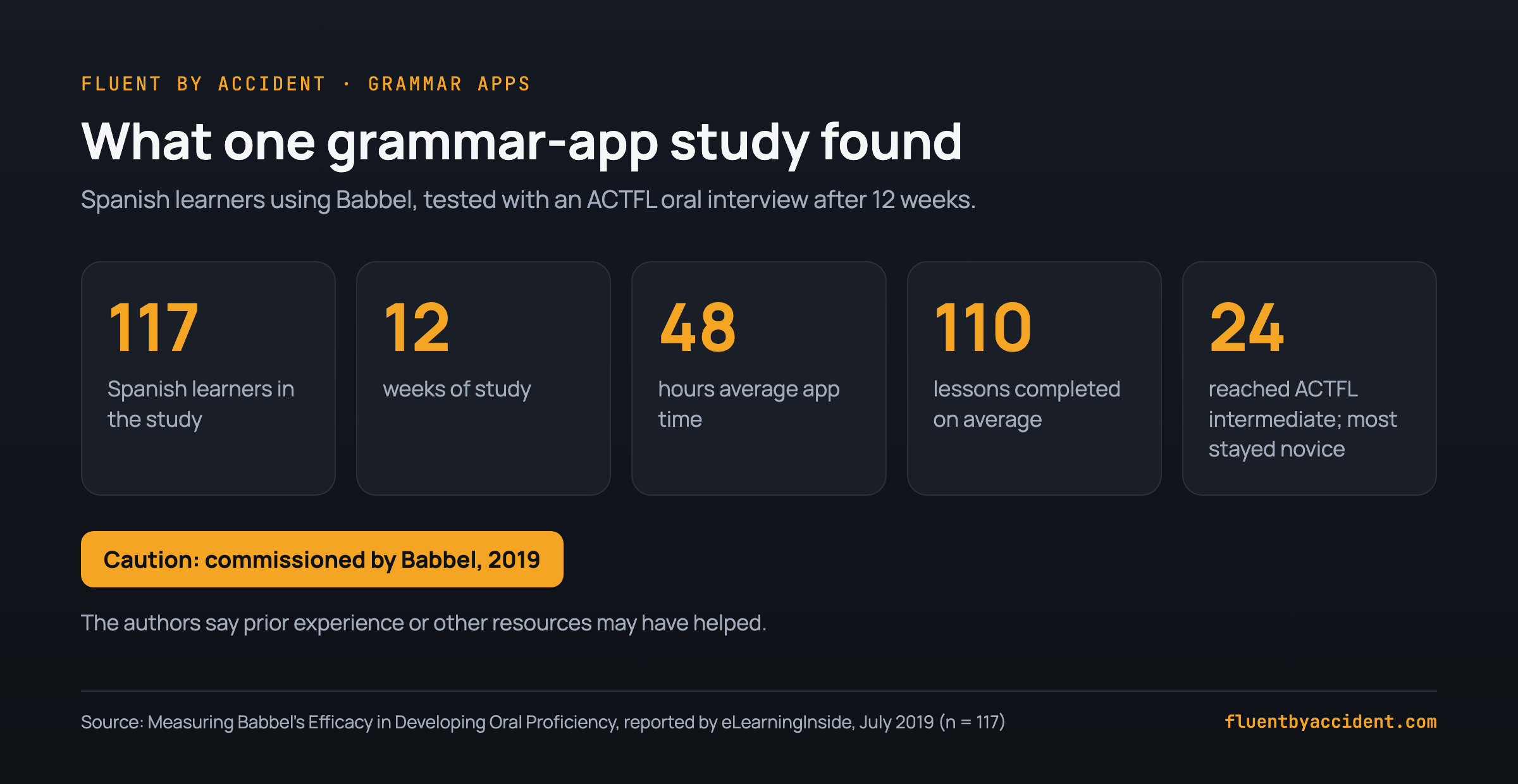
A worked example of what that means for you: 48 hours over 12 weeks is about 4 hours a week, or roughly 34 minutes a day. That is a real commitment, and it still left most learners at novice speaking level. Grammar apps build the skeleton; you need input and speaking to put weight on it.
Is Duolingo enough? Honest notes on gamified apps
No, Duolingo is not enough on its own to get conversational, and most Reddit learners say so kindly. The 27-apps learner on r/languagelearning said Duolingo may not be that useful, yet it helps them keep a steady habit, and that they doubt anyone has become conversational from it alone. italki's summary files Duolingo under "build a beginner habit", and StoryLearning's guide to Duolingo alternatives is built around what to use after it to reach B1 or B2.
The reason is structural. Streaks reward showing up, not hours of listening or minutes of speaking. A five-minute lesson keeps the streak alive just as well as an hour with a show, so the game nudges you toward the smallest possible session.
Duolingo has published peer-reviewed research on its Spanish course in Language Learning & Technology (2024), authored by Smith, Jiang and Peters. We could not confirm the authors' affiliations or verify its figures, so we do not quote any here.
What a streak counts Days you opened the app 5 minutes = 1 day 60 minutes = 1 day What builds skill Hours of real input Minutes of speaking Words reviewed on time Illustration, not dataUse it this way: Keep Duolingo as a 10-minute warm-up if you enjoy it, then spend the real time on input and speaking. Our guide to learning with Netflix shows how to turn an episode into a lesson.
A weekly app stack you can copy
Here is an example plan for someone with about an hour a day. It is a starting template built from the Reddit stack pattern above, not a promise of results; shrink every block if you have less time.
| Day | Vocabulary (Anki) | Input (show, YouTube, LingQ) | Speaking | Grammar (Babbel, Busuu, Language Transfer) |
|---|---|---|---|---|
| Mon | 15 min reviews | 30 min episode | None | 20 min lesson |
| Tue | 15 min reviews | 45 min episode or podcast | 30 min tutor or exchange call | None |
| Wed | 15 min reviews | 30 min episode | None | 20 min lesson |
| Thu | 15 min reviews | 45 min YouTube or reading | None | None |
| Fri | 15 min reviews | 30 min episode | None | 20 min lesson |
| Sat | 15 min reviews | 60 min episode, no pausing | 30 min tutor or exchange call | None |
| Sun | Add 10 new cards from the week | Rewatch one scene | None | None |
The arithmetic for this example: about 90 minutes of reviews, 4 hours of input, 1 hour of speaking and 1 hour of grammar per week. Input gets the biggest share because it is the skill apps cover least. A few rules keep the plan working:
- Put new cards from what you heard into Anki the same day, ideally as sentences.
- Book speaking sessions in advance so they happen even on low-energy weeks.
- Drop the grammar block once lessons feel like review, and move that time to speaking.
- Keep any gamified app as an optional extra, never as the plan itself.
If your input comes from Netflix or YouTube, you can download Fluent by Accident to get two subtitle lines and save words straight into your deck.
FAQ
What is the best free language learning app?
Anki is the strongest free pick for vocabulary: LingQ's 2026 ranking calls it the best free vocabulary app, and italki's Reddit roundup calls it one of Reddit's most respected language-learning tools. For grammar, Language Transfer is free and named the best free structured course in LingQ's 2026 ranking. For listening, YouTube and podcasts are free, and language exchange apps like Tandem and HelloTalk have free tiers for speaking. A free stack of Anki, Language Transfer, YouTube and an exchange app covers all four skills, though you will usually progress faster in speaking once you can pay for a tutor.
Can Duolingo make you fluent?
On its own, Duolingo is unlikely to make you fluent, and Reddit learners largely agree. One learner who tried 27 apps over 8 years said it helps keep a steady habit but doubted anyone gets conversational from it alone. Duolingo rewards streaks, which count days you showed up rather than hours of listening or speaking. Use it as a short daily warm-up if you enjoy it, then add real input such as TV shows and podcasts, plus regular conversation with a tutor or exchange partner. That combination is what learners on r/languagelearning describe as the path to fluency.
Which app is best for speaking practice?
A tutor platform such as italki is the most recommended option for speaking on Reddit. Learners say a private tutor gives more speaking time per hour than group classes, and advise trying a couple of teachers before choosing one. Free exchange apps like Tandem and HelloTalk can help, but one Reddit learner described them as mostly chat apps, so steer conversations toward voice calls. Audio courses such as Pimsleur train pronunciation and quick responses, but nobody corrects you. Note that italki's own article on Reddit picks ranks italki first, so read the original threads too.
Can you learn a language just from an app?
You can learn a lot from apps, but rarely everything, which is why Reddit learners recommend a stack instead of one app. The 2019 Babbel study is a useful reality check: after 12 weeks and about 48 hours in the app, most of 117 Spanish learners still scored novice in an oral interview, while 24 reached intermediate. Babbel commissioned that study. Apps are good at vocabulary review and structured grammar. Understanding fast native speech needs hours of real input, and speaking needs a real person on the other end.
Is Babbel or Busuu better than Duolingo?
For grammar and structure, Babbel and Busuu are generally the better choice. A comparison quoted on r/Anki described Babbel as having a textbook-like emphasis on grammar, and one Reddit learner called Busuu's community section the best part of the app (it is where other users correct your exercises). Duolingo is better at one thing: making a daily habit easy and fun. A sensible approach is to use Babbel or Busuu for structure, keep Duolingo only if the habit helps you, and add listening and speaking practice. Check current prices on each vendor's own pricing page, since third-party lists disagree.
Sources
- italki, "Best language learning apps Reddit" (2026): https://www.italki.com/en/blog/best-language-learning-apps-reddit
- r/languagelearning, "I've used 27 apps/programs in 8 years of language learning": https://www.reddit.com/r/languagelearning/comments/1p6ivuu/ive_used_27_appsprograms_in_8_years_of_language/
- r/Anki, "NY Times on Best Language-Learning Apps, Anki not listed": https://www.reddit.com/r/Anki/comments/1ig0u48/ny_times_on_best_languagelearning_apps_anki_not/
- r/languagelearning, "Is italki worth it?": https://www.reddit.com/r/languagelearning/comments/1ouejfl/is_italki_worth_it/
- r/languagelearning, "Language school online vs italki private tutor": https://www.reddit.com/r/languagelearning/comments/1ttzl2f/language_school_online_vs_italki_private_tutor/
- r/SpanishLearning, "For anyone learning Spanish on italki, was it worth it?": https://www.reddit.com/r/SpanishLearning/comments/1knw8x0/for_anyone_learning_spanish_on_italkiwas_it_worth/
- LingQ, "Best language learning app" (2026): https://www.lingq.com/blog/best-language-learning-app/
- Lingopie, "10 Best Language Learning Apps Reviewed by Language Experts": https://lingopie.com/blog/best-language-learning-apps/
- StoryLearning (Olly Richards), "Best Duolingo alternatives for serious learners": https://storylearning.com/blog/best-duolingo-alternatives-for-serious-learners
- OpenL Team, "Best Language Learning Apps in 2026" (April 9, 2026): https://blog.openl.io/best-language-learning-apps-in-2026/
- eLearningInside, report on "Measuring Babbel's Efficacy in Developing Oral Proficiency" (Yale-led, commissioned by Babbel, 2019): https://news.elearninginside.com/language-learning-apps-like-babbel-are-popular-but-do-they-work-yale-researchers-investigate/
- Language Learning & Technology, "The effectiveness of Duolingo in developing receptive and productive language knowledge and proficiency" (2024, vol. 28): https://www.lltjournal.org/item-detail/1152/
- Fluent by Accident pricing (checked November 19, 2026): https://fluentbyaccident.com/pricing