Can you become fluent with Duolingo alone?
Duolingo alone will not get you to B2 fluency. Here is what its own studies measured, why progress stalls near A2, and a weekly add-on plan built around shows you already watch.
Last checked: November 2026
No, you cannot become fluent with Duolingo alone. If fluent means about B2 on the CEFR scale, as it does for most people, Duolingo gets you a solid beginner to low-intermediate base, and the rest has to come from real listening, reading and talking with people.
If you have a long streak and still freeze when someone answers you at normal speed, that is the pattern this article explains. Below you get a clear definition of "fluent", what Duolingo's studies did and did not measure, and a weekly plan you can add on top without dropping the app.
Can you become fluent with Duolingo alone? The short answer
Short answer: No. Duolingo is a good starting point and a good habit builder, but one app that mostly trains translation and short exercises does not cover real listening, conversation, or a large vocabulary.
Three points sum it up:
- Duolingo itself does not promise fluency. Its own blog says the answer is "up to you and how you use it" and that no single course, app, method, or book can reach all your goals.
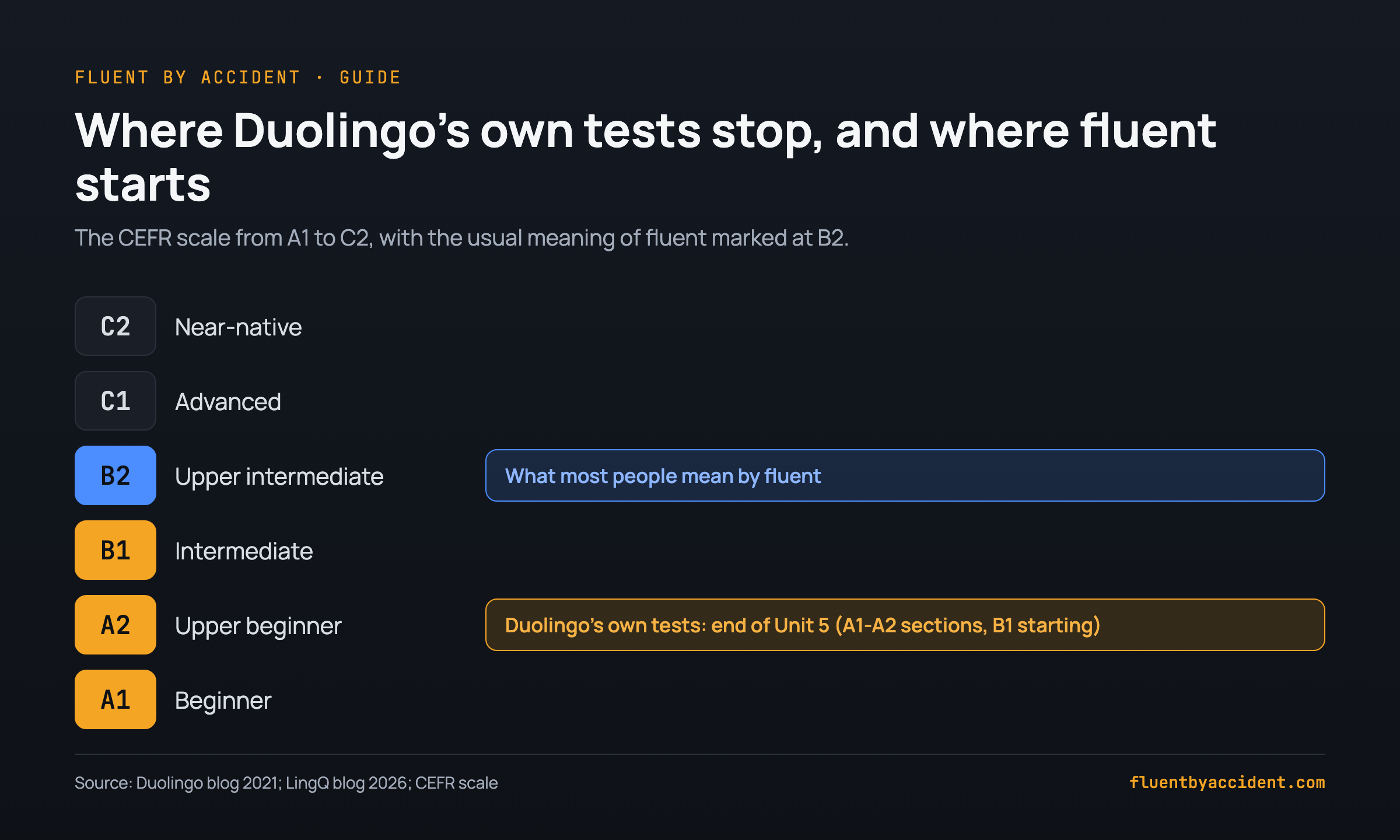
- Its speaking study tested learners right after Unit 5 (end of A1 and A2, B1 starting). Its 2024 reading and listening studies went to about half of B1 content, and none reports B2.
- Getting past that point means adding native-speed listening, spaced repetition for vocabulary, and real speaking.
What does "fluent" actually mean (A2 vs B1 vs B2)?
"Fluent" has no official definition, so this article uses the CEFR scale, the six-level framework (A1 to C2) that exams and schools use. LingQ, a competing language app, writes that when most people say "fluent," they mean B2 or above. That matches how learners use the word, so we use B2 as the working target.
Duolingo itself avoids the word. It says fluency is a vague goal that language experts shy away from, and it assesses speaking, writing, reading, and listening separately instead.
In plain terms, the levels look like this (our wording, simplified):
- A1 to A2: you handle set phrases, simple questions, and slow, clear speech. Beginner.
- B1: you get the gist of everyday topics and can manage simple conversations with effort.
- B2: you follow normal-speed conversation and shows most of the time and can talk without long searches for words.
How far does Duolingo actually take you? What its own studies show
Duolingo has published several studies. They are useful, but read who ran them and what they tested.
| Study | Skill tested | Result | Who ran it |
|---|---|---|---|
| Speaking study, 2021 | Speaking (Pearson Versant test), Spanish and French, tested right after Unit 5 | 258 learners. 66% of Spanish learners and 53% of French learners scored A2 or higher | Duolingo |
| Efficacy studies, 2024 | Reading and listening, French and Spanish | After five sections, learners knew as much as university students after five semesters of classes (about half of B1 content) | Duolingo |
| Efficacy studies, 2024 | Reading and listening, English | Learners who finished the A2 level scored above A2 on an independent standardized test | Duolingo |
Three limits matter. All of these studies are company-run or company-funded, they cover only Spanish, French, and English, and the studies we found report speaking, reading and listening, not B2. The speaking study tested learners right after Unit 5, where the A1 and A2 sections finish and B1 material starts, not conversation at B2.
One more point: the 2021 speaking post is older than three years and the only speaking-level data we found, so treat it as a snapshot. LingQ says Duolingo's courses are designed to take you to roughly A2, which is their claim, not Duolingo's.
Why does Duolingo stall around A2?
What follows is our analysis, supported by outside voices where noted. These are mechanisms, not measurements.
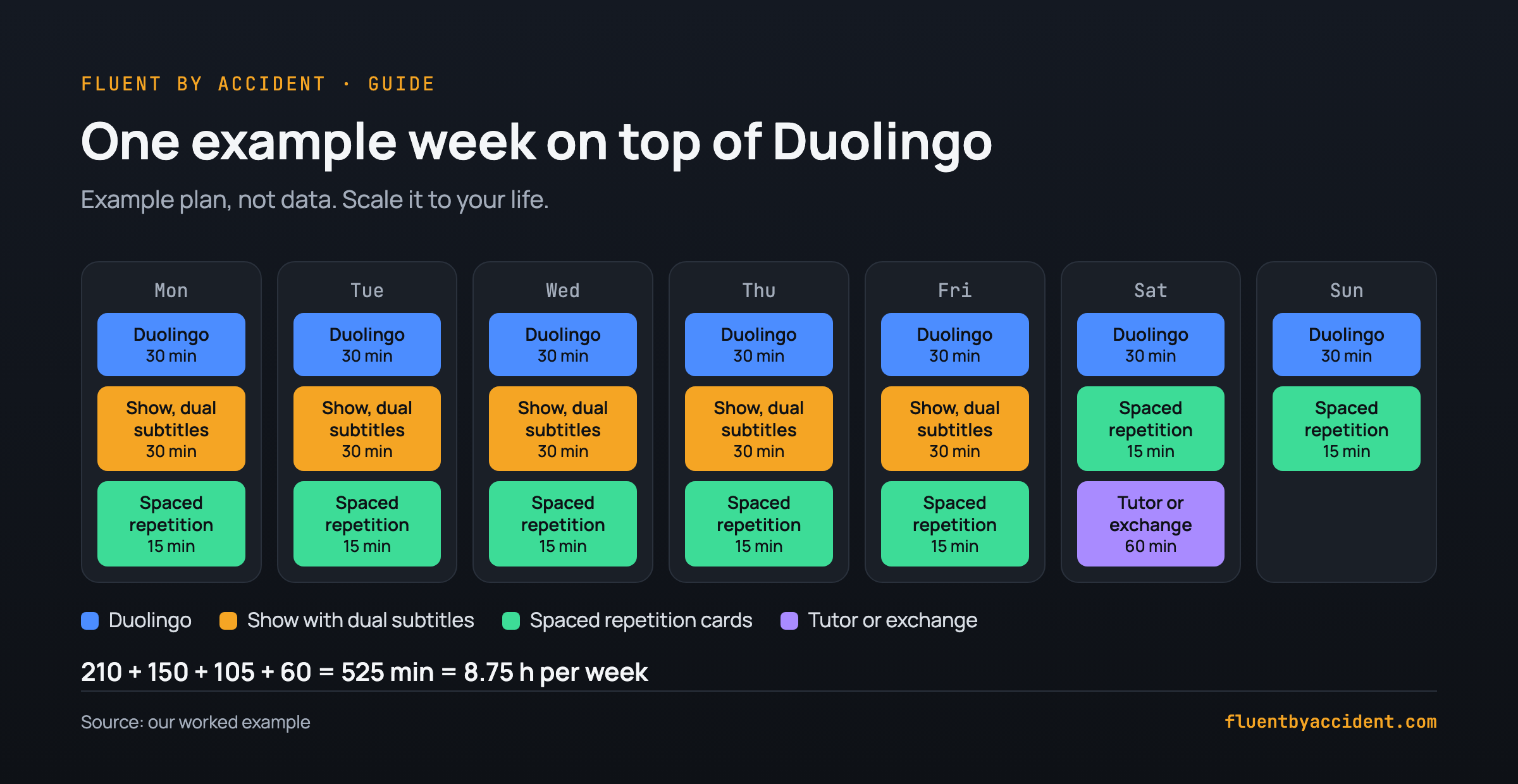
- Translation is the core exercise. LingQ says most exercises ask you to translate between your language and the target language. Real conversation does not come with a translation prompt.
- Limited vocabulary. Clozemaster, another app maker, says an average Duolingo tree introduces about 2,000 words. Treat that as their estimate. A show quickly runs into words beyond that.
- Slow, clean audio. The same post warns that with native speakers at normal pace you may struggle to pick out a single word if you only practiced with app audio. It is Clozemaster's opinion.
- Speaking is one-sided. Clozemaster notes Duolingo only has you pronounce single sentences, which is one sub-skill of a two-sided conversation, and that many users switch speaking exercises off.
- A streak measures habit, not progress. LingQ notes that many people with long streaks sense they are not progressing. Our view: showing up daily is valuable, but a streak says nothing about what you can understand.
What to add on top of Duolingo to get fluent (a weekly plan)
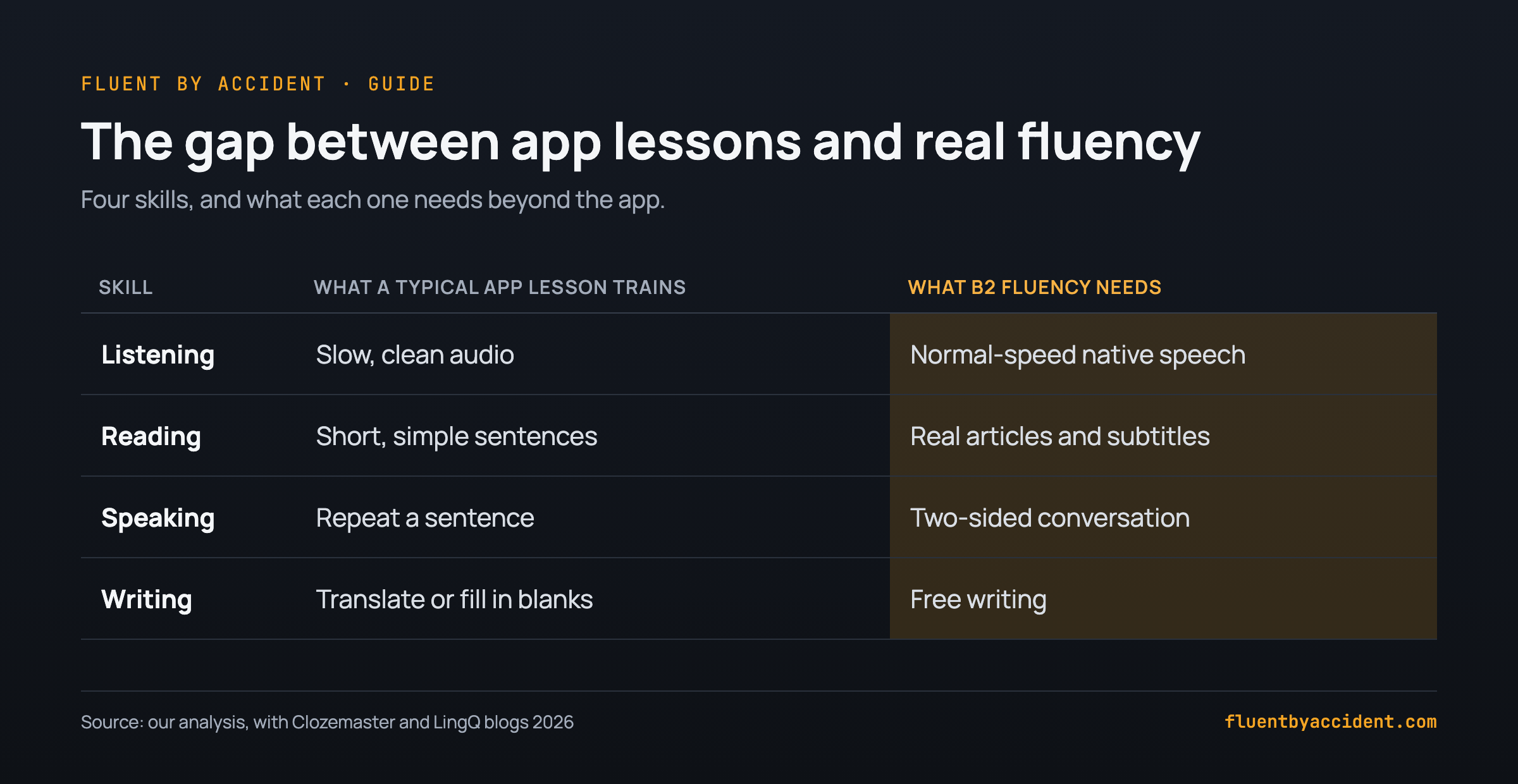
You do not need to quit the app. You need to add the four things it under-trains: listening through comprehensible input from TV shows, vocabulary through spaced repetition, speaking, and reading. The dual subtitle method for Netflix is an easy way to start the listening part. Here is a plan you can copy.
| Add-on | What to do | Example time | Read more |
|---|---|---|---|
| 1. Real listening | Watch a show or YouTube channel in your target language with dual subtitles, then fade the native-language line as you improve. | 30 min, 5 days | Dual subtitle method, comprehensible input, fading them out |
| 2. Vocabulary beyond the app | Save unknown words from what you watch as sentence cards and review them with spaced repetition. | 15 min, 7 days | Spaced repetition, sentence mining |
| 3. Speaking with a person | Book a tutor or exchange partner. Clozemaster names HelloTalk and iTalki as examples. Start in week 1, even if it is awkward. | 60 min, 1 day | |
| 4. Reading | Start with graded readers or transcripts of learner podcasts, then move to native articles and books. | Out of your show time (see example) | Learning with YouTube |
| Keep | Duolingo as your daily habit anchor. | 30 min, 7 days |
For learner-friendly audio, LingQ suggests podcasts such as News in Slow Spanish, InnerFrench, and Coffee Break, and it says the real goal is native-speed audio with native speakers. Those suit A2 listeners as a bridge.
Worked example (assumptions, not data): 30 minutes of Duolingo daily, 30 minutes of a show on 5 days, 15 minutes of cards daily, and one 60-minute tutor session.
- Duolingo: 30 x 7 = 210 minutes
- Show: 30 x 5 = 150 minutes
- Cards: 15 x 7 = 105 minutes
- Tutor: 1 x 60 = 60 minutes
- Total: 210 + 150 + 105 + 60 = 525 minutes, or 8.75 hours per week
Reading is not an extra block here. Swap part of the 150 show minutes for reading, for example one or two of the show slots, so the total stays the same.
That is one example of a reasonable load, not a prediction of how fast you will progress. Scale it up or down to your life, and if time is tight, protect the tutor session and the show first.
Checklist to copy:
- Keep the daily Duolingo session short (it is the habit anchor)
- Watch something in the target language 5 days a week
- Save unknown words as sentences and review them daily
- Book your first speaking session in week 1
- Swap one show slot a week for reading something real
- Every month, check what you understand without subtitles
Should you keep using Duolingo at all?
Yes, often. It is a gentle way to start, it builds a habit, and it covers basic patterns well. A SmarterTravel writer who tried Duolingo for one month each in three languages calls it "a wonderful starting point that can take you surprisingly far", but says you eventually need to widen your resources. Her answer to our title question was a plain no. Treat that as one person's experience, not as data. The question is when to rely on the app less.
| Situation | Keep | Replace | Add |
|---|---|---|---|
| Absolute beginner | Duolingo as the main starting tool | Nothing yet | Short listening clips from week 1 |
| Finished the beginner sections | A short daily session for habit | Most of the time you spent on new units | Shows, cards, and a speaking partner |
| Stuck on understanding real speech | Optional | Time in the app | More native-speed listening with subtitles |
| Learning a new script (our view) | Alphabet lessons | Nothing | Reading real text as soon as you can |
When the app starts to feel like you are completing lessons instead of understanding more, move your time toward the add-ons above. If the add-on you want is dual subtitles on the shows you already watch, one option is the Fluent by Accident extension, which we make, and which is Chrome only and needs a free sign-in.
FAQ
Can you become fluent with Duolingo alone?
No. Duolingo's own studies stop around the beginner and early B1 level, and the company says no single app can reach all your language goals. Most people mean B2 on the CEFR scale when they say fluent, and getting there takes real listening, a larger vocabulary, and conversation with other people. Duolingo can be a solid first step and a daily habit, but you will need other input and practice on top of it to reach conversational fluency.
How long does it take to become fluent with Duolingo?
There is no reliable number, and anyone who gives you one is guessing. It depends on your language, your starting point, and how much listening and speaking you add. The sources we checked do not give a timeline for fluency, so we do not either. A better question is what you can do this month, such as following a scene without subtitles or holding a short chat, and whether your weekly plan trains it.
What level can you reach with Duolingo?
Its speaking study tested learners right after Unit 5 (end of A1 and A2, B1 starting). Its 2024 reading and listening studies went to about half of B1 content, and none reports B2. In its 2021 speaking study, 66% of tested Spanish learners and 53% of French learners scored A2 or higher. These are company-run results for a few languages, not a guarantee, and they do not cover B2.
Is Duolingo enough to learn a language?
It is enough to start and to build a habit, but not to finish. Duolingo says itself that no single course, app, method, or book can help you reach all your language goals. For a full picture, combine it with listening to native speakers, vocabulary review, and speaking with a person. If you are comparing options, our guide to the best language learning app for your goal can help.
What should I do after Duolingo?
Shift time toward real listening and speaking. Watch shows or videos in your target language with subtitles you can fade, save new words as sentence cards, review them with spaced repetition, and book a tutor or exchange partner. Add reading as you go. The weekly plan above shows one way to split the time, and you can keep a short Duolingo session as a daily anchor.
Does Duolingo teach speaking?
It has speaking exercises, but they mostly ask you to say single sentences. Duolingo's 2021 study found many learners reached A2-level speaking after Unit 5 in Spanish and French. Clozemaster argues this is only one sub-skill of a two-sided conversation, and that many users turn the exercises off. Real speaking practice with a person fills that gap.
Sources
All pages checked November 24, 2026.
- Tolman, T. (2026). Can you become fluent with Duolingo? LingQ blog. A competing language app, so treat its opinions as theirs.
- Duolingo Team (2024). Can Duolingo make me fluent? Duolingo blog.
- Jiang, X. (2021). How well does Duolingo teach speaking skills? Duolingo blog. Company-run study.
- Jiang, X. (2024). Results of Duolingo efficacy studies Duolingo blog, September 2024. Company-funded.
- McPherson, C. (2022). Can you become fluent in a language using only Duolingo? SmarterTravel.
- Clozemaster. What to do after Duolingo Clozemaster blog. Undated, from a competing app maker, used as opinion only.