Anki vs Quizlet vs Memrise: Which to Use for Languages
Anki vs Quizlet vs Memrise for languages: a 20-word test protocol, official App Store data read in November 2026, how each app schedules reviews, prices, and who each fits.
In the Anki vs Quizlet question, pick Anki if you want long-term vocabulary you build yourself and you are willing to spend time on setup, because it is free on desktop and Android and schedules every review with real spaced repetition. Pick Quizlet if you want the fastest way to type up a set and drill it in class-style games, and pick Memrise if you would rather follow a ready-made course with native-speaker video and never make a card at all.
The rest of this page shows why, feature by feature, with one shared 20-word test protocol, official App Store data and the prices each company listed in November 2026.
Last checked: November 2026.
How we tested: On 17 November 2026 we checked each app's official pages and App Store listings (read with curl on macOS) against a 20-word test protocol you can repeat, built on the first 20 entries of our most common Spanish nouns list (Spanish word on the front, English meaning on the back). We read versions and prices on the official pages that day: Anki desktop is at version 26.09.4 on the Anki download page, AnkiMobile at 26.10.1, Quizlet's iOS app at 10.61 and the Memrise App Store listing at 2026.10.21. Quizlet's upgrade page blocked our automated check, so its prices below come from a secondary source and are marked as such. We have not yet timed a hands-on build of the deck in each app, so this page gives no minutes or click counts.
Anki vs Quizlet vs Memrise: the short answer
All three apps show you a word and ask you to recall it. They differ in who makes the cards, who decides when you see them again, and how you pay. If you want the wider field, our full ranking of 8 flashcard apps covers Mochi, RemNote, Brainscape and others; this page stays on these three.
| App | Best for | Price model | Review scheduling | Your own cards | Ready-made content |
|---|---|---|---|---|---|
| Anki | Long-term vocabulary you collect yourself | Free desktop and Android; paid iOS app | Spaced repetition, intervals visible and adjustable | Yes, its core purpose | Shared decks, no guided course |
| Quizlet | Fast set creation, class sets, quiz games | Free account plus paid Plus tiers | Spaced repetition per App Store listing; intervals not shown | Yes, quick to type | Large library of user sets |
| Memrise | Guided beginner course with video | Free download, monthly, annual or lifetime plans | Simplified, intervals hidden | Moved out of the main app | Yes, official courses in many languages |
The one-line version: Anki is a tool, Quizlet is a study set maker, and Memrise is a course. Choose by which of those you actually need.
The 20-word test protocol for all three apps
A fair Anki vs Quizlet vs Memrise comparison needs the same words in every app. The protocol uses the first 20 nouns from the most common Spanish nouns list because they are short, unambiguous and easy to check. You can repeat the test yourself in an evening with the steps below.
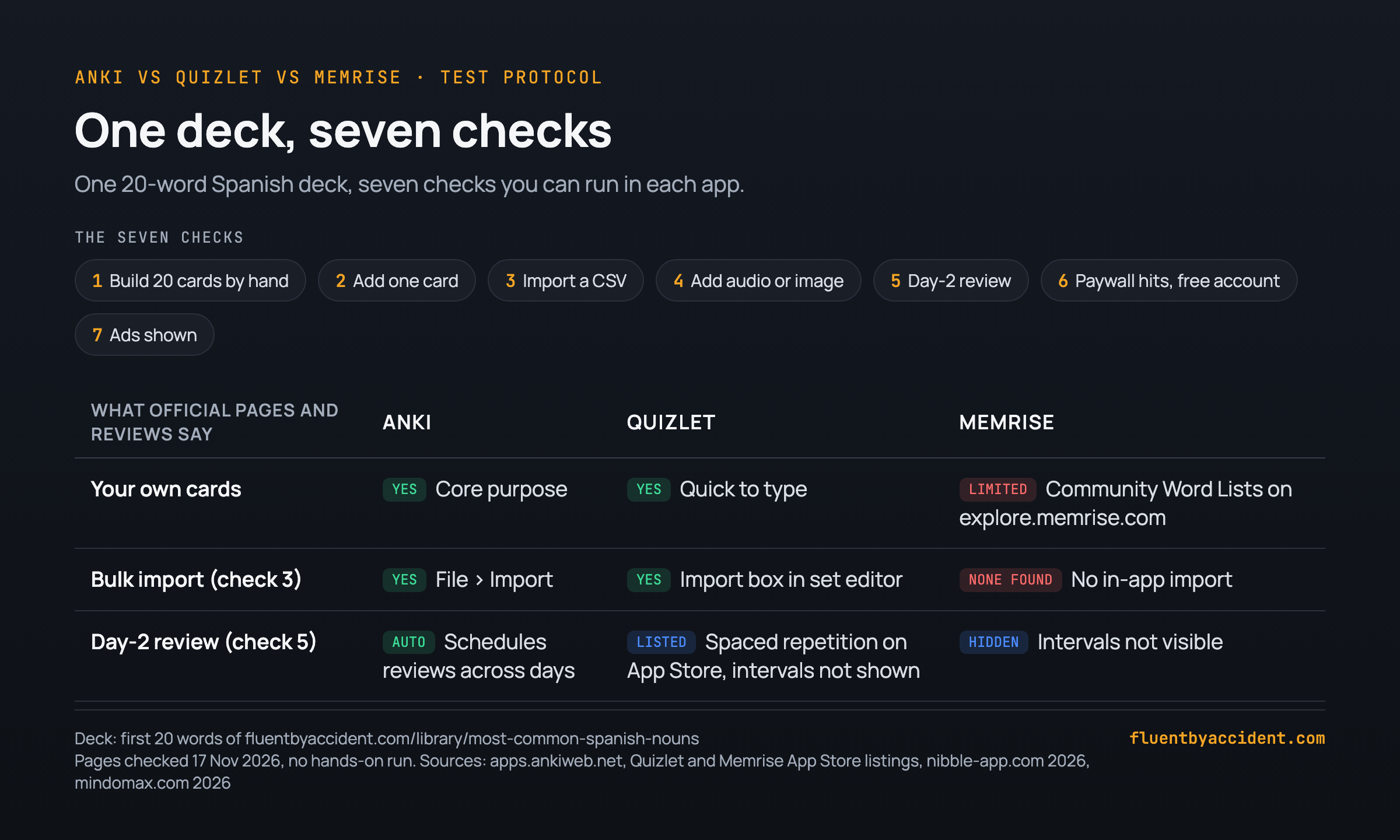
The protocol, step by step:
- Build the deck by hand. Type all 20 pairs and time it.
- Count the clicks to add one card. Open the editor, type the front and back, save.
- Try a bulk import. Paste the same 20 rows as CSV or tab-separated text.
- Add media. Check whether you can attach audio and an image to a card.
- Come back on day 2. Does the app bring the words back on its own, or do you have to start a new session?
- Stay on a free account. Note every upgrade prompt.
- Note whether ads appear. Count them during one study session.
What we could measure on 17 November 2026 without a hands-on run is the official US App Store data for each iPhone app, read through Apple's public lookup service:
| iPhone app | Price to download | Version | Last updated | Download size | App Store rating |
|---|---|---|---|---|---|
| AnkiMobile | $24.99 once | 26.10.1 | 16 Nov 2026 | 40.2 MB | 3.96 from 2,472 ratings |
| Quizlet | Free, paid Plus tiers | 10.61 | 16 Nov 2026 | 188.8 MB | 4.78 from 1,144,953 ratings |
| Memrise | Free, paid plans | 2026.10.21 | 23 Oct 2026 | 251.5 MB | 4.78 from 217,766 ratings |
Ratings measure how happy users are with each app overall, not how well it teaches. AnkiMobile is the only one you pay for before the first card, and the smallest download by far.
The big difference shows up at step 3 for Memrise. Mindomax reports that Memrise removed community-created courses from its main app in March 2024, and the Memrise site now points to a separate Community Word Lists space. So in Memrise you mostly study lists someone else made.
Anki has the opposite cost. Building is easy, as How to Learn Spanish put it back in 2016: "Anki is just a lot easier to create new cards in, that's what it was designed for." The setup cost is in the options, which is why we wrote a separate guide to Anki settings for language learning.
Anki vs Quizlet: which remembers words longer?
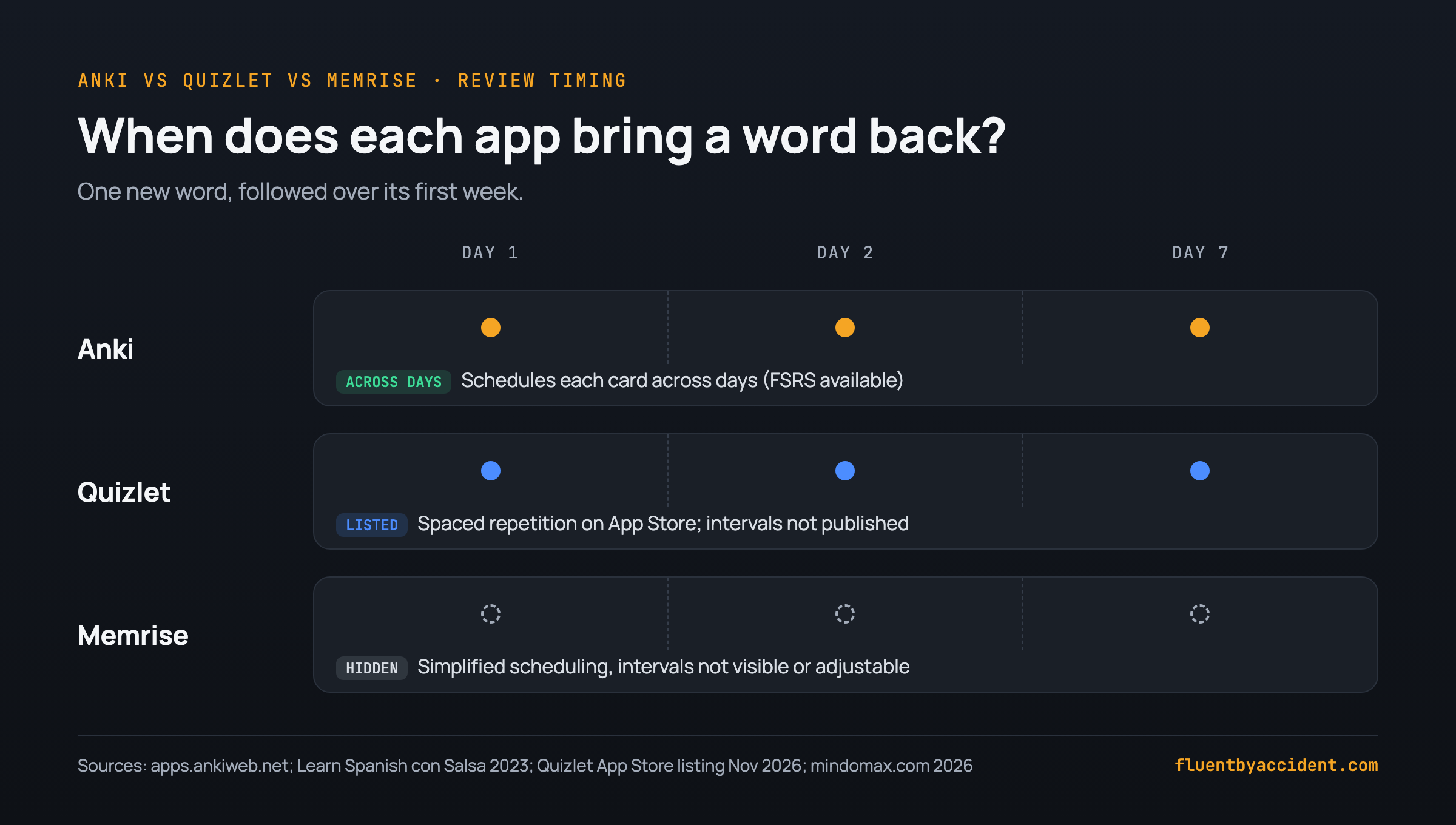
Both apps now claim spaced repetition, so the real Anki vs Quizlet difference is control: Anki shows every interval and lets you change it, while Quizlet does not publish how its scheduling works.
Anki decides when each card comes back based on how well you answered. Recent versions can use FSRS, a newer scheduling algorithm we explain in FSRS, Anki's newer scheduler. If you want the theory first, start with how spaced repetition works: you review a word just before you would forget it, so the gaps grow and each word costs less time.
Quizlet's history here is uneven. According to Learn Spanish con Salsa, "Quizlet stopped offering its Long-Term Learning feature, which was based on a spaced repetition algorithm, back in 2020," and Ling says the same about the 2020 update. Quizlet's App Store listing (v10.61, November 2026) now lists "Spaced Repetition: Quizlet intelligently resurfaces exactly what you need to review, right when you need it." It does not say which intervals it uses or whether the feature needs Plus. In Anki you can see every interval and change it.
What this means in practice:
- Exam on Friday, words you will never need again: Quizlet is fine, and its games make cramming less dull.
- Words you want to recognize in a show next year: Anki, because the schedule keeps pulling old words back after the cram is over.
- The catch with Anki: the schedule never stops. Skip a week and the reviews pile up, which is why so many learners end up searching for help with clearing an Anki backlog.
Verdict: Anki wins on long-term memory you can see and control. Quizlet wins on speed and short-term drilling.
Anki vs Memrise: build your own deck or follow a course?
Anki vs Memrise is less a flashcard fight than a choice between a toolbox and a classroom. Anki gives you an empty deck and full control; Memrise gives you a course and asks you to follow it.
The Memrise App Store listing describes courses for Spanish, Korean, Japanese "and 136 other languages," native-speaker videos, and "AI Buddies, your personalised language learning bots" for speaking practice. None of that exists in Anki unless you build it or download someone's shared deck.
The trade-off is control. Mindomax says Memrise uses "a simplified spaced repetition system" where "users cannot view or adjust the intervals" (Mindomax, 2026). In Anki you can see every interval and change the settings. Note that Mindomax sells a competing app, so read its comparison with that in mind.
| Question | Anki | Memrise | Edge |
|---|---|---|---|
| Who picks the words? | You | The course | Depends on you |
| Can you add a word from a show you watched? | Yes, any field you like | Not in the main app; separate Community Word Lists | Anki |
| Native-speaker video | Only if you add it | Built in | Memrise |
| Speaking practice | Not built in (add-ons only) | AI Buddies bots | Memrise |
| See and change review intervals | Yes | No, per Mindomax | Anki |
| Custom fields (kanji, reading, pitch, example) | Yes | No | Anki |
Verdict: Memrise for a total beginner who wants structure and sound from day one. Anki once you are collecting your own words from books, shows or a tutor.
Quizlet vs Memrise: which is better for vocabulary?
For vocabulary you choose yourself, Quizlet is better, because you can type a set in minutes and drill it straight away. For vocabulary you have not chosen yet, Memrise is better, because the course decides what comes next and pairs words with native audio and video.
| Feature | Quizlet | Memrise | Verdict |
|---|---|---|---|
| Make your own set | Yes, core feature | Outside the main app (Community Word Lists) | Quizlet |
| Bulk import | Import box in the set editor | No in-app import found on official pages | Quizlet |
| Native-speaker audio and video | Text-to-speech on sets; no native-speaker video | Built into courses | Memrise |
| Speaking practice | No speaking bot found on official pages (Nov 2026) | AI Buddies | Memrise |
| Review across days | Spaced repetition per App Store listing; intervals not shown | Simplified, hidden intervals (Mindomax) | Tie |
| Paid limits | Plus caps Learn rounds and practice tests per month (nibble-app) | Monthly, annual or lifetime plans (App Store) | Tie, check before paying |
Two notes on the table. The Quizlet caps come from nibble-app, which says Plus includes "a capped number of practice tests, textbook solutions, and Learn rounds each month" while Plus Unlimited "removes those monthly caps entirely." We could not confirm that on Quizlet's own page on test day. And nibble-app sells its own flashcard app, so treat its framing as one view.
Verdict: Quizlet for school-style vocabulary lists and quick review games. Memrise for learners who want the app to choose the words and supply the pronunciation.
How much do Anki, Quizlet and Memrise cost in 2026?
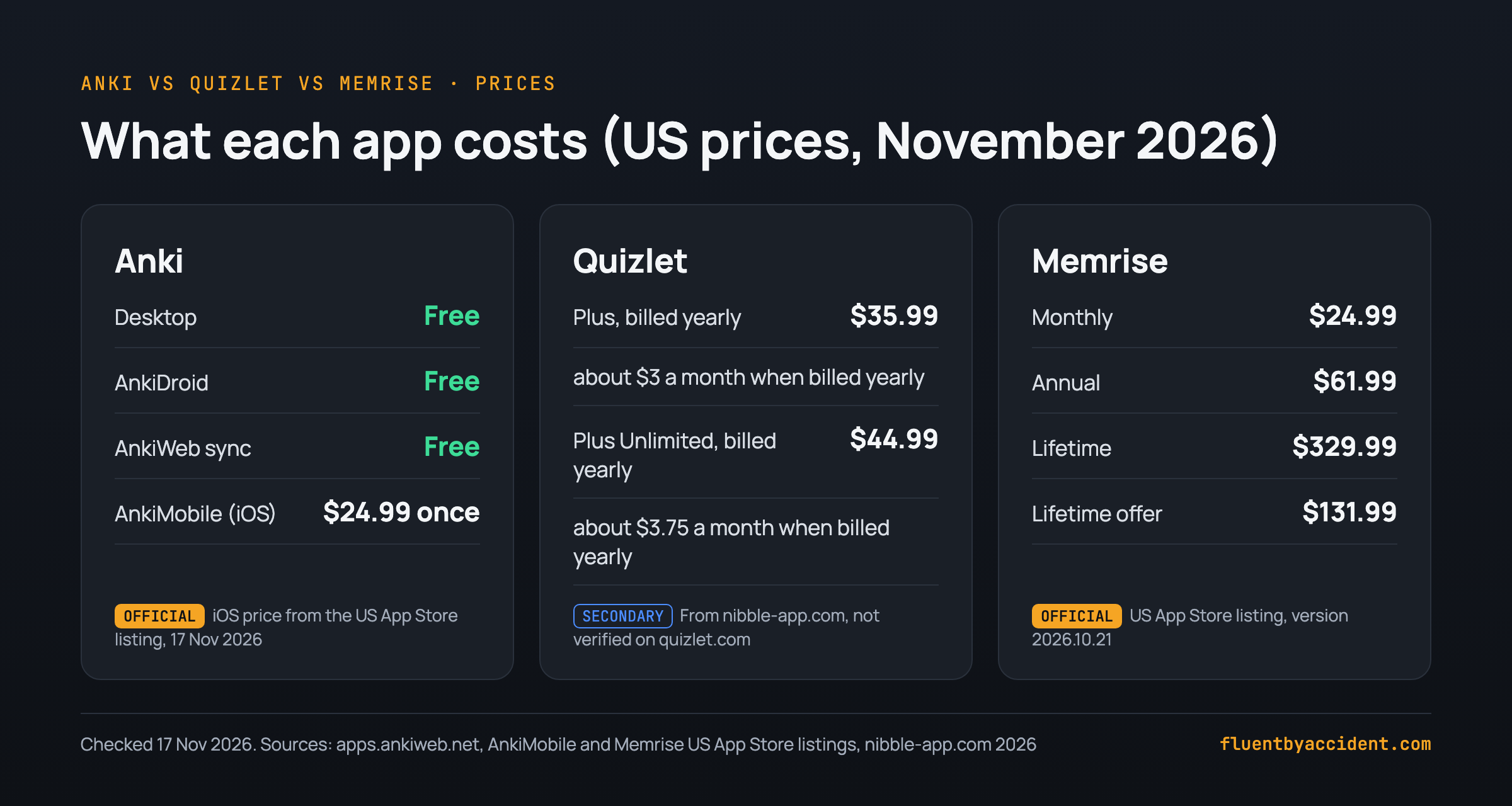
Anki is the cheapest of the three: the desktop version is free on all major platforms, AnkiDroid is free, and only the iPhone app costs money. Memrise is the most expensive if you pay monthly. On yearly billing Quizlet sits in between, though we could only read its prices from a secondary source.
The detail behind each number:
- Anki. The official download page says "the free computer version is available for all major platforms," "AnkiDroid for Android is free," and the AnkiWeb sync service is free. AnkiMobile is "the official iOS app and all purchases help fund Anki's development." AnkiMobile costs $24.99 as a one-time purchase on the US App Store (checked 17 Nov 2026).
- Quizlet. Per nibble-app, "Quizlet Plus is $2.99/month or $35.99/year; Plus Unlimited is $3.74/month or $44.99/year." The monthly figures are the yearly prices divided by 12, so read them as per month when billed yearly: $35.99 a year for Plus and $44.99 a year for Plus Unlimited. The Quizlet upgrade page is the place to confirm before you pay.
- Memrise. The US App Store listing shows a monthly plan at $24.99, an annual plan at $61.99, a lifetime plan at $329.99 and a lifetime offer at $131.99, plus several discounted subscription offers. The listing also shows a 3-month plan at the same $24.99, so check which plan the in-app screen offers you. Mindomax reports $60 to $116 a year depending on plan and region.
Worked example (our arithmetic, not a quote): paying Memrise monthly for a year costs 12 × $24.99 = $299.88, against $61.99 for the annual plan. If you plan to stay a year, the annual plan costs about a fifth of the monthly route.
Which one should you pick? (by learner type)
Pick by how you learn, not by which app has more features.
| Pick this | If you... | Watch out for |
|---|---|---|
| Memrise | are a total beginner and want a structured course with native-speaker video and speaking bots | Monthly price; you cannot tune the review schedule |
| Quizlet | are a student with class word lists, a test date and a love of quiz games | Review intervals not shown or adjustable; Learn caps on Plus |
| Anki | mine words from shows, books or a tutor and want to keep them for years | Setup time and a daily review habit |
| Anki | learn Japanese, Chinese or Korean and need extra fields for script, reading and examples | Designing your own note type takes setup time |
| Quizlet or Memrise | have a budget of zero and only an iPhone | AnkiMobile is the one paid Anki app |
| Anki, keeping Quizlet | are switching from Quizlet to Anki but still share sets with a class | Moving sets in both directions needs a file step |
If the daily load in Anki ever feels like too much, read about Anki alternatives before quitting altogether, and use our guide to making flashcards from Netflix and YouTube to keep the deck full of words you actually heard.
If most of your new words come from shows, Fluent by Accident is a Chrome extension that saves words from Netflix and YouTube subtitles into flashcards with spaced repetition and can import your existing Anki decks.
FAQ
Is Anki better than Quizlet for learning a language?
For long-term vocabulary, yes for most learners. Anki schedules each card across days and weeks. Quizlet's App Store listing advertises spaced repetition again, but it does not show or let you adjust the intervals the way Anki does. Quizlet is still better when you need a set typed up fast, want quiz games, or share sets with a class.
Does Quizlet still use spaced repetition?
Yes, its App Store listing advertises spaced repetition again, but the intervals are not visible or adjustable as in Anki. Quizlet dropped its older Long-Term Learning feature in 2020, per Learn Spanish con Salsa and Ling, and does not publish how the new scheduling works.
Is Memrise good for learning vocabulary?
Memrise is good for vocabulary when you want someone else to choose the words. Its courses cover Spanish, Korean, Japanese and 136 other languages, with native-speaker videos and AI Buddies for speaking practice, per its App Store listing. It is weaker for words you pick yourself: community-created courses left the main app in 2024, according to Mindomax, and now live in a separate Community Word Lists space.
Is Anki really free?
Mostly. The official Anki download page says the computer version is free for all major platforms, AnkiDroid for Android is free and built by contributors, and the AnkiWeb sync service is free. The exception is AnkiMobile, the official iOS app, which is paid and funds Anki's development. It costs $24.99 as a one-time purchase on the US App Store (checked 17 Nov 2026), not a subscription.
Can I move my Quizlet sets into Anki?
Yes, if you can get the set out as plain text first. Anki imports text and CSV files through its File > Import menu, mapping each column to a card field. If you have a CSV of word pairs, our free CSV to Anki converter turns it into a deck you can open in Anki. Going the other way, the Anki to Quizlet tool converts an Anki deck into text you can paste into Quizlet's import box.
Can I use Anki and Memrise together?
Yes, and it is a sensible split. Use Memrise for the structured part: the course order, native-speaker video and speaking practice with AI Buddies. Use Anki for the words you meet outside the course, from shows, books, a tutor or a textbook, because Anki lets you build cards with your own fields and controls when they come back. Keep Anki's new cards per day low while doing both.
Sources
- Anki Software (Ankitects). Anki download page, version 26.09.4. https://apps.ankiweb.net/ (checked 17 November 2026)
- Memrise Limited. "Memrise: Language Learning App," US App Store listing, version 2026.10.21. https://apps.apple.com/us/app/memrise-speak-a-new-language/id635966718 (checked 17 November 2026)
- Memrise. Community Word Lists. https://explore.memrise.com/community-word-lists (checked 17 November 2026)
- Ankitects. AnkiMobile Flashcards, US App Store listing. https://apps.apple.com/us/app/ankimobile-flashcards/id373493387 (checked 17 November 2026)
- Quizlet Inc. "Quizlet: More than Flashcards," US App Store listing, version 10.61. https://apps.apple.com/us/app/quizlet-more-than-flashcards/id546473125 (checked 17 November 2026)
- Apple. iTunes Search API lookup for ids 373493387, 546473125 and 635966718 (US). https://itunes.apple.com/lookup?id=373493387,546473125,635966718&country=us (checked 17 November 2026)
- Quizlet. Upgrade page. https://quizlet.com/upgrade (blocked our automated check on 17 November 2026; prices not captured)
- nibble-app. "Anki vs Quizlet: Which Flashcard App Helps You Remember More?" 2026. https://nibble-app.com/blog/anki-vs-quizlet
- Aglibot, S. "Quizlet Vs Anki: Which Is The Best For Learners?" Ling, 2022, updated 2023. https://ling-app.com/blog/quizlet-vs-anki/
- Learn Spanish con Salsa. "Anki vs. Quizlet: The Best App to Learn Spanish Vocabulary," 2023. https://www.learnspanishconsalsa.com/blog/anki-vs-quizlet-the-best-app-to-learn-spanish-vocabulary/
- How to Learn Spanish. "Anki vs Memrise," 2016. https://howlearnspanish.com/memrise-vs-anki/
- Mindomax. "Anki vs Memrise," 2026. https://www.mindomax.com/anki-vs-memrise
- Fluent by Accident. Most common Spanish nouns (test deck source). https://fluentbyaccident.com/library/most-common-spanish-nouns